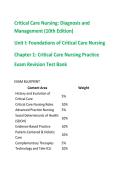
Critical Care Nursing: Diagnosis and
Management (10th Edition)
Unit I: Foundations of Critical Care Nursing
Chapter 1: Critical Care Nursing Practice
Exam Revision Test Bank
EXAM BLUEPRINT
Content Area Weight
History and Evolution of
5%
Critical Care
Critical Care Nursing Roles 10%
Advanced Practice Nursing 5%
Social Determinants of Health
10%
(SDOH)
Evidence-Based Practice 10%
Patient-Centered & Holistic
10%
Care
Complementary Therapies 5%
Technology and Tele-ICU 10%
,Interprofessional
10%
Collaboration
Rapid Response Teams 10%
Quality & Safety 10%
Healthy Work Environment 5%
1. MCQ | Bloom: Recall | Difficulty: Easy
Learning Objective: Identify the historical and
contemporary purpose of critical care nursing.
Chapter Reference: Unit I: Foundations of Critical Care
Nursing — Critical Care Nursing Practice
Question: Which statement best describes the primary purpose
of contemporary critical care nursing?
A. Provide only technology-driven interventions for unstable
patients
B. Deliver comprehensive care that integrates monitoring,
coordination, and patient advocacy
C. Restrict nursing actions to implementing physician orders
D. Focus mainly on end-of-life care in the ICU
Correct Answer: B
Rationale: Contemporary critical care nursing combines
surveillance, rapid response, patient advocacy, coordination,
,and evidence-based intervention to support patients with life-
threatening illness.
Distractor Analysis:
• A: Too narrow; critical care is not only technology-driven.
• C: Incorrect because critical care nurses function
autonomously within scope, not only by delegation.
• D: End-of-life care is one component, not the primary
purpose.
Clinical Significance: Critical care nurses improve outcomes by
integrating physiologic monitoring with holistic, coordinated
care.
2. MCQ | Bloom: Recall | Difficulty: Easy
Learning Objective: Recognize the goal of addressing
social determinants of health in critical care.
Chapter Reference: Unit I: Foundations of Critical Care
Nursing — Social Determinants of Health
Question: What is the main goal of addressing social
determinants of health (SDOH) in critical care practice?
A. Eliminate all genetic risk factors
B. Reduce health inequities and improve outcomes through
equitable care
, C. Replace medical treatment with social services
D. Classify patients by socioeconomic status for triage
Correct Answer: B
Rationale: SDOH work aims to reduce inequities in health
access, care delivery, and outcomes by identifying and
addressing upstream social barriers.
Distractor Analysis:
• A: Genetics cannot be eliminated by SDOH interventions.
• C: Social support complements, not replaces, medical
treatment.
• D: SDOH assessment is used to guide support, not to ration
care.
Clinical Significance: Unaddressed social barriers can worsen
ICU recovery, discharge planning, and readmission risk.
3. SATA | Bloom: Comprehension | Difficulty: Moderate
Learning Objective: Differentiate the roles of major critical
care professional organizations.
Chapter Reference: Unit I: Foundations of Critical Care
Nursing — Professional Organizations
Question: Which statements accurately describe professional
organizations relevant to critical care nursing? Select all that
Management (10th Edition)
Unit I: Foundations of Critical Care Nursing
Chapter 1: Critical Care Nursing Practice
Exam Revision Test Bank
EXAM BLUEPRINT
Content Area Weight
History and Evolution of
5%
Critical Care
Critical Care Nursing Roles 10%
Advanced Practice Nursing 5%
Social Determinants of Health
10%
(SDOH)
Evidence-Based Practice 10%
Patient-Centered & Holistic
10%
Care
Complementary Therapies 5%
Technology and Tele-ICU 10%
,Interprofessional
10%
Collaboration
Rapid Response Teams 10%
Quality & Safety 10%
Healthy Work Environment 5%
1. MCQ | Bloom: Recall | Difficulty: Easy
Learning Objective: Identify the historical and
contemporary purpose of critical care nursing.
Chapter Reference: Unit I: Foundations of Critical Care
Nursing — Critical Care Nursing Practice
Question: Which statement best describes the primary purpose
of contemporary critical care nursing?
A. Provide only technology-driven interventions for unstable
patients
B. Deliver comprehensive care that integrates monitoring,
coordination, and patient advocacy
C. Restrict nursing actions to implementing physician orders
D. Focus mainly on end-of-life care in the ICU
Correct Answer: B
Rationale: Contemporary critical care nursing combines
surveillance, rapid response, patient advocacy, coordination,
,and evidence-based intervention to support patients with life-
threatening illness.
Distractor Analysis:
• A: Too narrow; critical care is not only technology-driven.
• C: Incorrect because critical care nurses function
autonomously within scope, not only by delegation.
• D: End-of-life care is one component, not the primary
purpose.
Clinical Significance: Critical care nurses improve outcomes by
integrating physiologic monitoring with holistic, coordinated
care.
2. MCQ | Bloom: Recall | Difficulty: Easy
Learning Objective: Recognize the goal of addressing
social determinants of health in critical care.
Chapter Reference: Unit I: Foundations of Critical Care
Nursing — Social Determinants of Health
Question: What is the main goal of addressing social
determinants of health (SDOH) in critical care practice?
A. Eliminate all genetic risk factors
B. Reduce health inequities and improve outcomes through
equitable care
, C. Replace medical treatment with social services
D. Classify patients by socioeconomic status for triage
Correct Answer: B
Rationale: SDOH work aims to reduce inequities in health
access, care delivery, and outcomes by identifying and
addressing upstream social barriers.
Distractor Analysis:
• A: Genetics cannot be eliminated by SDOH interventions.
• C: Social support complements, not replaces, medical
treatment.
• D: SDOH assessment is used to guide support, not to ration
care.
Clinical Significance: Unaddressed social barriers can worsen
ICU recovery, discharge planning, and readmission risk.
3. SATA | Bloom: Comprehension | Difficulty: Moderate
Learning Objective: Differentiate the roles of major critical
care professional organizations.
Chapter Reference: Unit I: Foundations of Critical Care
Nursing — Professional Organizations
Question: Which statements accurately describe professional
organizations relevant to critical care nursing? Select all that