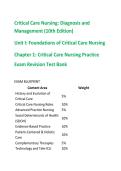
Critical Care Nursing: Diagnosis and
Management (10th Edition)
Unit I: Foundations of Critical Care Nursing
Chapter 1: Critical Care Nursing Practice
Exam Revision Test Bank
EXAM BLUEPRINT
Content Area Weight
History and Evolution of
5%
Critical Care
Critical Care Nursing Roles 10%
Advanced Practice Nursing 5%
Social Determinants of Health
10%
(SDOH)
Evidence-Based Practice 10%
Patient-Centered & Holistic
10%
Care
Complementary Therapies 5%
Technology and Tele-ICU 10%
,Interprofessional
10%
Collaboration
Rapid Response Teams 10%
Quality & Safety 10%
Healthy Work Environment 5%
Type: MCQ
Bloom’s Level: Recall
Learning Objective: Define the historical development of critical
care nursing.
Chapter Reference: Critical Care Nursing Practice — History of
Critical Care
Difficulty: Easy
Question: Which development most directly supported the
emergence of modern critical care units?
A. Routine outpatient monitoring of stable patients
B. Concentration of invasive monitoring and life-support
technologies in one setting
C. Elimination of interdisciplinary care
D. Exclusive use of paper charting
Correct Answer: B
,Rationale: Critical care evolved as hospitals concentrated highly
unstable patients, invasive monitoring, and advanced life-
support therapies in specialized units with trained staff.
Distractor Analysis:
A is incorrect because critical care is not outpatient-based.
C is incorrect because interdisciplinary collaboration is central
to critical care.
D is incorrect because documentation method does not define
the specialty.
Clinical Significance: Understanding the origin of critical care
explains why monitoring intensity, staffing expertise, and rapid
intervention are core ICU priorities.
Type: MCQ
Bloom’s Level: Comprehension
Learning Objective: Distinguish contemporary critical care from
earlier models of care.
Chapter Reference: Contemporary Critical Care
Difficulty: Moderate
Question: Which statement best reflects contemporary critical
care practice?
, A. Care is delivered primarily by a single discipline with minimal
consultation.
B. Critical care focuses only on technology and hemodynamic
numbers.
C. Care integrates advanced monitoring, evidence-based
practice, and family-centered collaboration.
D. Critical care is limited to patients receiving mechanical
ventilation.
Correct Answer: C
Rationale: Modern critical care emphasizes technology plus
evidence-based, patient-centered, and collaborative care that
includes families when appropriate.
Distractor Analysis:
A is incorrect because interprofessional teamwork is essential.
B is incorrect because care includes holistic, psychosocial, and
ethical dimensions.
D is incorrect because many ICU patients do not require
ventilation.
Clinical Significance: Contemporary ICU nursing requires
balancing physiologic stabilization with communication,
coordination, and family engagement.
Type: SATA
Management (10th Edition)
Unit I: Foundations of Critical Care Nursing
Chapter 1: Critical Care Nursing Practice
Exam Revision Test Bank
EXAM BLUEPRINT
Content Area Weight
History and Evolution of
5%
Critical Care
Critical Care Nursing Roles 10%
Advanced Practice Nursing 5%
Social Determinants of Health
10%
(SDOH)
Evidence-Based Practice 10%
Patient-Centered & Holistic
10%
Care
Complementary Therapies 5%
Technology and Tele-ICU 10%
,Interprofessional
10%
Collaboration
Rapid Response Teams 10%
Quality & Safety 10%
Healthy Work Environment 5%
Type: MCQ
Bloom’s Level: Recall
Learning Objective: Define the historical development of critical
care nursing.
Chapter Reference: Critical Care Nursing Practice — History of
Critical Care
Difficulty: Easy
Question: Which development most directly supported the
emergence of modern critical care units?
A. Routine outpatient monitoring of stable patients
B. Concentration of invasive monitoring and life-support
technologies in one setting
C. Elimination of interdisciplinary care
D. Exclusive use of paper charting
Correct Answer: B
,Rationale: Critical care evolved as hospitals concentrated highly
unstable patients, invasive monitoring, and advanced life-
support therapies in specialized units with trained staff.
Distractor Analysis:
A is incorrect because critical care is not outpatient-based.
C is incorrect because interdisciplinary collaboration is central
to critical care.
D is incorrect because documentation method does not define
the specialty.
Clinical Significance: Understanding the origin of critical care
explains why monitoring intensity, staffing expertise, and rapid
intervention are core ICU priorities.
Type: MCQ
Bloom’s Level: Comprehension
Learning Objective: Distinguish contemporary critical care from
earlier models of care.
Chapter Reference: Contemporary Critical Care
Difficulty: Moderate
Question: Which statement best reflects contemporary critical
care practice?
, A. Care is delivered primarily by a single discipline with minimal
consultation.
B. Critical care focuses only on technology and hemodynamic
numbers.
C. Care integrates advanced monitoring, evidence-based
practice, and family-centered collaboration.
D. Critical care is limited to patients receiving mechanical
ventilation.
Correct Answer: C
Rationale: Modern critical care emphasizes technology plus
evidence-based, patient-centered, and collaborative care that
includes families when appropriate.
Distractor Analysis:
A is incorrect because interprofessional teamwork is essential.
B is incorrect because care includes holistic, psychosocial, and
ethical dimensions.
D is incorrect because many ICU patients do not require
ventilation.
Clinical Significance: Contemporary ICU nursing requires
balancing physiologic stabilization with communication,
coordination, and family engagement.
Type: SATA