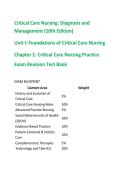
Critical Care Nursing: Diagnosis and
Management (10th Edition)
Unit I: Foundations of Critical Care Nursing
Chapter 1: Critical Care Nursing Practice
Exam Revision Test Bank
EXAM BLUEPRINT
Content Area Weight
History and Evolution of
5%
Critical Care
Critical Care Nursing Roles 10%
Advanced Practice Nursing 5%
Social Determinants of Health
10%
(SDOH)
Evidence-Based Practice 10%
Patient-Centered & Holistic
10%
Care
Complementary Therapies 5%
Technology and Tele-ICU 10%
,Interprofessional
10%
Collaboration
Rapid Response Teams 10%
Quality & Safety 10%
Healthy Work Environment 5%
1. Recall | MCQ
Question: Which organization is most directly associated with
standards, certification, and practice resources for critical care
nurses in the United States?
A. American Association of Critical-Care Nurses (AACN)
B. World Health Organization (WHO)
C. Centers for Disease Control and Prevention (CDC)
D. Joint Commission
Correct Answer: A
Rationale: AACN is the professional organization most closely
linked to critical care nursing practice standards, education,
certification, and practice resources.
Distractor Analysis:
• B: WHO is a global health agency, not a critical care
nursing organization.
, • C: CDC provides public health guidance, not specialty
critical care nursing standards.
• D: The Joint Commission regulates accreditation and
safety standards, but it is not a nursing professional
organization.
Difficulty: Easy
Learning Objective: Identify major professional organizations
relevant to critical care nursing.
Chapter Reference: Unit I, Critical Care Nursing Practice
Clinical Significance: Professional organizations shape
evidence-based standards and continuing competency in ICU
practice.
2. Recall | MCQ
Question: Which term best describes nursing care that
integrates a patient’s values, preferences, and cultural beliefs
into the plan of care?
A. Task-oriented care
B. Patient-centered care
C. Protocol-driven care
D. Delegated care
Correct Answer: B
, Rationale: Patient-centered care places the patient’s values,
preferences, and goals at the center of decision-making.
Distractor Analysis:
• A: Task-oriented care focuses on completing duties, not
individualized priorities.
• C: Protocols support consistency but do not replace
patient-centered planning.
• D: Delegation is a staffing process, not a care philosophy.
Difficulty: Easy
Learning Objective: Define patient-centered care in the critical
care setting.
Chapter Reference: Unit I, Holistic Critical Care Nursing
Clinical Significance: Patient-centered care improves alignment
between ICU interventions and patient goals.
3. Recall | SATA
Question: Which of the following are recognized domains of
social determinants of health? Select all that apply.
A. Economic stability
B. Education access and quality
C. Healthcare access and quality
D. Neighborhood and built environment
Management (10th Edition)
Unit I: Foundations of Critical Care Nursing
Chapter 1: Critical Care Nursing Practice
Exam Revision Test Bank
EXAM BLUEPRINT
Content Area Weight
History and Evolution of
5%
Critical Care
Critical Care Nursing Roles 10%
Advanced Practice Nursing 5%
Social Determinants of Health
10%
(SDOH)
Evidence-Based Practice 10%
Patient-Centered & Holistic
10%
Care
Complementary Therapies 5%
Technology and Tele-ICU 10%
,Interprofessional
10%
Collaboration
Rapid Response Teams 10%
Quality & Safety 10%
Healthy Work Environment 5%
1. Recall | MCQ
Question: Which organization is most directly associated with
standards, certification, and practice resources for critical care
nurses in the United States?
A. American Association of Critical-Care Nurses (AACN)
B. World Health Organization (WHO)
C. Centers for Disease Control and Prevention (CDC)
D. Joint Commission
Correct Answer: A
Rationale: AACN is the professional organization most closely
linked to critical care nursing practice standards, education,
certification, and practice resources.
Distractor Analysis:
• B: WHO is a global health agency, not a critical care
nursing organization.
, • C: CDC provides public health guidance, not specialty
critical care nursing standards.
• D: The Joint Commission regulates accreditation and
safety standards, but it is not a nursing professional
organization.
Difficulty: Easy
Learning Objective: Identify major professional organizations
relevant to critical care nursing.
Chapter Reference: Unit I, Critical Care Nursing Practice
Clinical Significance: Professional organizations shape
evidence-based standards and continuing competency in ICU
practice.
2. Recall | MCQ
Question: Which term best describes nursing care that
integrates a patient’s values, preferences, and cultural beliefs
into the plan of care?
A. Task-oriented care
B. Patient-centered care
C. Protocol-driven care
D. Delegated care
Correct Answer: B
, Rationale: Patient-centered care places the patient’s values,
preferences, and goals at the center of decision-making.
Distractor Analysis:
• A: Task-oriented care focuses on completing duties, not
individualized priorities.
• C: Protocols support consistency but do not replace
patient-centered planning.
• D: Delegation is a staffing process, not a care philosophy.
Difficulty: Easy
Learning Objective: Define patient-centered care in the critical
care setting.
Chapter Reference: Unit I, Holistic Critical Care Nursing
Clinical Significance: Patient-centered care improves alignment
between ICU interventions and patient goals.
3. Recall | SATA
Question: Which of the following are recognized domains of
social determinants of health? Select all that apply.
A. Economic stability
B. Education access and quality
C. Healthcare access and quality
D. Neighborhood and built environment