

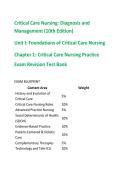
Critical Care Nursing: Diagnosis and
Management (10th Edition)
Unit I: Foundations of Critical Care Nursing
Chapter 1: Critical Care Nursing Practice
Exam Revision Test Bank
EXAM BLUEPRINT
Content Area Weight
History and Evolution of
5%
Critical Care
Critical Care Nursing Roles 10%
Advanced Practice Nursing 5%
Social Determinants of Health
10%
(SDOH)
Evidence-Based Practice 10%
Patient-Centered & Holistic
10%
Care
Complementary Therapies 5%
Technology and Tele-ICU 10%
,Interprofessional
10%
Collaboration
Rapid Response Teams 10%
Quality & Safety 10%
Healthy Work Environment 5%
Question 1
Cognitive Level: Recall
Question Type: MCQ
Difficulty: Easy
Which development most strongly contributed to the
emergence of modern critical care nursing?
A. Expansion of home health services
B. Creation of specialized monitoring and life-support units
C. Replacement of physicians in acute care settings
D. Elimination of interdisciplinary care
Correct Answer: B
Rationale: Modern critical care nursing developed as hospitals
created specialized units for continuous monitoring, mechanical
support, and rapid intervention for unstable patients.
Distractor Analysis:
, • A: Home health expanded later and is not the main driver
of critical care development.
• C: Nurses did not replace physicians; critical care is
interdisciplinary.
• D: Interdisciplinary care became more important, not less.
Learning Objective: Identify the historical forces that led to the
development of critical care nursing.
Chapter Reference: Unit I, Foundations of Critical Care Nursing
Clinical Significance: Understanding the history of critical care
helps nurses appreciate why continuous surveillance,
technology, and teamwork are central to ICU practice.
Question 2
Cognitive Level: Recall
Question Type: MCQ
Difficulty: Easy
Which example best reflects a social determinant of health
(SDOH)?
A. Serum potassium level
B. Housing instability
C. Cardiac output
D. Glasgow Coma Scale score
, Correct Answer: B
Rationale: SDOH are conditions in the environments where
people live, learn, work, and age. Housing stability is a major
SDOH.
Distractor Analysis:
• A: A laboratory value, not an SDOH.
• C: A physiologic measure, not an SDOH.
• D: A neurologic assessment score, not an SDOH.
Learning Objective: Distinguish social determinants of health
from physiologic clinical data.
Chapter Reference: Unit I, Foundations of Critical Care Nursing
Clinical Significance: SDOH can influence access to care,
adherence, recovery, and ICU readmission risk.
Question 3
Cognitive Level: Recall
Question Type: SATA
Difficulty: Moderate
Which are recognized challenges in the critical care work
environment? Select all that apply.
Management (10th Edition)
Unit I: Foundations of Critical Care Nursing
Chapter 1: Critical Care Nursing Practice
Exam Revision Test Bank
EXAM BLUEPRINT
Content Area Weight
History and Evolution of
5%
Critical Care
Critical Care Nursing Roles 10%
Advanced Practice Nursing 5%
Social Determinants of Health
10%
(SDOH)
Evidence-Based Practice 10%
Patient-Centered & Holistic
10%
Care
Complementary Therapies 5%
Technology and Tele-ICU 10%
,Interprofessional
10%
Collaboration
Rapid Response Teams 10%
Quality & Safety 10%
Healthy Work Environment 5%
Question 1
Cognitive Level: Recall
Question Type: MCQ
Difficulty: Easy
Which development most strongly contributed to the
emergence of modern critical care nursing?
A. Expansion of home health services
B. Creation of specialized monitoring and life-support units
C. Replacement of physicians in acute care settings
D. Elimination of interdisciplinary care
Correct Answer: B
Rationale: Modern critical care nursing developed as hospitals
created specialized units for continuous monitoring, mechanical
support, and rapid intervention for unstable patients.
Distractor Analysis:
, • A: Home health expanded later and is not the main driver
of critical care development.
• C: Nurses did not replace physicians; critical care is
interdisciplinary.
• D: Interdisciplinary care became more important, not less.
Learning Objective: Identify the historical forces that led to the
development of critical care nursing.
Chapter Reference: Unit I, Foundations of Critical Care Nursing
Clinical Significance: Understanding the history of critical care
helps nurses appreciate why continuous surveillance,
technology, and teamwork are central to ICU practice.
Question 2
Cognitive Level: Recall
Question Type: MCQ
Difficulty: Easy
Which example best reflects a social determinant of health
(SDOH)?
A. Serum potassium level
B. Housing instability
C. Cardiac output
D. Glasgow Coma Scale score
, Correct Answer: B
Rationale: SDOH are conditions in the environments where
people live, learn, work, and age. Housing stability is a major
SDOH.
Distractor Analysis:
• A: A laboratory value, not an SDOH.
• C: A physiologic measure, not an SDOH.
• D: A neurologic assessment score, not an SDOH.
Learning Objective: Distinguish social determinants of health
from physiologic clinical data.
Chapter Reference: Unit I, Foundations of Critical Care Nursing
Clinical Significance: SDOH can influence access to care,
adherence, recovery, and ICU readmission risk.
Question 3
Cognitive Level: Recall
Question Type: SATA
Difficulty: Moderate
Which are recognized challenges in the critical care work
environment? Select all that apply.


