

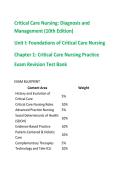
Critical Care Nursing: Diagnosis and
Management (10th Edition)
Unit I: Foundations of Critical Care Nursing
Chapter 1: Critical Care Nursing Practice
Exam Revision Test Bank
EXAM BLUEPRINT
Content Area Weight
History and Evolution of
5%
Critical Care
Critical Care Nursing Roles 10%
Advanced Practice Nursing 5%
Social Determinants of Health
10%
(SDOH)
Evidence-Based Practice 10%
Patient-Centered & Holistic
10%
Care
Complementary Therapies 5%
Technology and Tele-ICU 10%
,Interprofessional
10%
Collaboration
Rapid Response Teams 10%
Quality & Safety 10%
Healthy Work Environment 5%
1. [Recall] Which organization is most directly associated with
standards and resources for the practice of critical care
nursing in the United States?
A. World Health Organization
B. American Association of Critical-Care Nurses (AACN)
C. National Institutes of Health
D. Centers for Medicare and Medicaid Services
Correct answer: B
Rationale: AACN is a major professional organization for critical
care nurses and provides practice resources, standards, and
certification support.
Distractor analysis:
A. WHO is global but not the primary U.S. critical care nursing
body.
C. NIH supports research but is not a professional nursing
organization.
,D. CMS regulates reimbursement and coverage, not critical care
nursing practice standards.
Difficulty: Easy
Learning objective: Identify a key professional organization
supporting critical care nursing practice.
Chapter reference: Unit I, Critical Care Nursing Practice;
Professional Organizations
Clinical significance: Professional organizations guide
standards, competency, advocacy, and evidence-based
practice.
2. [Recall] Which role is most likely to focus on direct clinical
decision-making at the bedside while also coordinating
complex ICU care?
A. Unit secretary
B. Critical care nurse
C. Environmental services worker
D. Transport technician
Correct answer: B
Rationale: Critical care nurses manage ongoing assessments,
interventions, and coordination of care for unstable patients.
Distractor analysis:
A. The unit secretary supports communication and workflow.
, C. Environmental services supports cleanliness and infection
prevention.
D. Transport technicians move patients but do not provide
nursing decision-making.
Difficulty: Easy
Learning objective: Distinguish the bedside role of the critical
care nurse from ancillary roles.
Chapter reference: Unit I, Critical Care Nursing Roles
Clinical significance: Accurate role recognition supports safe
delegation and teamwork.
3. [Recall] Which item is a social determinant of health?
A. Serum creatinine
B. Health insurance coverage
C. Cardiac output
D. Glasgow Coma Scale score
Correct answer: B
Rationale: Health insurance coverage affects access to care and
is a social determinant of health.
Distractor analysis:
A. Serum creatinine is a laboratory value.
C. Cardiac output is a physiologic measure.
D. Glasgow Coma Scale is a neurologic assessment tool.
Management (10th Edition)
Unit I: Foundations of Critical Care Nursing
Chapter 1: Critical Care Nursing Practice
Exam Revision Test Bank
EXAM BLUEPRINT
Content Area Weight
History and Evolution of
5%
Critical Care
Critical Care Nursing Roles 10%
Advanced Practice Nursing 5%
Social Determinants of Health
10%
(SDOH)
Evidence-Based Practice 10%
Patient-Centered & Holistic
10%
Care
Complementary Therapies 5%
Technology and Tele-ICU 10%
,Interprofessional
10%
Collaboration
Rapid Response Teams 10%
Quality & Safety 10%
Healthy Work Environment 5%
1. [Recall] Which organization is most directly associated with
standards and resources for the practice of critical care
nursing in the United States?
A. World Health Organization
B. American Association of Critical-Care Nurses (AACN)
C. National Institutes of Health
D. Centers for Medicare and Medicaid Services
Correct answer: B
Rationale: AACN is a major professional organization for critical
care nurses and provides practice resources, standards, and
certification support.
Distractor analysis:
A. WHO is global but not the primary U.S. critical care nursing
body.
C. NIH supports research but is not a professional nursing
organization.
,D. CMS regulates reimbursement and coverage, not critical care
nursing practice standards.
Difficulty: Easy
Learning objective: Identify a key professional organization
supporting critical care nursing practice.
Chapter reference: Unit I, Critical Care Nursing Practice;
Professional Organizations
Clinical significance: Professional organizations guide
standards, competency, advocacy, and evidence-based
practice.
2. [Recall] Which role is most likely to focus on direct clinical
decision-making at the bedside while also coordinating
complex ICU care?
A. Unit secretary
B. Critical care nurse
C. Environmental services worker
D. Transport technician
Correct answer: B
Rationale: Critical care nurses manage ongoing assessments,
interventions, and coordination of care for unstable patients.
Distractor analysis:
A. The unit secretary supports communication and workflow.
, C. Environmental services supports cleanliness and infection
prevention.
D. Transport technicians move patients but do not provide
nursing decision-making.
Difficulty: Easy
Learning objective: Distinguish the bedside role of the critical
care nurse from ancillary roles.
Chapter reference: Unit I, Critical Care Nursing Roles
Clinical significance: Accurate role recognition supports safe
delegation and teamwork.
3. [Recall] Which item is a social determinant of health?
A. Serum creatinine
B. Health insurance coverage
C. Cardiac output
D. Glasgow Coma Scale score
Correct answer: B
Rationale: Health insurance coverage affects access to care and
is a social determinant of health.
Distractor analysis:
A. Serum creatinine is a laboratory value.
C. Cardiac output is a physiologic measure.
D. Glasgow Coma Scale is a neurologic assessment tool.


