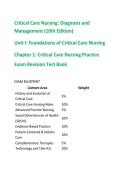
Critical Care Nursing: Diagnosis and
Management (10th Edition)
Unit I: Foundations of Critical Care Nursing
Chapter 1: Critical Care Nursing Practice
Exam Revision Test Bank
EXAM BLUEPRINT
Content Area Weight
History and Evolution of
5%
Critical Care
Critical Care Nursing Roles 10%
Advanced Practice Nursing 5%
Social Determinants of Health
10%
(SDOH)
Evidence-Based Practice 10%
Patient-Centered & Holistic
10%
Care
Complementary Therapies 5%
Technology and Tele-ICU 10%
,Interprofessional
10%
Collaboration
Rapid Response Teams 10%
Quality & Safety 10%
Healthy Work Environment 5%
Unit I — Foundations of Critical Care Nursing
Chapter Reference: Critical Care Nursing Practice
Exam Blueprint (20 items)
Topic Weighting
• Critical care nursing roles and practice: 20%
• SDOH, disparities, inequities, equity-focused care: 15%
• Evidence-based practice and clinical decision support: 15%
• Holistic, patient-centered, culturally responsive care: 10%
• Technology, tele-ICU, and interprofessional collaboration:
10%
• Quality, safety, regulatory issues: 15%
• Nurse well-being, fatigue, bullying, violence prevention,
HWE: 15%
Bloom’s Taxonomy Distribution
• Recall: 3 items
, • Comprehension: 3 items
• Application: 7 items
• Analysis: 5 items
• Evaluation/Judgment: 2 items
1. Recall | MCQ
Stem: Which historical development most directly accelerated
the growth of modern critical care units?
A. Home hospice expansion
B. Need for close physiologic surveillance during high-acuity
care
C. Outpatient chronic disease education programs
D. Community vaccination campaigns
Correct answer: B
Rationale: Critical care units evolved to provide continuous
monitoring and rapid intervention for unstable patients.
Distractor analysis:
A: Hospice focuses on comfort at end of life, not ICU
development.
, C: Important to health, but not a driver of ICU formation.
D: Valuable public health work, but not the basis of ICU growth.
Difficulty: Easy
Learning objective: Identify the historical purpose of critical
care services.
Chapter reference: Unit I, Chapter 1: Critical Care Nursing
Practice
Clinical significance: Understanding ICU origins supports
appreciation of monitoring intensity and rapid response
culture.
2. Recall | MCQ
Stem: Which organization is most directly associated with
critical care nursing practice and standards?
A. AACN
B. AORN
C. ANA
D. AMA
Correct answer: A
Rationale: The American Association of Critical-Care Nurses
focuses on critical care nursing practice, certification, and
professional resources.
Management (10th Edition)
Unit I: Foundations of Critical Care Nursing
Chapter 1: Critical Care Nursing Practice
Exam Revision Test Bank
EXAM BLUEPRINT
Content Area Weight
History and Evolution of
5%
Critical Care
Critical Care Nursing Roles 10%
Advanced Practice Nursing 5%
Social Determinants of Health
10%
(SDOH)
Evidence-Based Practice 10%
Patient-Centered & Holistic
10%
Care
Complementary Therapies 5%
Technology and Tele-ICU 10%
,Interprofessional
10%
Collaboration
Rapid Response Teams 10%
Quality & Safety 10%
Healthy Work Environment 5%
Unit I — Foundations of Critical Care Nursing
Chapter Reference: Critical Care Nursing Practice
Exam Blueprint (20 items)
Topic Weighting
• Critical care nursing roles and practice: 20%
• SDOH, disparities, inequities, equity-focused care: 15%
• Evidence-based practice and clinical decision support: 15%
• Holistic, patient-centered, culturally responsive care: 10%
• Technology, tele-ICU, and interprofessional collaboration:
10%
• Quality, safety, regulatory issues: 15%
• Nurse well-being, fatigue, bullying, violence prevention,
HWE: 15%
Bloom’s Taxonomy Distribution
• Recall: 3 items
, • Comprehension: 3 items
• Application: 7 items
• Analysis: 5 items
• Evaluation/Judgment: 2 items
1. Recall | MCQ
Stem: Which historical development most directly accelerated
the growth of modern critical care units?
A. Home hospice expansion
B. Need for close physiologic surveillance during high-acuity
care
C. Outpatient chronic disease education programs
D. Community vaccination campaigns
Correct answer: B
Rationale: Critical care units evolved to provide continuous
monitoring and rapid intervention for unstable patients.
Distractor analysis:
A: Hospice focuses on comfort at end of life, not ICU
development.
, C: Important to health, but not a driver of ICU formation.
D: Valuable public health work, but not the basis of ICU growth.
Difficulty: Easy
Learning objective: Identify the historical purpose of critical
care services.
Chapter reference: Unit I, Chapter 1: Critical Care Nursing
Practice
Clinical significance: Understanding ICU origins supports
appreciation of monitoring intensity and rapid response
culture.
2. Recall | MCQ
Stem: Which organization is most directly associated with
critical care nursing practice and standards?
A. AACN
B. AORN
C. ANA
D. AMA
Correct answer: A
Rationale: The American Association of Critical-Care Nurses
focuses on critical care nursing practice, certification, and
professional resources.