

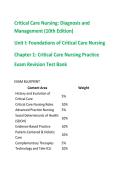
Critical Care Nursing: Diagnosis and
Management (10th Edition)
Unit I: Foundations of Critical Care Nursing
Chapter 1: Critical Care Nursing Practice
Exam Revision Test Bank
EXAM BLUEPRINT
Content Area Weight
History and Evolution of
5%
Critical Care
Critical Care Nursing Roles 10%
Advanced Practice Nursing 5%
Social Determinants of Health
10%
(SDOH)
Evidence-Based Practice 10%
Patient-Centered & Holistic
10%
Care
Complementary Therapies 5%
Technology and Tele-ICU 10%
,Interprofessional
10%
Collaboration
Rapid Response Teams 10%
Quality & Safety 10%
Healthy Work Environment 5%
Unit I — Foundations of Critical Care Nursing
Chapter Reference: Critical Care Nursing Practice
Exam Blueprint (20 items)
Topic Weighting
• Critical care nursing roles and practice: 20%
• SDOH, disparities, inequities, equity-focused care: 15%
• Evidence-based practice and clinical decision support: 15%
• Holistic, patient-centered, culturally responsive care: 10%
• Technology, tele-ICU, and interprofessional collaboration:
10%
• Quality, safety, regulatory issues: 15%
• Nurse well-being, fatigue, bullying, violence prevention,
HWE: 15%
Bloom’s Taxonomy Distribution
• Recall: 3 items
, • Comprehension: 3 items
• Application: 7 items
• Analysis: 5 items
• Evaluation/Judgment: 2 items
1. MCQ | Recall
Stem: Which organization is most closely associated with
standards, certification, and advocacy for acute and critical care
nurses?
A. SCCM
B. AACN
C. WHO
D. CDC
Correct answer: B
Rationale: The American Association of Critical-Care Nurses
(AACN) is the primary professional organization for acute and
critical care nursing practice, certification, and advocacy.
Distractor analysis:
A: SCCM focuses broadly on critical care medicine and
interdisciplinary ICU practice.
C: WHO is a global public health organization, not critical care
nursing-specific.
, D: CDC addresses population health and disease prevention,
not nursing certification.
Difficulty: Easy
Learning objective: Identify the major professional organization
supporting critical care nursing practice.
Chapter reference: Critical Care Nursing Practice
Clinical significance: Recognizing professional organizations
supports evidence-based practice, certification, and
professional accountability.
2. MCQ | Comprehension
Stem: Which statement best describes social determinants of
health (SDOH)?
A. Genetic variations that determine disease risk
B. Social and environmental conditions that influence health
outcomes
C. Hospital policies that guide ICU care
D. Individual lifestyle choices only
Correct answer: B
Rationale: SDOH are the conditions in which people are born,
grow, live, work, and age, and they strongly influence health
outcomes.
Distractor analysis:
A: Genetics are biologic factors, not SDOH.
C: Policies are system factors, not the definition of SDOH.
Management (10th Edition)
Unit I: Foundations of Critical Care Nursing
Chapter 1: Critical Care Nursing Practice
Exam Revision Test Bank
EXAM BLUEPRINT
Content Area Weight
History and Evolution of
5%
Critical Care
Critical Care Nursing Roles 10%
Advanced Practice Nursing 5%
Social Determinants of Health
10%
(SDOH)
Evidence-Based Practice 10%
Patient-Centered & Holistic
10%
Care
Complementary Therapies 5%
Technology and Tele-ICU 10%
,Interprofessional
10%
Collaboration
Rapid Response Teams 10%
Quality & Safety 10%
Healthy Work Environment 5%
Unit I — Foundations of Critical Care Nursing
Chapter Reference: Critical Care Nursing Practice
Exam Blueprint (20 items)
Topic Weighting
• Critical care nursing roles and practice: 20%
• SDOH, disparities, inequities, equity-focused care: 15%
• Evidence-based practice and clinical decision support: 15%
• Holistic, patient-centered, culturally responsive care: 10%
• Technology, tele-ICU, and interprofessional collaboration:
10%
• Quality, safety, regulatory issues: 15%
• Nurse well-being, fatigue, bullying, violence prevention,
HWE: 15%
Bloom’s Taxonomy Distribution
• Recall: 3 items
, • Comprehension: 3 items
• Application: 7 items
• Analysis: 5 items
• Evaluation/Judgment: 2 items
1. MCQ | Recall
Stem: Which organization is most closely associated with
standards, certification, and advocacy for acute and critical care
nurses?
A. SCCM
B. AACN
C. WHO
D. CDC
Correct answer: B
Rationale: The American Association of Critical-Care Nurses
(AACN) is the primary professional organization for acute and
critical care nursing practice, certification, and advocacy.
Distractor analysis:
A: SCCM focuses broadly on critical care medicine and
interdisciplinary ICU practice.
C: WHO is a global public health organization, not critical care
nursing-specific.
, D: CDC addresses population health and disease prevention,
not nursing certification.
Difficulty: Easy
Learning objective: Identify the major professional organization
supporting critical care nursing practice.
Chapter reference: Critical Care Nursing Practice
Clinical significance: Recognizing professional organizations
supports evidence-based practice, certification, and
professional accountability.
2. MCQ | Comprehension
Stem: Which statement best describes social determinants of
health (SDOH)?
A. Genetic variations that determine disease risk
B. Social and environmental conditions that influence health
outcomes
C. Hospital policies that guide ICU care
D. Individual lifestyle choices only
Correct answer: B
Rationale: SDOH are the conditions in which people are born,
grow, live, work, and age, and they strongly influence health
outcomes.
Distractor analysis:
A: Genetics are biologic factors, not SDOH.
C: Policies are system factors, not the definition of SDOH.


