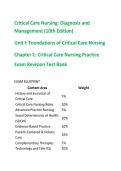
Critical Care Nursing: Diagnosis and
Management (10th Edition)
Unit I: Foundations of Critical Care Nursing
Chapter 1: Critical Care Nursing Practice
Exam Revision Test Bank
EXAM BLUEPRINT
Content Area Weight
History and Evolution of
5%
Critical Care
Critical Care Nursing Roles 10%
Advanced Practice Nursing 5%
Social Determinants of Health
10%
(SDOH)
Evidence-Based Practice 10%
Patient-Centered & Holistic
10%
Care
Complementary Therapies 5%
Technology and Tele-ICU 10%
,Interprofessional
10%
Collaboration
Rapid Response Teams 10%
Quality & Safety 10%
Healthy Work Environment 5%
1. Which event is most commonly associated with the early
development of modern critical care units?
Type: MCQ
Bloom’s level: Recall
Difficulty: Easy
Learning objective: Identify the historical roots of critical care
nursing practice.
Chapter reference: Unit I, Chapter 1
Clinical significance: Understanding the origin of ICU care
supports appreciation of specialized monitoring, staffing, and
escalation pathways.
Question:
Which event is most commonly associated with the early
development of modern critical care units?
A. The widespread use of home telemetry
B. The introduction of post-operative recovery rooms for close
observation
,C. The creation of outpatient urgent care centers
D. The replacement of bedside nurses with remote monitors
Correct answer: B
Rationale:
Post-operative recovery areas and specialized observation units
were early precursors to modern critical care because they
concentrated high-risk patients in settings with closer
monitoring and rapid intervention.
Distractor analysis:
A. Home telemetry is a much later development.
C. Urgent care centers are not part of ICU history.
D. Remote monitoring did not replace bedside nursing and is
not the origin of critical care.
2. A nurse says, “Critical care is only about ventilators and
vasoactive drips.” Which response best reflects contemporary
critical care?
Type: MCQ
Bloom’s level: Comprehension
Difficulty: Moderate
Learning objective: Explain the broader scope of contemporary
critical care.
Chapter reference: Unit I, Chapter 1
, Clinical significance: Contemporary ICU care includes
prevention, family support, coordination, and recovery-focused
interventions.
Question:
A nurse says, “Critical care is only about ventilators and
vasoactive drips.” Which response best reflects contemporary
critical care?
A. “That is correct; critical care is primarily technology-based.”
B. “Critical care now includes prevention, patient-centered
care, family support, and recovery planning.”
C. “Critical care is limited to trauma and cardiac arrest
patients.”
D. “Critical care focuses only on physician-directed
interventions.”
Correct answer: B
Rationale:
Contemporary critical care extends beyond life-support devices
to include holistic, patient-centered, evidence-based, and
interdisciplinary management.
Distractor analysis:
A. Too narrow and inaccurate.
C. Critical care serves many diagnoses, not just trauma or
arrest.
Management (10th Edition)
Unit I: Foundations of Critical Care Nursing
Chapter 1: Critical Care Nursing Practice
Exam Revision Test Bank
EXAM BLUEPRINT
Content Area Weight
History and Evolution of
5%
Critical Care
Critical Care Nursing Roles 10%
Advanced Practice Nursing 5%
Social Determinants of Health
10%
(SDOH)
Evidence-Based Practice 10%
Patient-Centered & Holistic
10%
Care
Complementary Therapies 5%
Technology and Tele-ICU 10%
,Interprofessional
10%
Collaboration
Rapid Response Teams 10%
Quality & Safety 10%
Healthy Work Environment 5%
1. Which event is most commonly associated with the early
development of modern critical care units?
Type: MCQ
Bloom’s level: Recall
Difficulty: Easy
Learning objective: Identify the historical roots of critical care
nursing practice.
Chapter reference: Unit I, Chapter 1
Clinical significance: Understanding the origin of ICU care
supports appreciation of specialized monitoring, staffing, and
escalation pathways.
Question:
Which event is most commonly associated with the early
development of modern critical care units?
A. The widespread use of home telemetry
B. The introduction of post-operative recovery rooms for close
observation
,C. The creation of outpatient urgent care centers
D. The replacement of bedside nurses with remote monitors
Correct answer: B
Rationale:
Post-operative recovery areas and specialized observation units
were early precursors to modern critical care because they
concentrated high-risk patients in settings with closer
monitoring and rapid intervention.
Distractor analysis:
A. Home telemetry is a much later development.
C. Urgent care centers are not part of ICU history.
D. Remote monitoring did not replace bedside nursing and is
not the origin of critical care.
2. A nurse says, “Critical care is only about ventilators and
vasoactive drips.” Which response best reflects contemporary
critical care?
Type: MCQ
Bloom’s level: Comprehension
Difficulty: Moderate
Learning objective: Explain the broader scope of contemporary
critical care.
Chapter reference: Unit I, Chapter 1
, Clinical significance: Contemporary ICU care includes
prevention, family support, coordination, and recovery-focused
interventions.
Question:
A nurse says, “Critical care is only about ventilators and
vasoactive drips.” Which response best reflects contemporary
critical care?
A. “That is correct; critical care is primarily technology-based.”
B. “Critical care now includes prevention, patient-centered
care, family support, and recovery planning.”
C. “Critical care is limited to trauma and cardiac arrest
patients.”
D. “Critical care focuses only on physician-directed
interventions.”
Correct answer: B
Rationale:
Contemporary critical care extends beyond life-support devices
to include holistic, patient-centered, evidence-based, and
interdisciplinary management.
Distractor analysis:
A. Too narrow and inaccurate.
C. Critical care serves many diagnoses, not just trauma or
arrest.