

Google Cloud Professional Data Engineer Exam
ACTUAL EXAM 2026/2027 | Data Architecture
BigQuery ML Pipelines | Verified Q&A | Pass
Guaranteed - A+ Graded
TABLE OF CONTENTS
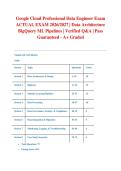
Table
Section Topic Questions Count
Section 1 Data Architecture & Design 1–10 10
Section 2 BigQuery 11–25 15
Section 3 Machine Learning Pipelines 26–37 12
Section 4 Data Processing 38–47 10
Section 5 Data Governance, Security, & Compliance 48–55 8
Section 6 Data Integration & Migration 56–63 8
Section 7 Monitoring, Logging, & Troubleshooting 64–69 6
Section 8 Case Study Scenarios 70–75 6
Total Questions: 75
Passing Score: 90%
,Section 1: Data Architecture & Design (Questions 1–10)
Q1: A retail company collects 50 TB of transaction data daily from 2,000 stores worldwide. They need a
data architecture that supports real-time fraud detection, daily batch reporting, and ad-hoc analytics for
data scientists. The architecture must minimize data movement and support both structured and semi-
structured data. Which architecture best meets these requirements?
A. Store all data in Cloud SQL with read replicas for analytics, use Cloud Functions for real-time
processing, and export to BigQuery nightly for batch reports.
B. Use Cloud Storage as a data lake for raw data, Dataflow for real-time streaming to BigQuery, and
scheduled BigQuery queries for batch reporting with separate Cloud Spanner for fraud detection.
C. Ingest all data into Pub/Sub, stream to BigQuery via Dataflow for real-time analytics, use BigQuery
scheduled queries for batch reporting, and enable BigQuery ML for fraud detection, with Cloud Storage
as the landing zone for raw data. [CORRECT]
D. Deploy Hadoop on Compute Engine VMs, use HDFS for storage, Spark Streaming for real-time
processing, and Hive for batch analytics with nightly ETL to a data warehouse.
Correct Answer: C
Rationale: This architecture leverages Pub/Sub for durable message ingestion, Dataflow for exactly-once
streaming into BigQuery, and BigQuery's unified storage for both real-time and batch analytics without
data movement. BigQuery ML enables in-database fraud detection, and Cloud Storage serves as a cost-
effective raw data landing zone—aligning with GCP's modern data lakehouse pattern.
Q2: A healthcare organization must design a data platform that supports HIPAA compliance, multi-
region disaster recovery with RPO < 1 hour, and analytics on 10 years of patient records (500 TB). Data
residency must remain within the US. Which design satisfies all constraints?
A. Store data in a single US multi-region Cloud Storage bucket with Nearline storage class, use BigQuery
in US multi-region, and replicate to a second single-region bucket in us-east1.
B. Use Cloud Storage dual-region buckets (us-central1, us-east1) with Standard storage, BigQuery in US
multi-region, and Cloud KMS with CMEK for encryption, with IAM policies restricting data access to US
personnel only. [CORRECT]
C. Deploy data across three single-region Cloud Storage buckets (us-central1, us-east1, us-west1) with
Coldline storage, use BigQuery in EU multi-region for cost savings, and enable VPC Service Controls.
,D. Store all data in a single us-central1 Cloud Storage bucket with Archive storage class, use on-premises
Hadoop for analytics, and replicate backups to AWS S3 in us-east-1.
Correct Answer: B
Rationale: Dual-region Cloud Storage buckets provide geo-redundancy with < 1 hour RPO while
maintaining US data residency. BigQuery US multi-region ensures analytics availability across dual
regions. Cloud KMS with CMEK satisfies HIPAA encryption requirements, and IAM geo-restrictions
enforce access controls—this is GCP's recommended pattern for regulated multi-region workloads.
Q3: A financial services firm needs to modernize their on-premises data warehouse. They have 2 PB of
historical data, complex SQL queries with 500+ joins, and strict SLAs requiring query completion in under
30 seconds. They want to minimize refactoring effort. Which GCP solution is most appropriate?
A. Migrate data to Cloud Spanner with interleaved tables for join performance, rewrite queries to use
Spanner SQL dialect, and use Cloud Data Fusion for ETL.
B. Use BigQuery with clustered and partitioned tables, leverage BI Engine for sub-second dashboard
queries, and use BigQuery migration assessment utility to identify query compatibility issues before
migration. [CORRECT]
C. Deploy Cloud SQL for PostgreSQL with read replicas, shard data across 20 instances, and use
pgBouncer for connection pooling to handle query load.
D. Migrate to Dataproc with Hive on Spark, maintain existing HiveQL queries, and use preemptible VMs
for cost savings on batch processing.
Correct Answer: B
Rationale: BigQuery is GCP's serverless data warehouse designed for petabyte-scale analytics with
standard SQL support, minimizing query refactoring. Clustering and partitioning optimize join
performance on large datasets, while BI Engine provides in-memory acceleration for dashboard queries
under 30 seconds. The migration assessment utility identifies compatibility gaps early.
Q4: A gaming company streams 1 million events per second from mobile devices globally. They need to
aggregate player statistics in real-time with 99.9% availability and process the same stream for ML
feature engineering with exactly-once semantics. Which architecture is optimal?
A. Use Cloud Load Balancing to distribute events to Compute Engine VMs running custom aggregators,
write results to Cloud SQL, and use Cloud Scheduler for batch ML feature extraction.
, B. Ingest into Pub/Sub with global topics, process with Dataflow using windowing and triggers for real-
time aggregation, write to BigQuery for analytics, and use Dataflow's side inputs for ML feature lookup
tables with exactly-once processing guarantees. [CORRECT]
C. Stream directly into BigQuery using streaming inserts, use materialized views for real-time
aggregation, and export to Cloud Storage hourly for ML training data preparation.
D. Use Cloud Tasks to queue events, process with Cloud Run services, store aggregates in Firestore, and
use BigQuery Data Transfer Service for daily ML feature snapshots.
Correct Answer: B
Rationale: Pub/Sub provides globally available, durable message ingestion at millions of events per
second. Dataflow's Apache Beam model supports event-time windowing with triggers for real-time
aggregation and exactly-once processing semantics via checkpointing. Side inputs enable enrichment
with ML feature stores, and BigQuery serves as the analytics sink—this is GCP's canonical streaming
analytics pattern.
Q5: A multinational corporation needs to design a data mesh architecture across 12 business units. Each
unit owns their domain data, but enterprise-wide analytics require cross-domain joins. Data must be
discoverable via a central catalog while maintaining domain autonomy. Which GCP approach best
implements data mesh principles?
A. Create a single enterprise BigQuery dataset with all data, grant column-level access via IAM, and use
Data Catalog for metadata management.
B. Deploy separate BigQuery projects per domain with authorized datasets/views for cross-domain
access, use Data Catalog for federated metadata discovery, and establish domain data product contracts
via BigQuery data sharing. [CORRECT]
C. Store all data in a central Cloud Storage bucket with folder-per-domain structure, use Dataproc for
cross-domain ETL, and maintain an Excel-based data dictionary.
D. Use Cloud SQL instances per domain with foreign data wrappers for cross-database queries, and
implement a custom REST API for data discovery.
Correct Answer: B
Rationale: BigQuery authorized datasets and views enable secure cross-domain querying without data
duplication, preserving domain ownership. Separate projects maintain autonomy and cost attribution.
Data Catalog provides federated metadata discovery across domains, and BigQuery data sharing
establishes formal data product contracts—directly implementing data mesh principles on GCP.
ACTUAL EXAM 2026/2027 | Data Architecture
BigQuery ML Pipelines | Verified Q&A | Pass
Guaranteed - A+ Graded
TABLE OF CONTENTS
Table
Section Topic Questions Count
Section 1 Data Architecture & Design 1–10 10
Section 2 BigQuery 11–25 15
Section 3 Machine Learning Pipelines 26–37 12
Section 4 Data Processing 38–47 10
Section 5 Data Governance, Security, & Compliance 48–55 8
Section 6 Data Integration & Migration 56–63 8
Section 7 Monitoring, Logging, & Troubleshooting 64–69 6
Section 8 Case Study Scenarios 70–75 6
Total Questions: 75
Passing Score: 90%
,Section 1: Data Architecture & Design (Questions 1–10)
Q1: A retail company collects 50 TB of transaction data daily from 2,000 stores worldwide. They need a
data architecture that supports real-time fraud detection, daily batch reporting, and ad-hoc analytics for
data scientists. The architecture must minimize data movement and support both structured and semi-
structured data. Which architecture best meets these requirements?
A. Store all data in Cloud SQL with read replicas for analytics, use Cloud Functions for real-time
processing, and export to BigQuery nightly for batch reports.
B. Use Cloud Storage as a data lake for raw data, Dataflow for real-time streaming to BigQuery, and
scheduled BigQuery queries for batch reporting with separate Cloud Spanner for fraud detection.
C. Ingest all data into Pub/Sub, stream to BigQuery via Dataflow for real-time analytics, use BigQuery
scheduled queries for batch reporting, and enable BigQuery ML for fraud detection, with Cloud Storage
as the landing zone for raw data. [CORRECT]
D. Deploy Hadoop on Compute Engine VMs, use HDFS for storage, Spark Streaming for real-time
processing, and Hive for batch analytics with nightly ETL to a data warehouse.
Correct Answer: C
Rationale: This architecture leverages Pub/Sub for durable message ingestion, Dataflow for exactly-once
streaming into BigQuery, and BigQuery's unified storage for both real-time and batch analytics without
data movement. BigQuery ML enables in-database fraud detection, and Cloud Storage serves as a cost-
effective raw data landing zone—aligning with GCP's modern data lakehouse pattern.
Q2: A healthcare organization must design a data platform that supports HIPAA compliance, multi-
region disaster recovery with RPO < 1 hour, and analytics on 10 years of patient records (500 TB). Data
residency must remain within the US. Which design satisfies all constraints?
A. Store data in a single US multi-region Cloud Storage bucket with Nearline storage class, use BigQuery
in US multi-region, and replicate to a second single-region bucket in us-east1.
B. Use Cloud Storage dual-region buckets (us-central1, us-east1) with Standard storage, BigQuery in US
multi-region, and Cloud KMS with CMEK for encryption, with IAM policies restricting data access to US
personnel only. [CORRECT]
C. Deploy data across three single-region Cloud Storage buckets (us-central1, us-east1, us-west1) with
Coldline storage, use BigQuery in EU multi-region for cost savings, and enable VPC Service Controls.
,D. Store all data in a single us-central1 Cloud Storage bucket with Archive storage class, use on-premises
Hadoop for analytics, and replicate backups to AWS S3 in us-east-1.
Correct Answer: B
Rationale: Dual-region Cloud Storage buckets provide geo-redundancy with < 1 hour RPO while
maintaining US data residency. BigQuery US multi-region ensures analytics availability across dual
regions. Cloud KMS with CMEK satisfies HIPAA encryption requirements, and IAM geo-restrictions
enforce access controls—this is GCP's recommended pattern for regulated multi-region workloads.
Q3: A financial services firm needs to modernize their on-premises data warehouse. They have 2 PB of
historical data, complex SQL queries with 500+ joins, and strict SLAs requiring query completion in under
30 seconds. They want to minimize refactoring effort. Which GCP solution is most appropriate?
A. Migrate data to Cloud Spanner with interleaved tables for join performance, rewrite queries to use
Spanner SQL dialect, and use Cloud Data Fusion for ETL.
B. Use BigQuery with clustered and partitioned tables, leverage BI Engine for sub-second dashboard
queries, and use BigQuery migration assessment utility to identify query compatibility issues before
migration. [CORRECT]
C. Deploy Cloud SQL for PostgreSQL with read replicas, shard data across 20 instances, and use
pgBouncer for connection pooling to handle query load.
D. Migrate to Dataproc with Hive on Spark, maintain existing HiveQL queries, and use preemptible VMs
for cost savings on batch processing.
Correct Answer: B
Rationale: BigQuery is GCP's serverless data warehouse designed for petabyte-scale analytics with
standard SQL support, minimizing query refactoring. Clustering and partitioning optimize join
performance on large datasets, while BI Engine provides in-memory acceleration for dashboard queries
under 30 seconds. The migration assessment utility identifies compatibility gaps early.
Q4: A gaming company streams 1 million events per second from mobile devices globally. They need to
aggregate player statistics in real-time with 99.9% availability and process the same stream for ML
feature engineering with exactly-once semantics. Which architecture is optimal?
A. Use Cloud Load Balancing to distribute events to Compute Engine VMs running custom aggregators,
write results to Cloud SQL, and use Cloud Scheduler for batch ML feature extraction.
, B. Ingest into Pub/Sub with global topics, process with Dataflow using windowing and triggers for real-
time aggregation, write to BigQuery for analytics, and use Dataflow's side inputs for ML feature lookup
tables with exactly-once processing guarantees. [CORRECT]
C. Stream directly into BigQuery using streaming inserts, use materialized views for real-time
aggregation, and export to Cloud Storage hourly for ML training data preparation.
D. Use Cloud Tasks to queue events, process with Cloud Run services, store aggregates in Firestore, and
use BigQuery Data Transfer Service for daily ML feature snapshots.
Correct Answer: B
Rationale: Pub/Sub provides globally available, durable message ingestion at millions of events per
second. Dataflow's Apache Beam model supports event-time windowing with triggers for real-time
aggregation and exactly-once processing semantics via checkpointing. Side inputs enable enrichment
with ML feature stores, and BigQuery serves as the analytics sink—this is GCP's canonical streaming
analytics pattern.
Q5: A multinational corporation needs to design a data mesh architecture across 12 business units. Each
unit owns their domain data, but enterprise-wide analytics require cross-domain joins. Data must be
discoverable via a central catalog while maintaining domain autonomy. Which GCP approach best
implements data mesh principles?
A. Create a single enterprise BigQuery dataset with all data, grant column-level access via IAM, and use
Data Catalog for metadata management.
B. Deploy separate BigQuery projects per domain with authorized datasets/views for cross-domain
access, use Data Catalog for federated metadata discovery, and establish domain data product contracts
via BigQuery data sharing. [CORRECT]
C. Store all data in a central Cloud Storage bucket with folder-per-domain structure, use Dataproc for
cross-domain ETL, and maintain an Excel-based data dictionary.
D. Use Cloud SQL instances per domain with foreign data wrappers for cross-database queries, and
implement a custom REST API for data discovery.
Correct Answer: B
Rationale: BigQuery authorized datasets and views enable secure cross-domain querying without data
duplication, preserving domain ownership. Separate projects maintain autonomy and cost attribution.
Data Catalog provides federated metadata discovery across domains, and BigQuery data sharing
establishes formal data product contracts—directly implementing data mesh principles on GCP.


