

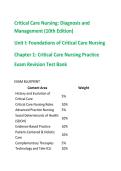
Critical Care Nursing: Diagnosis and
Management (10th Edition)
Unit I: Foundations of Critical Care Nursing
Chapter 1: Critical Care Nursing Practice
Exam Revision Test Bank
EXAM BLUEPRINT
Content Area Weight
History and Evolution of
5%
Critical Care
Critical Care Nursing Roles 10%
Advanced Practice Nursing 5%
Social Determinants of Health
10%
(SDOH)
Evidence-Based Practice 10%
Patient-Centered & Holistic
10%
Care
Complementary Therapies 5%
Technology and Tele-ICU 10%
, Interprofessional
10%
Collaboration
Rapid Response Teams 10%
Quality & Safety 10%
Healthy Work Environment 5%
Question 1 (Recall – MCQ)
Which organization is primarily dedicated to supporting bedside critical care nurses
through education, certification, and practice standards?
A. Society of Critical Care Medicine (SCCM)
B. American Association of Critical Care Nurses (AACN)
C. American Medical Association (AMA)
D. National Institutes of Health (NIH)
Correct Answer: B
Rationale: AACN is the largest specialty organization for acute and critical care nurses and
focuses on education, certification, and evidence-based practice.
Distractor Analysis:
• A: SCCM is multidisciplinary, not nursing-specific.
• C: Represents physicians.
• D: Research agency, not a professional nursing organization.
Difficulty: Easy
Learning Objective: Identify professional organizations supporting critical care nursing.
Chapter Reference: Critical Care Professional Organizations
Clinical Significance: Professional organizations shape standards that influence patient
outcomes.
, Question 2 (Recall – MCQ)
The primary goal of addressing Social Determinants of Health (SDOH) is to:
A. Reduce hospital costs
B. Improve health equity and outcomes
C. Increase ICU admissions
D. Standardize insurance coverage
Correct Answer: B
Rationale: SDOH initiatives focus on eliminating barriers and promoting equitable health
outcomes.
Distractor Analysis:
• A: Secondary benefit.
• C: Incorrect.
• D: Not the primary goal.
Difficulty: Easy
Learning Objective: Describe the purpose of SDOH initiatives.
Chapter Reference: SDOH Goal
Clinical Significance: Understanding SDOH helps identify factors affecting recovery and
access to care.
Question 3 (Comprehension – MCQ)
Which statement best reflects patient-centered care in the ICU?
A. Treatment decisions are made exclusively by physicians.
B. Care is standardized regardless of patient preferences.
C. Patient values and preferences guide clinical decisions.
D. Family participation should be minimized.
Correct Answer: C
, Rationale: Patient-centered care incorporates patient goals, preferences, and values into
care planning.
Distractor Analysis:
• A: Excludes collaborative decision-making.
• B: Ignores individual needs.
• D: Contradicts family-centered principles.
Difficulty: Moderate
Learning Objective: Explain principles of patient-centered care.
Chapter Reference: Patient-Centered Care
Clinical Significance: Improves satisfaction, adherence, and outcomes.
Question 4 (Comprehension – SATA)
Which interventions are considered complementary and alternative therapies used in
critical care settings?
Select all that apply.
A. Mindfulness
B. Massage
C. Music therapy
D. Animal-assisted intervention
E. Mechanical ventilation
Correct Answers: A, B, C, D
Rationale: These therapies may reduce anxiety, pain, and stress.
Distractor Analysis:
• E: Life-support technology, not complementary therapy.
Difficulty: Easy
Management (10th Edition)
Unit I: Foundations of Critical Care Nursing
Chapter 1: Critical Care Nursing Practice
Exam Revision Test Bank
EXAM BLUEPRINT
Content Area Weight
History and Evolution of
5%
Critical Care
Critical Care Nursing Roles 10%
Advanced Practice Nursing 5%
Social Determinants of Health
10%
(SDOH)
Evidence-Based Practice 10%
Patient-Centered & Holistic
10%
Care
Complementary Therapies 5%
Technology and Tele-ICU 10%
, Interprofessional
10%
Collaboration
Rapid Response Teams 10%
Quality & Safety 10%
Healthy Work Environment 5%
Question 1 (Recall – MCQ)
Which organization is primarily dedicated to supporting bedside critical care nurses
through education, certification, and practice standards?
A. Society of Critical Care Medicine (SCCM)
B. American Association of Critical Care Nurses (AACN)
C. American Medical Association (AMA)
D. National Institutes of Health (NIH)
Correct Answer: B
Rationale: AACN is the largest specialty organization for acute and critical care nurses and
focuses on education, certification, and evidence-based practice.
Distractor Analysis:
• A: SCCM is multidisciplinary, not nursing-specific.
• C: Represents physicians.
• D: Research agency, not a professional nursing organization.
Difficulty: Easy
Learning Objective: Identify professional organizations supporting critical care nursing.
Chapter Reference: Critical Care Professional Organizations
Clinical Significance: Professional organizations shape standards that influence patient
outcomes.
, Question 2 (Recall – MCQ)
The primary goal of addressing Social Determinants of Health (SDOH) is to:
A. Reduce hospital costs
B. Improve health equity and outcomes
C. Increase ICU admissions
D. Standardize insurance coverage
Correct Answer: B
Rationale: SDOH initiatives focus on eliminating barriers and promoting equitable health
outcomes.
Distractor Analysis:
• A: Secondary benefit.
• C: Incorrect.
• D: Not the primary goal.
Difficulty: Easy
Learning Objective: Describe the purpose of SDOH initiatives.
Chapter Reference: SDOH Goal
Clinical Significance: Understanding SDOH helps identify factors affecting recovery and
access to care.
Question 3 (Comprehension – MCQ)
Which statement best reflects patient-centered care in the ICU?
A. Treatment decisions are made exclusively by physicians.
B. Care is standardized regardless of patient preferences.
C. Patient values and preferences guide clinical decisions.
D. Family participation should be minimized.
Correct Answer: C
, Rationale: Patient-centered care incorporates patient goals, preferences, and values into
care planning.
Distractor Analysis:
• A: Excludes collaborative decision-making.
• B: Ignores individual needs.
• D: Contradicts family-centered principles.
Difficulty: Moderate
Learning Objective: Explain principles of patient-centered care.
Chapter Reference: Patient-Centered Care
Clinical Significance: Improves satisfaction, adherence, and outcomes.
Question 4 (Comprehension – SATA)
Which interventions are considered complementary and alternative therapies used in
critical care settings?
Select all that apply.
A. Mindfulness
B. Massage
C. Music therapy
D. Animal-assisted intervention
E. Mechanical ventilation
Correct Answers: A, B, C, D
Rationale: These therapies may reduce anxiety, pain, and stress.
Distractor Analysis:
• E: Life-support technology, not complementary therapy.
Difficulty: Easy


