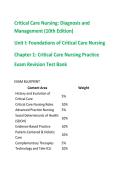
Critical Care Nursing: Diagnosis and
Management (10th Edition)
Unit I: Foundations of Critical Care Nursing
Chapter 1: Critical Care Nursing Practice
Exam Revision Test Bank
EXAM BLUEPRINT
Content Area Weight
History and Evolution of
5%
Critical Care
Critical Care Nursing Roles 10%
Advanced Practice Nursing 5%
Social Determinants of Health
10%
(SDOH)
Evidence-Based Practice 10%
Patient-Centered & Holistic
10%
Care
Complementary Therapies 5%
Technology and Tele-ICU 10%
, Interprofessional
10%
Collaboration
Rapid Response Teams 10%
Quality & Safety 10%
Healthy Work Environment 5%
Question 1
Cognitive Level: Recall
Question Type: MCQ
Difficulty: Easy
A primary goal of critical care nursing is to:
A. Eliminate all chronic illnesses
B. Promote optimal outcomes for patients with actual or potential life-threatening
conditions
C. Reduce hospital admissions through outpatient treatment
D. Focus solely on physiologic stabilization
Correct Answer: B
Rationale: Critical care nursing focuses on patients with actual or potential life-
threatening illnesses and aims to achieve optimal patient outcomes through
comprehensive assessment, intervention, and monitoring.
Distractor Analysis:
• A: Critical care does not eliminate chronic illnesses.
• C: Admission reduction is not the primary focus.
• D: Critical care includes psychosocial, cultural, and family-centered care in addition to
physiologic stabilization.
, Learning Objective: Describe the purpose and scope of critical care nursing practice.
Chapter Reference: Chapter 1 – Critical Care Nursing Practice
Clinical Significance: Understanding the scope of critical care nursing guides
comprehensive patient management.
Question 2
Cognitive Level: Recall
Question Type: MCQ
Difficulty: Easy
Which organization is primarily dedicated to supporting critical care nurses through
education, certification, and practice standards?
A. SCCM
B. AACN
C. ANA
D. CDC
Correct Answer: B
Rationale: AACN is the largest specialty nursing organization dedicated to critical care
nursing practice, education, certification, and advocacy.
Distractor Analysis:
• A: SCCM is multidisciplinary.
• C: ANA represents all nurses.
• D: CDC focuses on public health.
, Learning Objective: Identify major professional organizations in critical care nursing.
Chapter Reference: Critical Care Professional Organizations
Clinical Significance: Professional organizations support evidence-based practice and
specialty competency.
Question 3
Cognitive Level: Comprehension
Question Type: MCQ
Difficulty: Moderate
Which statement best describes evidence-based practice (EBP)?
A. Reliance solely on expert opinion
B. Integration of research evidence, clinical expertise, and patient preferences
C. Use of institutional policies only
D. Following physician recommendations without question
Correct Answer: B
Rationale: EBP combines the best available evidence, clinician expertise, and patient
values to optimize outcomes.
Distractor Analysis:
• A: Expert opinion alone is insufficient.
• C: Policies are only one component.
• D: EBP requires critical appraisal and collaboration.
Learning Objective: Explain the components of evidence-based nursing practice.
Management (10th Edition)
Unit I: Foundations of Critical Care Nursing
Chapter 1: Critical Care Nursing Practice
Exam Revision Test Bank
EXAM BLUEPRINT
Content Area Weight
History and Evolution of
5%
Critical Care
Critical Care Nursing Roles 10%
Advanced Practice Nursing 5%
Social Determinants of Health
10%
(SDOH)
Evidence-Based Practice 10%
Patient-Centered & Holistic
10%
Care
Complementary Therapies 5%
Technology and Tele-ICU 10%
, Interprofessional
10%
Collaboration
Rapid Response Teams 10%
Quality & Safety 10%
Healthy Work Environment 5%
Question 1
Cognitive Level: Recall
Question Type: MCQ
Difficulty: Easy
A primary goal of critical care nursing is to:
A. Eliminate all chronic illnesses
B. Promote optimal outcomes for patients with actual or potential life-threatening
conditions
C. Reduce hospital admissions through outpatient treatment
D. Focus solely on physiologic stabilization
Correct Answer: B
Rationale: Critical care nursing focuses on patients with actual or potential life-
threatening illnesses and aims to achieve optimal patient outcomes through
comprehensive assessment, intervention, and monitoring.
Distractor Analysis:
• A: Critical care does not eliminate chronic illnesses.
• C: Admission reduction is not the primary focus.
• D: Critical care includes psychosocial, cultural, and family-centered care in addition to
physiologic stabilization.
, Learning Objective: Describe the purpose and scope of critical care nursing practice.
Chapter Reference: Chapter 1 – Critical Care Nursing Practice
Clinical Significance: Understanding the scope of critical care nursing guides
comprehensive patient management.
Question 2
Cognitive Level: Recall
Question Type: MCQ
Difficulty: Easy
Which organization is primarily dedicated to supporting critical care nurses through
education, certification, and practice standards?
A. SCCM
B. AACN
C. ANA
D. CDC
Correct Answer: B
Rationale: AACN is the largest specialty nursing organization dedicated to critical care
nursing practice, education, certification, and advocacy.
Distractor Analysis:
• A: SCCM is multidisciplinary.
• C: ANA represents all nurses.
• D: CDC focuses on public health.
, Learning Objective: Identify major professional organizations in critical care nursing.
Chapter Reference: Critical Care Professional Organizations
Clinical Significance: Professional organizations support evidence-based practice and
specialty competency.
Question 3
Cognitive Level: Comprehension
Question Type: MCQ
Difficulty: Moderate
Which statement best describes evidence-based practice (EBP)?
A. Reliance solely on expert opinion
B. Integration of research evidence, clinical expertise, and patient preferences
C. Use of institutional policies only
D. Following physician recommendations without question
Correct Answer: B
Rationale: EBP combines the best available evidence, clinician expertise, and patient
values to optimize outcomes.
Distractor Analysis:
• A: Expert opinion alone is insufficient.
• C: Policies are only one component.
• D: EBP requires critical appraisal and collaboration.
Learning Objective: Explain the components of evidence-based nursing practice.