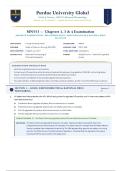
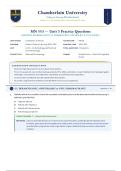
Purdue University Global
4–1 .HC • 355NM
★ ★
P School of Nursing · MN553 Advanced Pharmacology
M A K I N G T H E D I F F E R E N C E · C A R E E R- O R I E N T E D H I G H E R E D U C AT I O N
EST. 1998
MN553 — Chapters 1, 3 & 4 Examination
A D VA N C E D P H A R M A CO LO G Y: P R E S C R I B I N G R O L E S , D R U G R E G U L AT I O N & R AT I O N A L D R U G
SELECTION
INSTITUTION Purdue University Global COURSE CODE MN553
PROGRAM Master of Science in Nursing (MSN-FNP) ACADEMIC YEAR
EXAM CHAPTERS Chapters 1, 3, and 4 TOTAL QUESTIONS 25 Questions
COURSE TITLE Advanced Pharmacology & FORMAT Multiple Choice — Select the Single Best
Pharmacotherapeutics Answer
EXAMINATION INSTRUCTIONS
▸ Select the single best answer for each question.
▸ Content covers NP prescriptive authority, rational drug prescribing process, drug regulation (FDA, DEA), clinical drug testing
phases, controlled substances, and pharmacokinetic/pharmacodynamic principles.
▸ Correct answers and detailed clinical rationales appear below each question.
▸ Pay careful attention to federal legislation dates, controlled substance schedules, and the "I Can PresCribE A Drug" mnemonic.
SECTION I — ROLES, RESPONSIBILITIES & RATIONAL DRUG Questions 1 –
PRESCRIBING 25
1. All states have title protection for NPs. Which body primarily regulates NP practice, and in how many states do NPs
have total autonomy?
A. The Medical Board regulates all states; NPs are autonomous in 5 states.
B. The Board of Nursing regulates practice; NPs are totally autonomous in 26 states.
C. The FDA regulates NP practice; NPs are autonomous in all 50 states.
D. The DEA regulates NP practice; NPs are autonomous in 21 states.
CORRECT ANSWER B — The Board of Nursing regulates practice; NPs are totally autonomous in 26 states.
RATIONALE The Board of Nursing regulates NP practice in all states. Twenty-six states have total NP autonomy
(independent practice without physician oversight). Five states have joint oversight with the Medical Board.
Twenty-one states have independent prescribing. The FDA regulates drug approval and safety, not nursing
practice. The DEA enforces controlled substance regulations. Understanding the regulatory landscape is
essential for NPs to practice within their legal scope.
, 2. The "I Can PresCribE A Drug" mnemonic guides rational drug selection. What does the "C" stand for in this
mnemonic?
A. Contraindications
B. Cost/Compliance
C. Clinical trials
D. Controlled substances
CORRECT ANSWER B — Cost/Compliance
RATIONALE The "I Can PresCribE A Drug" mnemonic stands for: Indication, Contraindications, Precautions,
Cost/Compliance, Efficacy, Adverse effects, Dose/Duration/Direction. "Cost/Compliance" reminds the
prescriber to consider both the financial burden of the medication and the patient's ability and willingness to
adhere to the prescribed regimen. Poor adherence contributes to worsening disease, hospital admissions,
and death. Patient education should be at the 5th or 6th grade level.
3. The process of rational drug prescribing includes six steps. Which of the following is the correct first step?
A. Choose the treatment using evidence-based guidelines.
B. Specify the therapeutic objective or goal of treatment.
C. Define the patient's problem — assess, develop differential diagnosis, and confirm with diagnostic tests.
D. Educate the patient about the purpose, administration, and ADRs of the medication.
CORRECT ANSWER C — Define the patient's problem — assess, develop differential diagnosis, and confirm with diagnostic
tests.
RATIONALE The six steps of rational drug prescribing in order are: (1) Define the patient's problem — assess, develop
working and differential diagnosis, use diagnostic tests to confirm; (2) Specify the therapeutic objective; (3)
Collaborate with the patient; (4) Choose the treatment; (5) Educate the patient; (6) Monitor effectiveness.
Early screening of high-risk patients maximizes the benefit of pharmacological treatment. The process always
begins with accurate diagnosis before any therapeutic decision.
4. Which type of drug monitoring involves follow-up laboratory tests or measurements to assess therapeutic
effectiveness?
A. Passive monitoring — patient is educated and instructed to contact provider
B. Active monitoring — follow-up labs or testing to measure therapeutic effectiveness
C. Retrospective monitoring — reviewing outcomes after treatment completion
D. Observational monitoring — watching for visible signs of efficacy
CORRECT ANSWER B — Active monitoring — follow-up labs or testing to measure therapeutic effectiveness
RATIONALE Active monitoring involves follow-up laboratory tests or specific measurements to assess therapeutic
effectiveness (e.g., checking HbA1c after starting a diabetes medication, monitoring INR on warfarin). Passive
monitoring educates the patient on expected outcomes and instructs them to contact the provider if issues
arise, but does not involve scheduled testing. Both are important components of the "Monitor Effectiveness"
step of rational drug prescribing.
4–1 .HC • 355NM
★ ★
P School of Nursing · MN553 Advanced Pharmacology
M A K I N G T H E D I F F E R E N C E · C A R E E R- O R I E N T E D H I G H E R E D U C AT I O N
EST. 1998
MN553 — Chapters 1, 3 & 4 Examination
A D VA N C E D P H A R M A CO LO G Y: P R E S C R I B I N G R O L E S , D R U G R E G U L AT I O N & R AT I O N A L D R U G
SELECTION
INSTITUTION Purdue University Global COURSE CODE MN553
PROGRAM Master of Science in Nursing (MSN-FNP) ACADEMIC YEAR
EXAM CHAPTERS Chapters 1, 3, and 4 TOTAL QUESTIONS 25 Questions
COURSE TITLE Advanced Pharmacology & FORMAT Multiple Choice — Select the Single Best
Pharmacotherapeutics Answer
EXAMINATION INSTRUCTIONS
▸ Select the single best answer for each question.
▸ Content covers NP prescriptive authority, rational drug prescribing process, drug regulation (FDA, DEA), clinical drug testing
phases, controlled substances, and pharmacokinetic/pharmacodynamic principles.
▸ Correct answers and detailed clinical rationales appear below each question.
▸ Pay careful attention to federal legislation dates, controlled substance schedules, and the "I Can PresCribE A Drug" mnemonic.
SECTION I — ROLES, RESPONSIBILITIES & RATIONAL DRUG Questions 1 –
PRESCRIBING 25
1. All states have title protection for NPs. Which body primarily regulates NP practice, and in how many states do NPs
have total autonomy?
A. The Medical Board regulates all states; NPs are autonomous in 5 states.
B. The Board of Nursing regulates practice; NPs are totally autonomous in 26 states.
C. The FDA regulates NP practice; NPs are autonomous in all 50 states.
D. The DEA regulates NP practice; NPs are autonomous in 21 states.
CORRECT ANSWER B — The Board of Nursing regulates practice; NPs are totally autonomous in 26 states.
RATIONALE The Board of Nursing regulates NP practice in all states. Twenty-six states have total NP autonomy
(independent practice without physician oversight). Five states have joint oversight with the Medical Board.
Twenty-one states have independent prescribing. The FDA regulates drug approval and safety, not nursing
practice. The DEA enforces controlled substance regulations. Understanding the regulatory landscape is
essential for NPs to practice within their legal scope.
, 2. The "I Can PresCribE A Drug" mnemonic guides rational drug selection. What does the "C" stand for in this
mnemonic?
A. Contraindications
B. Cost/Compliance
C. Clinical trials
D. Controlled substances
CORRECT ANSWER B — Cost/Compliance
RATIONALE The "I Can PresCribE A Drug" mnemonic stands for: Indication, Contraindications, Precautions,
Cost/Compliance, Efficacy, Adverse effects, Dose/Duration/Direction. "Cost/Compliance" reminds the
prescriber to consider both the financial burden of the medication and the patient's ability and willingness to
adhere to the prescribed regimen. Poor adherence contributes to worsening disease, hospital admissions,
and death. Patient education should be at the 5th or 6th grade level.
3. The process of rational drug prescribing includes six steps. Which of the following is the correct first step?
A. Choose the treatment using evidence-based guidelines.
B. Specify the therapeutic objective or goal of treatment.
C. Define the patient's problem — assess, develop differential diagnosis, and confirm with diagnostic tests.
D. Educate the patient about the purpose, administration, and ADRs of the medication.
CORRECT ANSWER C — Define the patient's problem — assess, develop differential diagnosis, and confirm with diagnostic
tests.
RATIONALE The six steps of rational drug prescribing in order are: (1) Define the patient's problem — assess, develop
working and differential diagnosis, use diagnostic tests to confirm; (2) Specify the therapeutic objective; (3)
Collaborate with the patient; (4) Choose the treatment; (5) Educate the patient; (6) Monitor effectiveness.
Early screening of high-risk patients maximizes the benefit of pharmacological treatment. The process always
begins with accurate diagnosis before any therapeutic decision.
4. Which type of drug monitoring involves follow-up laboratory tests or measurements to assess therapeutic
effectiveness?
A. Passive monitoring — patient is educated and instructed to contact provider
B. Active monitoring — follow-up labs or testing to measure therapeutic effectiveness
C. Retrospective monitoring — reviewing outcomes after treatment completion
D. Observational monitoring — watching for visible signs of efficacy
CORRECT ANSWER B — Active monitoring — follow-up labs or testing to measure therapeutic effectiveness
RATIONALE Active monitoring involves follow-up laboratory tests or specific measurements to assess therapeutic
effectiveness (e.g., checking HbA1c after starting a diabetes medication, monitoring INR on warfarin). Passive
monitoring educates the patient on expected outcomes and instructs them to contact the provider if issues
arise, but does not involve scheduled testing. Both are important components of the "Monitor Effectiveness"
step of rational drug prescribing.