

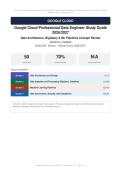
Google Cloud Professional Data Engineer Study Guide 2026/2027 | Data Architecture, BigQuery & ML Pipelines Concept Review | Questions | Updated
2026/2027 | Page 1 | Passing Score: 70%
GOOGLE CLOUD
Google Cloud Professional Data Engineer Study Guide
2026/2027
Data Architecture, BigQuery & ML Pipelines Concept Review
Questions | Updated
2026/2027 Edition - Official Exam 2026/2027
50 70% N/A
QUESTIONS PASSING SCORE RECERTIFICATION
TABLE OF CONTENTS
Section 1 Data Architecture and Design Q1-13
Section 2 Data Ingestion and Processing (BigQuery, Dataflow) Q14-26
Section 3 Machine Learning Pipelines Q27-39
Section 4 Data Governance, Security, and Compliance Q40-50
Instructions: Select the single best answer for each question. This exam is designed for Google Cloud Professional Data Engineer
certification preparation. Passing score: 70% (35 questions correct).
Google Cloud Data Engineer -- 2026/2027 | Passing Score: 70% | Page 1 of 29
, SECTION 1 | Data Architecture and Design | Q1-Q13 | Google Cloud Data Engineer 2026/2027
Q1 Question 1 of 50
A retail company is migrating its on-premises data warehouse to Google Cloud and needs to design a
lakehouse architecture that supports both batch and streaming workloads. The data science team requires
direct SQL access to raw files for exploratory analysis, while the BI team needs curated tables with sub-second
query latency. Which architecture approach best meets both requirements?
A. Store raw files in Cloud Storage and create BigQuery external tables for data science, then use
BigQuery native tables with materialized views for BI dashboards
B. Use Cloud SQL for both raw exploratory queries and BI dashboards with read replicas to handle the different
access patterns
C. Load all data into BigQuery native tables and use row-level security policies to separate data science and BI
access patterns
D. Store raw data in Cloud Spanner and use Dataflow to stream curated results into BigQuery for BI
consumption
Correct Answer: A
Rationale:
External tables on Cloud Storage give data scientists direct SQL access to raw files without duplication, while native
tables with materialized views deliver the sub-second BI performance required. Cloud SQL (B) lacks BigQuery's
analytical scale. Row-level security (C) does not address the raw-vs-curated distinction. Cloud Spanner (D) is an OLTP
database unsuitable for analytical lakehouse workloads.
Q2 Question 2 of 50
A financial services firm processes 2 TB of transaction data daily and must design a storage strategy that
minimizes cost while keeping the most recent 90 days of data immediately queryable. Historical data older than
90 days must remain accessible within seconds but is queried infrequently. Which combination of BigQuery
features best addresses this requirement?
A. Use BigQuery partitioning by date and set a 90-day partition expiration policy to automatically delete old data,
then reload it from Cloud Storage when needed
B. Store all data in BigQuery with no special configuration and rely on BigQuery's automatic query caching for
infrequently accessed partitions
C. Use BigQuery partitioning by date with clustering on transaction type, and configure a 90-day
partition expiration that moves expired partitions to Cloud Storage via BigQuery object export
D. Create two BigQuery datasets: one for hot data with a 90-day retention policy, and one for cold data loaded
from Cloud Storage external tables using a scheduled query
Correct Answer: C
Rationale:
Partitioning by date with clustering optimizes both cost and query performance for the active 90-day window. Exporting
expired partitions to Cloud Storage and accessing them via external tables preserves second-level access at lower
storage cost. Option A deletes data permanently. Option B does not reduce storage cost for old data. Option D
introduces unnecessary complexity and potential consistency issues between two datasets.
Google Cloud Data Engineer -- 2026/2027 | Passing Score: 70% | Page 2 of 29
, Q3 Question 3 of 50
A healthcare startup needs to build a real-time analytics platform that ingests patient vital signs from IoT
devices at 10,000 events per second. The data must be stored durably, transformed in transit to remove PHI,
and made available for both real-time monitoring dashboards and retrospective ML training. Which end-to-end
design is most appropriate?
A. Ingest via Pub/Sub, transform with Dataflow (streaming), store raw in Cloud Storage for ML, and write
de-identified records to BigQuery for dashboards
B. Ingest via Cloud IoT Core, transform with Cloud Functions, store everything in Cloud SQL, and use Data
Studio for dashboards
C. Ingest via Pub/Sub, write directly to BigQuery using the BigQuery Storage Write API, and use BigQuery ML
for both dashboards and training
D. Ingest via Kafka on GKE, transform with Spark Streaming, store in Cloud Storage, and use Looker for
dashboards
Correct Answer: A
Rationale:
Pub/Sub handles the high-throughput ingestion, Dataflow provides exactly-once streaming transformation for PHI
removal, Cloud Storage durably archives raw data for ML training, and BigQuery powers low-latency dashboards on
de-identified data. Option B lacks scalability for this volume. Option C cannot remove PHI before storage. Option D
introduces unnecessary operational complexity compared to serverless services.
Q4 Question 4 of 50
A media company with 500 TB of video metadata needs to enable cross-regional analytics while respecting
data residency requirements in the EU and US. The EU dataset cannot leave the EU region, and the US
dataset cannot leave the US region, but analysts need to run queries that join both datasets. What is the
recommended architecture?
A. Replicate all data to a single BigQuery multi-region dataset and apply column-level security to restrict access
by user location
B. Use BigQuery Omni to query data in both AWS and Azure regions where the data currently resides
C. Use separate BigQuery datasets in EU and US regions, and leverage BigQuery's cross-cloud and
cross-region capabilities with authorized views and federated queries
D. Store EU data in Cloud Storage EU and US data in Cloud Storage US, then use Dataproc clusters in each
region to process data locally
Correct Answer: C
Rationale:
Separate regional datasets satisfy data residency constraints, and authorized views plus federated queries allow
analysts to join data without physically moving it across regions. Option A violates residency by replicating data to a
single region. Option B addresses multi-cloud but not cross-region joins within GCP. Option D requires custom
orchestration and does not provide SQL-based cross-region joins.
Google Cloud Data Engineer -- 2026/2027 | Passing Score: 70% | Page 3 of 29
2026/2027 | Page 1 | Passing Score: 70%
GOOGLE CLOUD
Google Cloud Professional Data Engineer Study Guide
2026/2027
Data Architecture, BigQuery & ML Pipelines Concept Review
Questions | Updated
2026/2027 Edition - Official Exam 2026/2027
50 70% N/A
QUESTIONS PASSING SCORE RECERTIFICATION
TABLE OF CONTENTS
Section 1 Data Architecture and Design Q1-13
Section 2 Data Ingestion and Processing (BigQuery, Dataflow) Q14-26
Section 3 Machine Learning Pipelines Q27-39
Section 4 Data Governance, Security, and Compliance Q40-50
Instructions: Select the single best answer for each question. This exam is designed for Google Cloud Professional Data Engineer
certification preparation. Passing score: 70% (35 questions correct).
Google Cloud Data Engineer -- 2026/2027 | Passing Score: 70% | Page 1 of 29
, SECTION 1 | Data Architecture and Design | Q1-Q13 | Google Cloud Data Engineer 2026/2027
Q1 Question 1 of 50
A retail company is migrating its on-premises data warehouse to Google Cloud and needs to design a
lakehouse architecture that supports both batch and streaming workloads. The data science team requires
direct SQL access to raw files for exploratory analysis, while the BI team needs curated tables with sub-second
query latency. Which architecture approach best meets both requirements?
A. Store raw files in Cloud Storage and create BigQuery external tables for data science, then use
BigQuery native tables with materialized views for BI dashboards
B. Use Cloud SQL for both raw exploratory queries and BI dashboards with read replicas to handle the different
access patterns
C. Load all data into BigQuery native tables and use row-level security policies to separate data science and BI
access patterns
D. Store raw data in Cloud Spanner and use Dataflow to stream curated results into BigQuery for BI
consumption
Correct Answer: A
Rationale:
External tables on Cloud Storage give data scientists direct SQL access to raw files without duplication, while native
tables with materialized views deliver the sub-second BI performance required. Cloud SQL (B) lacks BigQuery's
analytical scale. Row-level security (C) does not address the raw-vs-curated distinction. Cloud Spanner (D) is an OLTP
database unsuitable for analytical lakehouse workloads.
Q2 Question 2 of 50
A financial services firm processes 2 TB of transaction data daily and must design a storage strategy that
minimizes cost while keeping the most recent 90 days of data immediately queryable. Historical data older than
90 days must remain accessible within seconds but is queried infrequently. Which combination of BigQuery
features best addresses this requirement?
A. Use BigQuery partitioning by date and set a 90-day partition expiration policy to automatically delete old data,
then reload it from Cloud Storage when needed
B. Store all data in BigQuery with no special configuration and rely on BigQuery's automatic query caching for
infrequently accessed partitions
C. Use BigQuery partitioning by date with clustering on transaction type, and configure a 90-day
partition expiration that moves expired partitions to Cloud Storage via BigQuery object export
D. Create two BigQuery datasets: one for hot data with a 90-day retention policy, and one for cold data loaded
from Cloud Storage external tables using a scheduled query
Correct Answer: C
Rationale:
Partitioning by date with clustering optimizes both cost and query performance for the active 90-day window. Exporting
expired partitions to Cloud Storage and accessing them via external tables preserves second-level access at lower
storage cost. Option A deletes data permanently. Option B does not reduce storage cost for old data. Option D
introduces unnecessary complexity and potential consistency issues between two datasets.
Google Cloud Data Engineer -- 2026/2027 | Passing Score: 70% | Page 2 of 29
, Q3 Question 3 of 50
A healthcare startup needs to build a real-time analytics platform that ingests patient vital signs from IoT
devices at 10,000 events per second. The data must be stored durably, transformed in transit to remove PHI,
and made available for both real-time monitoring dashboards and retrospective ML training. Which end-to-end
design is most appropriate?
A. Ingest via Pub/Sub, transform with Dataflow (streaming), store raw in Cloud Storage for ML, and write
de-identified records to BigQuery for dashboards
B. Ingest via Cloud IoT Core, transform with Cloud Functions, store everything in Cloud SQL, and use Data
Studio for dashboards
C. Ingest via Pub/Sub, write directly to BigQuery using the BigQuery Storage Write API, and use BigQuery ML
for both dashboards and training
D. Ingest via Kafka on GKE, transform with Spark Streaming, store in Cloud Storage, and use Looker for
dashboards
Correct Answer: A
Rationale:
Pub/Sub handles the high-throughput ingestion, Dataflow provides exactly-once streaming transformation for PHI
removal, Cloud Storage durably archives raw data for ML training, and BigQuery powers low-latency dashboards on
de-identified data. Option B lacks scalability for this volume. Option C cannot remove PHI before storage. Option D
introduces unnecessary operational complexity compared to serverless services.
Q4 Question 4 of 50
A media company with 500 TB of video metadata needs to enable cross-regional analytics while respecting
data residency requirements in the EU and US. The EU dataset cannot leave the EU region, and the US
dataset cannot leave the US region, but analysts need to run queries that join both datasets. What is the
recommended architecture?
A. Replicate all data to a single BigQuery multi-region dataset and apply column-level security to restrict access
by user location
B. Use BigQuery Omni to query data in both AWS and Azure regions where the data currently resides
C. Use separate BigQuery datasets in EU and US regions, and leverage BigQuery's cross-cloud and
cross-region capabilities with authorized views and federated queries
D. Store EU data in Cloud Storage EU and US data in Cloud Storage US, then use Dataproc clusters in each
region to process data locally
Correct Answer: C
Rationale:
Separate regional datasets satisfy data residency constraints, and authorized views plus federated queries allow
analysts to join data without physically moving it across regions. Option A violates residency by replicating data to a
single region. Option B addresses multi-cloud but not cross-region joins within GCP. Option D requires custom
orchestration and does not provide SQL-based cross-region joins.
Google Cloud Data Engineer -- 2026/2027 | Passing Score: 70% | Page 3 of 29


