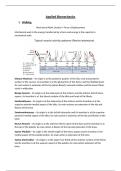
Applied Biomechanics
1. Walking
Mechanical Work (Joules) = Force x Displacement
Mechanical work is the energy transferred by a force and energy is the capacity to
mechanical work.
Gluteus Maximus – Its origin is at the posterior quarter of the iliac crest and posterior
surface of the sacrum. Its insertion is at the gluteal line of the femur and the iliotibial band.
Its main action is extension of the hip (when flexed,) outward rotation and the lower fibres
assist in adduction.
Biceps Femoris – Its origin is at the tuberosity of the ischium and the inferior half of linera
aspera. Its insertion is at the lateral condyle of the tibia and head of the fibula.
Semitendinosus – Its origin is at the tuberosity of the ischium and its insertion is at the
superior-anterior-medial aspect of the tibia. Its main actions are extension of the hip and
flexion of the knee.
Semimembranosus – Its origin is at the ischial tuberosity and its insertion is at the superior-
posterior-medial aspect of the tibia. Its main action is extension of the hip and flexion of the
knee.
Rectus Femoris – Its origin is at the anterior-inferior spine of the ilium and its insertion is at
the top of the patella. Its main action is flexion of the hip and extension of the knee.
Vastus Medialis – Its origin is the whole length of the linera aspera and its insertion is the
medial aspect of the patella tendon. Its main action is extension of the knee.
Vastus Intermedius – Its origin is at the upper two thirds of the anterior surface of the femur
and its insertion is at the superior aspect of the patella. Its main action extension of the
knee.
, Tibialis Anterior – Its origin is at the upper two thirds of the lateral surface of the tibia and
its insertion is at the most medial cunieform bone and 1st metatarsal. Its main actions are
dorsi-flexion and inversion of the foot.
Gastrocnemius – Its origin is at the posterior surface of the femoral condyles and its
insertion is at the achilles tendon. Its main actions are plantar-flexion of the ankle and
flexion of the knee.
Soleus – Its origin is at the proximal two thrids of the posterior surface of the tibia and
fibula. Its main action is plantar flexion of the ankle.
Iliopsoas – Its origin is at the inner surface of the ilium, base of the sacrum and the sides of
the bodies of the lower vertebrae. Its insertion is at the lesser trochanter of the femur and
shaft below. Its main action is flexion, outward rotation and lumbar flexion.
Locomotion – fundamentally, locomotion is the translation of the centre of gravity through
space along a pathway requiring the least expenditure of energy.
“Minimising the amount that the bodies centre of gravity is displaced from the line of
progression is the major mechanism for reducing the muscular effort of walking, and
consequently, saving energy.”
Soft yielding substratum such as sand has a profound effect on the mechanics and energetics
of locomotion. Walking on sand requires 2.1-2.7 times more energy expenditure than
walking on a hard surface at the same speed. The increase is caused by mechanical work
done on the sand and a decrease in the efficiency of positive work done by the muscles and
tendons.
Inverse dynamics is a method for computing joint forces and moments of forces (torques)
using kinematics and kinetic data. It can also derive the minimum forces and moments
responsible individual movements.
The moment we obtain from inverse dynamics tells us the active muscle group and the
moment (torque) created by the muscle group.
Joint power = joint moment x angular velocity of the joint.
If the joint is not moving, the angular velocity, and therefore the power, will be zero. If it is
moving in the direction of the muscle contraction, the power will be positive, corresponding
to concentric contraction of the muscle. If the joint is rotating away from the direction in
which the muscle is pulling, the power will be negative, denoting an eccentric contraction.
1. Walking
Mechanical Work (Joules) = Force x Displacement
Mechanical work is the energy transferred by a force and energy is the capacity to
mechanical work.
Gluteus Maximus – Its origin is at the posterior quarter of the iliac crest and posterior
surface of the sacrum. Its insertion is at the gluteal line of the femur and the iliotibial band.
Its main action is extension of the hip (when flexed,) outward rotation and the lower fibres
assist in adduction.
Biceps Femoris – Its origin is at the tuberosity of the ischium and the inferior half of linera
aspera. Its insertion is at the lateral condyle of the tibia and head of the fibula.
Semitendinosus – Its origin is at the tuberosity of the ischium and its insertion is at the
superior-anterior-medial aspect of the tibia. Its main actions are extension of the hip and
flexion of the knee.
Semimembranosus – Its origin is at the ischial tuberosity and its insertion is at the superior-
posterior-medial aspect of the tibia. Its main action is extension of the hip and flexion of the
knee.
Rectus Femoris – Its origin is at the anterior-inferior spine of the ilium and its insertion is at
the top of the patella. Its main action is flexion of the hip and extension of the knee.
Vastus Medialis – Its origin is the whole length of the linera aspera and its insertion is the
medial aspect of the patella tendon. Its main action is extension of the knee.
Vastus Intermedius – Its origin is at the upper two thirds of the anterior surface of the femur
and its insertion is at the superior aspect of the patella. Its main action extension of the
knee.
, Tibialis Anterior – Its origin is at the upper two thirds of the lateral surface of the tibia and
its insertion is at the most medial cunieform bone and 1st metatarsal. Its main actions are
dorsi-flexion and inversion of the foot.
Gastrocnemius – Its origin is at the posterior surface of the femoral condyles and its
insertion is at the achilles tendon. Its main actions are plantar-flexion of the ankle and
flexion of the knee.
Soleus – Its origin is at the proximal two thrids of the posterior surface of the tibia and
fibula. Its main action is plantar flexion of the ankle.
Iliopsoas – Its origin is at the inner surface of the ilium, base of the sacrum and the sides of
the bodies of the lower vertebrae. Its insertion is at the lesser trochanter of the femur and
shaft below. Its main action is flexion, outward rotation and lumbar flexion.
Locomotion – fundamentally, locomotion is the translation of the centre of gravity through
space along a pathway requiring the least expenditure of energy.
“Minimising the amount that the bodies centre of gravity is displaced from the line of
progression is the major mechanism for reducing the muscular effort of walking, and
consequently, saving energy.”
Soft yielding substratum such as sand has a profound effect on the mechanics and energetics
of locomotion. Walking on sand requires 2.1-2.7 times more energy expenditure than
walking on a hard surface at the same speed. The increase is caused by mechanical work
done on the sand and a decrease in the efficiency of positive work done by the muscles and
tendons.
Inverse dynamics is a method for computing joint forces and moments of forces (torques)
using kinematics and kinetic data. It can also derive the minimum forces and moments
responsible individual movements.
The moment we obtain from inverse dynamics tells us the active muscle group and the
moment (torque) created by the muscle group.
Joint power = joint moment x angular velocity of the joint.
If the joint is not moving, the angular velocity, and therefore the power, will be zero. If it is
moving in the direction of the muscle contraction, the power will be positive, corresponding
to concentric contraction of the muscle. If the joint is rotating away from the direction in
which the muscle is pulling, the power will be negative, denoting an eccentric contraction.