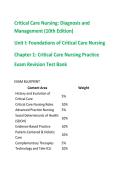
Critical Care Nursing
10th Edition
Author(s)Linda D. Urden;
Kathleen M. Stacy; Mary E.
Lough; Kimberly Sanchez
Critical Care Nursing: Diagnosis and Management, 10th
Edition
Unit I – Foundations of Critical Care Nursing
Exam Revision Test Bank (20 Questions)
,Critical Care Nursing Test Bank (20 Questions)
Unit I: Foundations of Critical Care Nursing
Unit I. Foundations of Critical Care Nursing – Exam Revision Test Bank
(20 Questions)
Question 1
Type: MCQ
Bloom Level: Recall
Which statement best describes the primary purpose for the development of modern critical care
units?
A. To reduce hospital costs through centralized care
B. To provide specialized monitoring and treatment for critically ill patients
C. To improve outpatient management of chronic diseases
D. To replace medical-surgical nursing units
Correct Answer: B
Rationale:
Critical care units were developed to provide concentrated expertise, advanced monitoring, and
specialized therapies for patients with life-threatening conditions.
Distractor Analysis:
A: Cost reduction was not the primary reason.
C: Critical care focuses on acute illness rather than outpatient management.
D: ICUs complement rather than replace general units.
Difficulty: Easy
Learning Objective: Describe the historical development of critical care nursing.
Chapter Reference: Critical Care Nursing Practice
Clinical Significance: Understanding ICU evolution supports appreciation of specialized
nursing roles.
,Question 2
Type: MCQ
Bloom Level: Recall
Which professional organization is most specifically dedicated to advancing excellence in
critical care nursing practice?
A. American Nurses Association (ANA)
B. National League for Nursing (NLN)
C. American Association of Critical-Care Nurses (AACN)
D. Sigma Theta Tau
Correct Answer: C
Rationale:
AACN focuses specifically on critical care nursing standards, education, certification, and
advocacy.
Distractor Analysis:
A: Represents all nursing specialties.
B: Focuses on nursing education.
D: Nursing honor society.
Difficulty: Easy
Learning Objective: Identify major professional organizations supporting critical care nursing.
Chapter Reference: Critical Care Professional Organizations
Clinical Significance: Professional engagement promotes evidence-based practice and lifelong
learning.
Question 3
Type: SATA
Bloom Level: Comprehension
Which factors are driving the increased emphasis on evidence-based practice (EBP)? Select all
that apply.
A. Improved patient outcomes
B. Rising healthcare costs
, C. Regulatory requirements
D. Availability of research evidence
E. Elimination of clinical judgment
Correct Answers: A, B, C, D
Rationale:
EBP is driven by quality improvement initiatives, cost containment, regulatory expectations, and
expanding scientific evidence.
Distractor Analysis:
E: EBP incorporates—not eliminates—clinical judgment.
Difficulty: Moderate
Learning Objective: Explain factors promoting evidence-based nursing practice.
Chapter Reference: Evidence-Based Nursing Practice
Clinical Significance: EBP improves safety, quality, and consistency of care.
Question 4
Type: MCQ
Bloom Level: Comprehension
Which statement best reflects patient-centered care in the ICU?
A. Standardizing treatment regardless of patient preferences
B. Allowing providers to make decisions without family input
C. Respecting patient values, beliefs, and goals during care planning
D. Limiting communication to prevent emotional distress
Correct Answer: C
Rationale:
Patient-centered care integrates patient preferences and values into decision-making.
Distractor Analysis:
A: Opposite of individualized care.
B: Excludes important stakeholders.
D: Communication is essential.
10th Edition
Author(s)Linda D. Urden;
Kathleen M. Stacy; Mary E.
Lough; Kimberly Sanchez
Critical Care Nursing: Diagnosis and Management, 10th
Edition
Unit I – Foundations of Critical Care Nursing
Exam Revision Test Bank (20 Questions)
,Critical Care Nursing Test Bank (20 Questions)
Unit I: Foundations of Critical Care Nursing
Unit I. Foundations of Critical Care Nursing – Exam Revision Test Bank
(20 Questions)
Question 1
Type: MCQ
Bloom Level: Recall
Which statement best describes the primary purpose for the development of modern critical care
units?
A. To reduce hospital costs through centralized care
B. To provide specialized monitoring and treatment for critically ill patients
C. To improve outpatient management of chronic diseases
D. To replace medical-surgical nursing units
Correct Answer: B
Rationale:
Critical care units were developed to provide concentrated expertise, advanced monitoring, and
specialized therapies for patients with life-threatening conditions.
Distractor Analysis:
A: Cost reduction was not the primary reason.
C: Critical care focuses on acute illness rather than outpatient management.
D: ICUs complement rather than replace general units.
Difficulty: Easy
Learning Objective: Describe the historical development of critical care nursing.
Chapter Reference: Critical Care Nursing Practice
Clinical Significance: Understanding ICU evolution supports appreciation of specialized
nursing roles.
,Question 2
Type: MCQ
Bloom Level: Recall
Which professional organization is most specifically dedicated to advancing excellence in
critical care nursing practice?
A. American Nurses Association (ANA)
B. National League for Nursing (NLN)
C. American Association of Critical-Care Nurses (AACN)
D. Sigma Theta Tau
Correct Answer: C
Rationale:
AACN focuses specifically on critical care nursing standards, education, certification, and
advocacy.
Distractor Analysis:
A: Represents all nursing specialties.
B: Focuses on nursing education.
D: Nursing honor society.
Difficulty: Easy
Learning Objective: Identify major professional organizations supporting critical care nursing.
Chapter Reference: Critical Care Professional Organizations
Clinical Significance: Professional engagement promotes evidence-based practice and lifelong
learning.
Question 3
Type: SATA
Bloom Level: Comprehension
Which factors are driving the increased emphasis on evidence-based practice (EBP)? Select all
that apply.
A. Improved patient outcomes
B. Rising healthcare costs
, C. Regulatory requirements
D. Availability of research evidence
E. Elimination of clinical judgment
Correct Answers: A, B, C, D
Rationale:
EBP is driven by quality improvement initiatives, cost containment, regulatory expectations, and
expanding scientific evidence.
Distractor Analysis:
E: EBP incorporates—not eliminates—clinical judgment.
Difficulty: Moderate
Learning Objective: Explain factors promoting evidence-based nursing practice.
Chapter Reference: Evidence-Based Nursing Practice
Clinical Significance: EBP improves safety, quality, and consistency of care.
Question 4
Type: MCQ
Bloom Level: Comprehension
Which statement best reflects patient-centered care in the ICU?
A. Standardizing treatment regardless of patient preferences
B. Allowing providers to make decisions without family input
C. Respecting patient values, beliefs, and goals during care planning
D. Limiting communication to prevent emotional distress
Correct Answer: C
Rationale:
Patient-centered care integrates patient preferences and values into decision-making.
Distractor Analysis:
A: Opposite of individualized care.
B: Excludes important stakeholders.
D: Communication is essential.