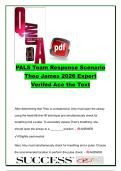
Prepare for Pediatric Advanced Life Support (PALS) certification and emergency response examinations with this comprehensive Theo James Team Response Scenario study guide featuring over 15 scenario-based questions and expert-verified answers. This resource focuses on the recognition and management of pediatric cardiac arrest, emphasizing high-quality CPR, airway management, pulse assessment, AED application, bag-mask ventilation (BVM), team-based resuscitation, and return of spontaneous circulation (ROSC). The content follows current American Heart Association (AHA) Pediatric Advanced Life Support recommendations and provides step-by-step guidance on critical interventions required during pediatric emergencies.
Key concepts covered include pediatric basic life support assessment, head-tilt/chin-lift airway positioning, carotid pulse evaluation, recognition of poor perfusion, initiation of CPR for symptomatic bradycardia, chest compression depth and technique, single-provider and multiple-provider CPR ratios, AED pad placement strategies, team role transitions during resuscitation, two-person bag-mask ventilation techniques, effective chest compressions, pediatric cardiac arrest algorithms, and indications for discontinuing CPR. Students will strengthen their understanding of evidence-based pediatric resuscitation practices, emergency teamwork, and rapid decision-making in life-threatening clinical situations.
This study material aligns with the latest American Heart Association Pediatric Advanced Life Support (PALS) Guidelines and Pediatric Basic Life Support (PBLS) recommendations. Current evidence demonstrates that rapid recognition of cardiac arrest, early initiation of high-quality CPR, effective ventilation, prompt AED use, and coordinated team performance significantly improve survival rates and neurological outcomes in pediatric patients experiencing cardiopulmonary emergencies (American Heart Association, 2025; Berg et al., Pediatric Resuscitation Guidelines).
This resource is ideal for nursing students, BSN students, ADN students, pediatric nurses, emergency department nurses, critical care nurses, paramedic students, respiratory therapy students, EMS professionals, medical students, PALS certification candidates, ACLS certification candidates, nurse residency participants, pediatric healthcare providers, and healthcare professionals preparing for emergency response and resuscitation examinations.
References:
American Heart Association. (2025). Pediatric Advanced Life Support (PALS) Provider Manual.
American Heart Association. (2025). Guidelines for Cardiopulmonary Resuscitation and Emergency Cardiovascular Care.
Berg, M. D., Atkins, D. L., de Caen, A. R., et al. Pediatric Basic Life Support and Cardiopulmonary Resuscitation Quality Guidelines.
American Academy of Pediatrics. Pediatric Emergency Assessment and Resuscitation Standards.
Keywords
PALS, PALS Team Response Scenario, Theo James, pediatric advanced life support, pediatric CPR, pediatric cardiac arrest, child CPR, pediatric resuscitation, pediatric emergency care, high quality CPR, chest compressions, compression depth, compression ventilation ratio, 30 to 2 ratio, 15 to 2 ratio, pediatric bradycardia, poor perfusion, pulse assessment, carotid pulse, airway management, head tilt chin lift, bag mask ventilation, BVM ventilation, AED pediatric use, AED pad placement, anterior posterior placement, pediatric life support, return of spontaneous circulation, ROSC, pediatric emergency nursing, emergency response team, resuscitation team, pediatric nursing, critical care nursing, emergency nursing, PALS certification, ACLS pediatric concepts, EMS training, paramedic education, nursing exam questions, pediatric emergency medicine, healthcare provider certification, pediatric advanced resuscitation
Content preview
PALS Team Response Scenario
Theo James 2026 Expert
Verifed Ace the Text
After determining that Theo is unresponsive, Amy must open the airway
using the head-tilt/chin-lift technique and simultaneously check for
breathing and a pulse. To accurately assess Theo's breathing, she
should open the airway to a ________ position. - ANSWER
✔✔Slightly past-neutral
Next, Amy must simultaneously check for breathing and a pulse. Choose
the recommended location to perform the pulse check. - ANSWER