

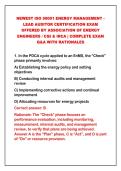
NEWEST ISO 50001 ENERGY MANAGEMENT -
LEAD AUDITOR CERTIFICATION EXAM
OFFERED BY ASSOCIATION OF ENERGY
ENGINEERS / CQI & IRCA | COMPLETE EXAM
Q&A WITH RATIONALES
1. In the PDCA cycle applied to an EnMS, the “Check”
phase primarily involves:
A) Establishing the energy policy and setting
objectives
B) Conducting internal audits and management
review
C) Implementing corrective actions and continual
improvement
D) Allocating resources for energy projects
Correct answer: B
Rationale: The “Check” phase focuses on
performance evaluation, including monitoring,
measurement, internal audits, and management
review, to verify that plans are being achieved.
Answer A is the “Plan” phase, C is “Act”, and D is part
of “Do” or resource provision.
,2. Which clause of ISO 50001 requires top
management to assign responsibility for the energy
management team and ensure the EnMS meets
requirements?
A) Clause 4.1 – Understanding the organization and
its context
B) Clause 5.3 – Organizational roles, responsibilities,
and authorities
C) Clause 6.2 – Energy objectives and planning
D) Clause 7.1 – Resources
Correct answer: B
Rationale: Clause 5.3 requires top management to
assign responsibilities and authorities, including
those for the energy management team, to ensure the
EnMS conforms to ISO 50001 requirements.
3. During a Stage 1 audit, the lead auditor is most
likely to:
A) Review documented information for conformity to
ISO 50001 requirements
B) Conduct detailed on-site verification of operational
controls for SEUs
C) Interview all employees about energy awareness
,D) Witness real-time energy consumption data
collection
Correct answer: A
Rationale: Stage 1 audits focus on reviewing the
organization’s documented information to assess its
readiness for Stage 2, including conformity with ISO
50001, verification of scope, and adequacy of
planning.
4. A manufacturing organization has identified its
compressed air system as a Significant Energy Use
(SEU). Which of the following pieces of objective
evidence would provide the strongest confirmation
that the EnMS is effectively controlling this SEU?
A) An operator logbook recording daily start and stop
times
B) A documented procedure for maintenance of the
compressor, supported by completed maintenance
records and leakage inspection logs
C) A statement from the maintenance manager that
the system “seems efficient”
D) A copy of the original purchase specification for
the compressor
Correct answer: B
, Rationale: Clause 8.1 requires operational planning
and control of SEUs. Documented procedures with
evidence of maintenance and inspection provide
objective evidence of control. A logbook alone is
insufficient; a statement is not objective evidence;
the purchase specification does not demonstrate
current control.
5. An organization’s energy policy includes a
commitment to “improve energy performance.”
However, during the Stage 2 audit, the lead auditor
notes that no energy baseline (EnB) or energy
performance indicator (EnPI) has been established.
According to ISO 50001:2018, what is the most
appropriate classification for this finding?
A) Major nonconformity, because without an EnB and
EnPI, the organization cannot demonstrate whether
energy performance has improved, which is the core
requirement of the EnMS
B) Minor nonconformity, because the organization
can establish EnB and EnPI after the audit
C) Observation, because the policy does not require
supporting metrics
D) Not a nonconformity, because the policy
commitment is aspirational and not binding
Correct answer: A
LEAD AUDITOR CERTIFICATION EXAM
OFFERED BY ASSOCIATION OF ENERGY
ENGINEERS / CQI & IRCA | COMPLETE EXAM
Q&A WITH RATIONALES
1. In the PDCA cycle applied to an EnMS, the “Check”
phase primarily involves:
A) Establishing the energy policy and setting
objectives
B) Conducting internal audits and management
review
C) Implementing corrective actions and continual
improvement
D) Allocating resources for energy projects
Correct answer: B
Rationale: The “Check” phase focuses on
performance evaluation, including monitoring,
measurement, internal audits, and management
review, to verify that plans are being achieved.
Answer A is the “Plan” phase, C is “Act”, and D is part
of “Do” or resource provision.
,2. Which clause of ISO 50001 requires top
management to assign responsibility for the energy
management team and ensure the EnMS meets
requirements?
A) Clause 4.1 – Understanding the organization and
its context
B) Clause 5.3 – Organizational roles, responsibilities,
and authorities
C) Clause 6.2 – Energy objectives and planning
D) Clause 7.1 – Resources
Correct answer: B
Rationale: Clause 5.3 requires top management to
assign responsibilities and authorities, including
those for the energy management team, to ensure the
EnMS conforms to ISO 50001 requirements.
3. During a Stage 1 audit, the lead auditor is most
likely to:
A) Review documented information for conformity to
ISO 50001 requirements
B) Conduct detailed on-site verification of operational
controls for SEUs
C) Interview all employees about energy awareness
,D) Witness real-time energy consumption data
collection
Correct answer: A
Rationale: Stage 1 audits focus on reviewing the
organization’s documented information to assess its
readiness for Stage 2, including conformity with ISO
50001, verification of scope, and adequacy of
planning.
4. A manufacturing organization has identified its
compressed air system as a Significant Energy Use
(SEU). Which of the following pieces of objective
evidence would provide the strongest confirmation
that the EnMS is effectively controlling this SEU?
A) An operator logbook recording daily start and stop
times
B) A documented procedure for maintenance of the
compressor, supported by completed maintenance
records and leakage inspection logs
C) A statement from the maintenance manager that
the system “seems efficient”
D) A copy of the original purchase specification for
the compressor
Correct answer: B
, Rationale: Clause 8.1 requires operational planning
and control of SEUs. Documented procedures with
evidence of maintenance and inspection provide
objective evidence of control. A logbook alone is
insufficient; a statement is not objective evidence;
the purchase specification does not demonstrate
current control.
5. An organization’s energy policy includes a
commitment to “improve energy performance.”
However, during the Stage 2 audit, the lead auditor
notes that no energy baseline (EnB) or energy
performance indicator (EnPI) has been established.
According to ISO 50001:2018, what is the most
appropriate classification for this finding?
A) Major nonconformity, because without an EnB and
EnPI, the organization cannot demonstrate whether
energy performance has improved, which is the core
requirement of the EnMS
B) Minor nonconformity, because the organization
can establish EnB and EnPI after the audit
C) Observation, because the policy does not require
supporting metrics
D) Not a nonconformity, because the policy
commitment is aspirational and not binding
Correct answer: A


