

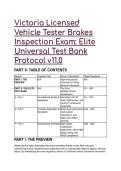
Victoria Licensed
Vehicle Tester Brakes
Inspection Exam: Elite
Universal Test Bank
Protocol v11.0
PART 0: TABLE OF CONTENTS
Section Cognitive Tier Focus / Description Target Questions
PART I: THE N/A High-Instructional N/A
PREVIEW Overview & Critical
Axioms Framework
PART II: THE ELITE N/A The Core Q1 – Q60
TEST BANK Multiple-Choice
Assessment
├─ Tier 1 Foundational Syntax & Hard-deck VSI 26 Q1 – Q15
Application limits, ADR syntax, and
core LVT component
constraints
├─ Tier 2 Complex Application & Brake thermodynamics, Q16 – Q35
Simulation multi-system
interactions, and
edge-case defect
analysis
└─ Tier 3 Grandmaster Synthesis High-stakes Q36 – Q60
modification
diagnostics, heavy-light
trailer towing, and
VASS compliance
PART I: THE PREVIEW
Mastering this highly specialized test bank translates directly to elite field execution,
transforming routine roadworthiness inspections into an impenetrable defense against vehicular
failure. By internalizing the exact regulatory metrics of VicRoads Vehicle Standards Information
,26 (VSI 26), the practitioner replaces subjective guesswork with calibrated, legally defensible
analytical precision.
The "Critical Axioms" Cheat Sheet
● The Deceleration Hard Deck (Table 1): For light vehicles under 2.5 tonnes GVM, the
absolute minimum average deceleration is 3.8 m/s² (0.39g), and peak is 5.8 m/s² (0.59g).
For vehicles 2.5 to 4.5 tonnes GVM, the minimum average is 2.8 m/s² (0.29g), and peak
is 4.4 m/s² (0.45g).
● The 1.0mm Friction Baseline: If a brake pad lacks an OEM wear indicator and no
manufacturer data is available, the absolute minimum useable thickness of the lining
material at its thinnest point is 1.0mm.
● The Fluid Dampness Exception: Active brake fluid dripping or severe contamination is a
critical failure; however, minor fluid dampness behind a hydraulic cylinder boot is strictly
classified as acceptable and cannot independently trigger a rejection.
● The Gradient Anchor Rule: The parking brake must independently hold the loaded or
unloaded vehicle stationary on a 12% gradient on a dry, smooth surface.
● The Electronic Gatekeeper: If a vehicle is originally manufactured with an Anti-lock
Braking System (ABS) or Electronic Stability Control (ESC), the system must operate
flawlessly. Any persistent illumination of the system's warning light constitutes an
immediate failure.
PART II: THE ELITE TEST BANK
Q1: A Licensed Vehicle Tester (LVT) is inspecting a 2.1-tonne passenger vehicle. The inspector
removes the front wheels and notes that the brake pads do not possess OEM wear indicators.
The inspector cannot locate the manufacturer's minimum specification in the workshop
database. Based on VSI 26, what is the MOST ACCURATE minimum thickness threshold for
the remaining brake lining? A) The lining must be rejected if it measures below 1.5mm at its
thickest point. B) The lining is acceptable provided the backing plate is not contacting the rotor.
C) The lining must measure no less than 1.0mm of useable thickness at any point. D) The lining
must be automatically rejected without the manufacturer's specifications.
● The Answer: C (The lining must measure no less than 1.0mm of useable thickness at
any point.)
● Distractor Analysis:
○ A is incorrect: The 1.5mm measurement is a common novice confusion with
minimum tire tread depth, not brake linings.
○ B is incorrect: Allowing the pad to run down until metal-to-metal contact is a
catastrophic safety violation and fundamentally ignores regulatory minimums.
○ D is incorrect: VSI 26 provides a specific fallback statutory limit precisely to prevent
testers from rejecting vehicles simply because older OEM data is unavailable.
The Mentor's Analysis: Regulatory frameworks provide hard safety floors when OEM data
vanishes. When assessing friction material without direct guidance, the immediate priority is
verifying the statutory minimum. By utilizing the 1.0mm Friction Baseline, the practitioner
bypasses the common trap of either arbitrarily failing a safe vehicle or passing a dangerously
thin pad. Professional/Academic Intuition: When in doubt, the 1.0mm limit is your statutory
safety net for undocumented friction linings.
,Q2: During the hydraulic inspection of a 2015 light commercial van, the LVT peels back the dust
boot on the rear left wheel cylinder. The inspector observes slight brake fluid dampness inside
the boot, but there is no active dripping, and the brake shoes are completely dry. Based on the
principles of VSI 26, which action is the MOST APPROPRIATE? A) Immediately issue a major
defect notice and fail the inspection due to hydraulic compromise. B) Pass the cylinder, as
isolated fluid dampness behind the boot is legally acceptable. C) Fail the vehicle but allow the
customer a 7-day exemption to drive it. D) Pass the vehicle only if the brake fluid reservoir is
filled slightly above the maximum line.
● The Answer: B (Pass the cylinder, as isolated fluid dampness behind the boot is legally
acceptable.)
● Distractor Analysis:
○ A is incorrect: While a severe leak is a critical failure, VSI 26 explicitly states that
dampness behind cylinder boots alone is not a cause for rejection.
○ C is incorrect: LVTs do not grant exemptions for hydraulic failures; if it were a true
leak, it would fail outright.
○ D is incorrect: Overfilling a hydraulic reservoir causes expansion locking when hot;
the fluid must simply be at the appropriate level.
The Mentor's Analysis: Not all moisture is a hemorrhage. When inspecting hydraulic seals, the
immediate priority is distinguishing between a catastrophic pressure leak and standard
microscopic seal bypass. By utilizing the Fluid Dampness Exception, the practitioner bypasses
the common trap of over-servicing and failing perfectly functional legacy components.
Professional/Academic Intuition: Dampness is acceptable; dripping is a failure. Never reject a
wheel cylinder for a slightly weeping dust boot.
Q3: A tester is utilizing an approved electronic decelerometer to test a 1.8-tonne GVM
passenger sedan. The vehicle is traveling at 35 km/h on a dry, smooth surface. According to
Table 1 of VSI 26, what are the absolute minimum average and peak deceleration rates required
to pass this specific vehicle? A) Minimum average 2.8 m/s² (0.29g) / Minimum peak 4.4 m/s²
(0.45g) B) Minimum average 4.5 m/s² (0.45g) / Minimum peak 6.0 m/s² (0.61g) C) Minimum
average 3.8 m/s² (0.39g) / Minimum peak 5.8 m/s² (0.59g) D) Minimum average 5.8 m/s² (0.59g)
/ Minimum peak 7.8 m/s² (0.79g)
● The Answer: C (Minimum average 3.8 m/s² (0.39g) / Minimum peak 5.8 m/s² (0.59g))
● Distractor Analysis:
○ A is incorrect: These lower parameters apply only to heavier light vehicles (2.5 to
4.5 tonnes GVM).
○ B is incorrect: This references outdated legacy deceleration metrics that have since
been revised.
○ D is incorrect: This applies the peak requirement as the average requirement,
demanding an impossibly high braking standard.
The Mentor's Analysis: Kinetic energy scales brutally with mass, and regulatory math reflects
this reality. When evaluating light passenger vehicles (under 2.5t), the immediate priority is
verifying the higher baseline braking efficiency. By utilizing the Light Vehicle Deceleration Deck,
the practitioner bypasses the common trap of using heavy-vehicle parameters to improperly
pass a sedan. Professional/Academic Intuition: Vehicles under 2.5t GVM must brake harder
and faster than their heavier counterparts. Memorize the 0.39g/0.59g threshold.
Q4: A 2018 model 4x4 vehicle equipped with Electronic Stability Control (ESC) and ABS is
presented for an inspection. Upon starting the engine, the ESC warning light illuminates and
remains permanently lit. The mechanical brake components are pristine, and the vehicle easily
passes the decelerometer test. What is the MOST ACCURATE conclusion? A) The vehicle
, passes, because ESC does not affect the physical stopping distance. B) The vehicle fails,
because any vehicle fitted with ESC as standard must have the system operating correctly
without a warning light. C) The vehicle passes, provided the driver signs a waiver
acknowledging the electronic fault. D) The vehicle fails, but the LVT is permitted to physically
remove the bulb from the dashboard to rectify the defect.
● The Answer: B (The vehicle fails, because any vehicle fitted with ESC as standard must
have the system operating correctly without a warning light.)
● Distractor Analysis:
○ A is incorrect: VSI 26 strictly mandates that standard-fit ABS/ESC systems must
operate correctly, regardless of base hydraulic performance.
○ C is incorrect: Waivers do not override statutory safety standards.
○ D is incorrect: Removing a warning bulb is a fraudulent circumvention of an active
safety system monitor.
The Mentor's Analysis: Mechanical stopping power does not excuse electronic blindness.
When modern safety architecture is present, the immediate priority is verifying system harmony
via the dash interface. By enforcing the Electronic Gatekeeper rule, the practitioner bypasses
the common trap of ignoring active safety management systems simply because the brake pads
look thick. Professional/Academic Intuition: If the factory built it with a brain, the brain must
be awake. A permanent ESC/ABS light is an instant failure.
Q5: During the road test of a light vehicle, the examiner conducts a heavy braking maneuver at
35 km/h. During the sustained application of the brake pedal, the vehicle violently pulls to the
right, crossing the painted lines of the lane. Based on VSI 26 lane projection rules, what is the
MOST ACCURATE assessment? A) The vehicle passes, provided the total stopping distance
was under 12.5 meters. B) The vehicle fails, as braking must not cause the vehicle to project
outside a 3.7-meter wide lane. C) The vehicle passes, provided the driver can manually wrestle
the steering wheel to keep it centered. D) The vehicle fails, but only if the front right brake rotor
is visibly scored.
● The Answer: B (The vehicle fails, as braking must not cause the vehicle to project
outside a 3.7-meter wide lane.)
● Distractor Analysis:
○ A is incorrect: Exceptional stopping distance is negated if the vehicle careens into
oncoming traffic; spatial stability is mandatory.
○ C is incorrect: The vehicle must brake straight under normal application; it cannot
rely on driver over-correction.
○ D is incorrect: The outcome dictates the failure, regardless of whether the root
cause is a scored rotor or a seized caliper.
The Mentor's Analysis: Braking vectors must remain perfectly linear. When assessing dynamic
deceleration, the immediate priority is lateral stability. By utilizing the 3.7m Lane Projection Limit,
the practitioner bypasses the common trap of passing a vehicle with severe brake imbalance
that happens to meet the raw longitudinal deceleration math. Professional/Academic
Intuition: Stopping fast is useless if you stop in the adjacent lane. The vehicle must brake within
a 3.7m wide footprint.
Q6: An LVT is evaluating the parking brake on a 3.5-tonne GVM light delivery truck. The vehicle
is fully loaded with cargo. According to the strict parameters of VSI 26, the parking brake MUST
be capable of: A) Holding the vehicle stationary on a 15% gradient, but only when unloaded. B)
Holding the loaded vehicle stationary on a 12% gradient on a dry, smooth surface. C)
Decelerating the vehicle from 35 km/h at a rate of 1.5 m/s². D) Completely locking the rear
wheels on a flat, wet surface.
Vehicle Tester Brakes
Inspection Exam: Elite
Universal Test Bank
Protocol v11.0
PART 0: TABLE OF CONTENTS
Section Cognitive Tier Focus / Description Target Questions
PART I: THE N/A High-Instructional N/A
PREVIEW Overview & Critical
Axioms Framework
PART II: THE ELITE N/A The Core Q1 – Q60
TEST BANK Multiple-Choice
Assessment
├─ Tier 1 Foundational Syntax & Hard-deck VSI 26 Q1 – Q15
Application limits, ADR syntax, and
core LVT component
constraints
├─ Tier 2 Complex Application & Brake thermodynamics, Q16 – Q35
Simulation multi-system
interactions, and
edge-case defect
analysis
└─ Tier 3 Grandmaster Synthesis High-stakes Q36 – Q60
modification
diagnostics, heavy-light
trailer towing, and
VASS compliance
PART I: THE PREVIEW
Mastering this highly specialized test bank translates directly to elite field execution,
transforming routine roadworthiness inspections into an impenetrable defense against vehicular
failure. By internalizing the exact regulatory metrics of VicRoads Vehicle Standards Information
,26 (VSI 26), the practitioner replaces subjective guesswork with calibrated, legally defensible
analytical precision.
The "Critical Axioms" Cheat Sheet
● The Deceleration Hard Deck (Table 1): For light vehicles under 2.5 tonnes GVM, the
absolute minimum average deceleration is 3.8 m/s² (0.39g), and peak is 5.8 m/s² (0.59g).
For vehicles 2.5 to 4.5 tonnes GVM, the minimum average is 2.8 m/s² (0.29g), and peak
is 4.4 m/s² (0.45g).
● The 1.0mm Friction Baseline: If a brake pad lacks an OEM wear indicator and no
manufacturer data is available, the absolute minimum useable thickness of the lining
material at its thinnest point is 1.0mm.
● The Fluid Dampness Exception: Active brake fluid dripping or severe contamination is a
critical failure; however, minor fluid dampness behind a hydraulic cylinder boot is strictly
classified as acceptable and cannot independently trigger a rejection.
● The Gradient Anchor Rule: The parking brake must independently hold the loaded or
unloaded vehicle stationary on a 12% gradient on a dry, smooth surface.
● The Electronic Gatekeeper: If a vehicle is originally manufactured with an Anti-lock
Braking System (ABS) or Electronic Stability Control (ESC), the system must operate
flawlessly. Any persistent illumination of the system's warning light constitutes an
immediate failure.
PART II: THE ELITE TEST BANK
Q1: A Licensed Vehicle Tester (LVT) is inspecting a 2.1-tonne passenger vehicle. The inspector
removes the front wheels and notes that the brake pads do not possess OEM wear indicators.
The inspector cannot locate the manufacturer's minimum specification in the workshop
database. Based on VSI 26, what is the MOST ACCURATE minimum thickness threshold for
the remaining brake lining? A) The lining must be rejected if it measures below 1.5mm at its
thickest point. B) The lining is acceptable provided the backing plate is not contacting the rotor.
C) The lining must measure no less than 1.0mm of useable thickness at any point. D) The lining
must be automatically rejected without the manufacturer's specifications.
● The Answer: C (The lining must measure no less than 1.0mm of useable thickness at
any point.)
● Distractor Analysis:
○ A is incorrect: The 1.5mm measurement is a common novice confusion with
minimum tire tread depth, not brake linings.
○ B is incorrect: Allowing the pad to run down until metal-to-metal contact is a
catastrophic safety violation and fundamentally ignores regulatory minimums.
○ D is incorrect: VSI 26 provides a specific fallback statutory limit precisely to prevent
testers from rejecting vehicles simply because older OEM data is unavailable.
The Mentor's Analysis: Regulatory frameworks provide hard safety floors when OEM data
vanishes. When assessing friction material without direct guidance, the immediate priority is
verifying the statutory minimum. By utilizing the 1.0mm Friction Baseline, the practitioner
bypasses the common trap of either arbitrarily failing a safe vehicle or passing a dangerously
thin pad. Professional/Academic Intuition: When in doubt, the 1.0mm limit is your statutory
safety net for undocumented friction linings.
,Q2: During the hydraulic inspection of a 2015 light commercial van, the LVT peels back the dust
boot on the rear left wheel cylinder. The inspector observes slight brake fluid dampness inside
the boot, but there is no active dripping, and the brake shoes are completely dry. Based on the
principles of VSI 26, which action is the MOST APPROPRIATE? A) Immediately issue a major
defect notice and fail the inspection due to hydraulic compromise. B) Pass the cylinder, as
isolated fluid dampness behind the boot is legally acceptable. C) Fail the vehicle but allow the
customer a 7-day exemption to drive it. D) Pass the vehicle only if the brake fluid reservoir is
filled slightly above the maximum line.
● The Answer: B (Pass the cylinder, as isolated fluid dampness behind the boot is legally
acceptable.)
● Distractor Analysis:
○ A is incorrect: While a severe leak is a critical failure, VSI 26 explicitly states that
dampness behind cylinder boots alone is not a cause for rejection.
○ C is incorrect: LVTs do not grant exemptions for hydraulic failures; if it were a true
leak, it would fail outright.
○ D is incorrect: Overfilling a hydraulic reservoir causes expansion locking when hot;
the fluid must simply be at the appropriate level.
The Mentor's Analysis: Not all moisture is a hemorrhage. When inspecting hydraulic seals, the
immediate priority is distinguishing between a catastrophic pressure leak and standard
microscopic seal bypass. By utilizing the Fluid Dampness Exception, the practitioner bypasses
the common trap of over-servicing and failing perfectly functional legacy components.
Professional/Academic Intuition: Dampness is acceptable; dripping is a failure. Never reject a
wheel cylinder for a slightly weeping dust boot.
Q3: A tester is utilizing an approved electronic decelerometer to test a 1.8-tonne GVM
passenger sedan. The vehicle is traveling at 35 km/h on a dry, smooth surface. According to
Table 1 of VSI 26, what are the absolute minimum average and peak deceleration rates required
to pass this specific vehicle? A) Minimum average 2.8 m/s² (0.29g) / Minimum peak 4.4 m/s²
(0.45g) B) Minimum average 4.5 m/s² (0.45g) / Minimum peak 6.0 m/s² (0.61g) C) Minimum
average 3.8 m/s² (0.39g) / Minimum peak 5.8 m/s² (0.59g) D) Minimum average 5.8 m/s² (0.59g)
/ Minimum peak 7.8 m/s² (0.79g)
● The Answer: C (Minimum average 3.8 m/s² (0.39g) / Minimum peak 5.8 m/s² (0.59g))
● Distractor Analysis:
○ A is incorrect: These lower parameters apply only to heavier light vehicles (2.5 to
4.5 tonnes GVM).
○ B is incorrect: This references outdated legacy deceleration metrics that have since
been revised.
○ D is incorrect: This applies the peak requirement as the average requirement,
demanding an impossibly high braking standard.
The Mentor's Analysis: Kinetic energy scales brutally with mass, and regulatory math reflects
this reality. When evaluating light passenger vehicles (under 2.5t), the immediate priority is
verifying the higher baseline braking efficiency. By utilizing the Light Vehicle Deceleration Deck,
the practitioner bypasses the common trap of using heavy-vehicle parameters to improperly
pass a sedan. Professional/Academic Intuition: Vehicles under 2.5t GVM must brake harder
and faster than their heavier counterparts. Memorize the 0.39g/0.59g threshold.
Q4: A 2018 model 4x4 vehicle equipped with Electronic Stability Control (ESC) and ABS is
presented for an inspection. Upon starting the engine, the ESC warning light illuminates and
remains permanently lit. The mechanical brake components are pristine, and the vehicle easily
passes the decelerometer test. What is the MOST ACCURATE conclusion? A) The vehicle
, passes, because ESC does not affect the physical stopping distance. B) The vehicle fails,
because any vehicle fitted with ESC as standard must have the system operating correctly
without a warning light. C) The vehicle passes, provided the driver signs a waiver
acknowledging the electronic fault. D) The vehicle fails, but the LVT is permitted to physically
remove the bulb from the dashboard to rectify the defect.
● The Answer: B (The vehicle fails, because any vehicle fitted with ESC as standard must
have the system operating correctly without a warning light.)
● Distractor Analysis:
○ A is incorrect: VSI 26 strictly mandates that standard-fit ABS/ESC systems must
operate correctly, regardless of base hydraulic performance.
○ C is incorrect: Waivers do not override statutory safety standards.
○ D is incorrect: Removing a warning bulb is a fraudulent circumvention of an active
safety system monitor.
The Mentor's Analysis: Mechanical stopping power does not excuse electronic blindness.
When modern safety architecture is present, the immediate priority is verifying system harmony
via the dash interface. By enforcing the Electronic Gatekeeper rule, the practitioner bypasses
the common trap of ignoring active safety management systems simply because the brake pads
look thick. Professional/Academic Intuition: If the factory built it with a brain, the brain must
be awake. A permanent ESC/ABS light is an instant failure.
Q5: During the road test of a light vehicle, the examiner conducts a heavy braking maneuver at
35 km/h. During the sustained application of the brake pedal, the vehicle violently pulls to the
right, crossing the painted lines of the lane. Based on VSI 26 lane projection rules, what is the
MOST ACCURATE assessment? A) The vehicle passes, provided the total stopping distance
was under 12.5 meters. B) The vehicle fails, as braking must not cause the vehicle to project
outside a 3.7-meter wide lane. C) The vehicle passes, provided the driver can manually wrestle
the steering wheel to keep it centered. D) The vehicle fails, but only if the front right brake rotor
is visibly scored.
● The Answer: B (The vehicle fails, as braking must not cause the vehicle to project
outside a 3.7-meter wide lane.)
● Distractor Analysis:
○ A is incorrect: Exceptional stopping distance is negated if the vehicle careens into
oncoming traffic; spatial stability is mandatory.
○ C is incorrect: The vehicle must brake straight under normal application; it cannot
rely on driver over-correction.
○ D is incorrect: The outcome dictates the failure, regardless of whether the root
cause is a scored rotor or a seized caliper.
The Mentor's Analysis: Braking vectors must remain perfectly linear. When assessing dynamic
deceleration, the immediate priority is lateral stability. By utilizing the 3.7m Lane Projection Limit,
the practitioner bypasses the common trap of passing a vehicle with severe brake imbalance
that happens to meet the raw longitudinal deceleration math. Professional/Academic
Intuition: Stopping fast is useless if you stop in the adjacent lane. The vehicle must brake within
a 3.7m wide footprint.
Q6: An LVT is evaluating the parking brake on a 3.5-tonne GVM light delivery truck. The vehicle
is fully loaded with cargo. According to the strict parameters of VSI 26, the parking brake MUST
be capable of: A) Holding the vehicle stationary on a 15% gradient, but only when unloaded. B)
Holding the loaded vehicle stationary on a 12% gradient on a dry, smooth surface. C)
Decelerating the vehicle from 35 km/h at a rate of 1.5 m/s². D) Completely locking the rear
wheels on a flat, wet surface.


