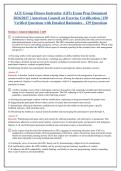
ACE GROUP FITNESS INSTRUCTOR (GFI) EXAM
PREP DOCUMENT | 2026/2027 Edition | 150
Verified Questions
ACE Group Fitness Instructor (GFI) Final EXAM 2026-2027 LATEST UPDATED
VERSION 150 QUESTIONS AND ANSWERS
100% Verified Solutions | Updated Per Latest ACE Guidelines | Graded A+
This exam prep document has been meticulously prepared for candidates pursuing the ACE
Group Fitness Instructor (GFI) certification. Each of the 150 questions (135 scored, 15
experimental, reflecting the official exam structure) is aligned with the 2026/2027 ACE
guidelines, current group exercise instruction standards, and the ACE Mover Method. The
verified answers, detailed rationales, and distractor explanations provide a rigorous and reliable
preparation resource for the ACE GFI certification exam. All content reflects the latest industry
updates, including expanded virtual and hybrid class integration, wearable technology guidelines,
and revised inclusive fitness standards.
Key Features
✓ The ACE Mover Method and participant-centered coaching for lasting behavior change
✓ Class design, choreography, and music selection aligned with ACE IFT Model principles
✓ Effective cueing and communication techniques for diverse learning styles
✓ Legal and professional responsibilities for group instructors including professional scope
✓ Modifications and safety for special populations including prenatal, older adults, and chronic
conditions
Updates for 2026
1. Expanded integration of the ACE Mover Method in virtual and hybrid class formats: ACE has
updated its guidelines to address the unique communication and engagement challenges of
virtual and hybrid group fitness environments. Instructors are now expected to apply participant-
centered coaching techniques that account for the physical separation between instructor and
participant, including enhanced visual and verbal cueing strategies and modified scan-and-
connect techniques for digital platforms.
2. Updated guidelines for wearable technology integration and heart rate monitoring in group
settings: ACE has released new recommendations for incorporating wearable fitness technology
into group classes, including guidance on using heart rate data to personalize intensity within the
group environment, privacy considerations for participant data, and the appropriate use of
technology as a supplement to (not replacement for) RPE and talk test assessments.
3. Revised industry standards for inclusive and accessible group fitness environments: Building
on the ACE Mover Method's emphasis on autonomy, competence, and relatedness, ACE has
expanded its inclusion guidelines to address a broader range of participant needs, including
adaptive programming for individuals with disabilities, culturally responsive instruction, and
body-positive class environments that welcome participants of all sizes and abilities.
Abstract
This document presents a comprehensive 150-question exam prep resource designed for the
American Council on Exercise (ACE) Group Fitness Instructor (GFI) certification examination.
The content is organized into five core domains: Professional Role and Responsibilities, Class
,Design and Choreography, Instructional Techniques and Cueing, Legal and Professional
Guidelines, and Special Populations and Class Management. Each question is accompanied by a
verified correct answer, an evidence-based rationale explaining the correct response, a 'Why
Wrong' analysis addressing each distractor, and a specific reference to the 2026 ACE Group
Fitness Instructor Manual, ACE Mover Method guidelines, or industry standards. The 150-
question format reflects the official ACE GFI exam structure (135 scored questions plus 15
experimental items). This resource is aligned with the 2026/2027 ACE guidelines and current
group exercise instruction standards, providing certification candidates with a rigorous, evidence-
based tool for examination preparation.
Keywords
ACE GFI, Group Fitness Instructor, Class Design, Choreography, Cueing Techniques, ACE
Mover Method, Special Populations, Group Exercise Leadership, ACE IFT Model, Self-
Determination Theory
Answer Format
Correct answers are displayed in bold immediately following the answer options. Each question
includes an italicized rationale explaining why the correct answer is accurate, followed by a “Why
Wrong” section that briefly explains why each distractor is incorrect. All question text and answer
choices (A, B, C, D) A specific reference citation accompanies each question.
Content Area Overview
Content Area Questions Key Topics Weight
Professional Role & Q1–Q30 ACE Mover Method, 20%
Responsibilities SDT, professional
scope, self-efficacy,
motivational
interviewing
Class Design & Q31–Q60 Warm-up/cool-down, 20%
Choreography FITT principle, 32-
count phrases, HIIT,
circuit training,
periodization
Instructional Q61–Q90 Verbal/visual/tactile 20%
Techniques & cues, mirroring,
Cueing previewing, positive
cueing, scan-and-
connect, split cueing
Legal & Professional Q91–Q120 Duty of care, 20%
Guidelines negligence, waivers,
copyright,
confidentiality, ADA,
social media, virtual
instruction
Special Populations Q121–Q150 Prenatal, older adults, 20%
& Class Management hypertension, diabetes,
arthritis, inclusive
environments, class
management
,Examination Questions
Domain: Professional Role & Responsibilities
Q1. According to the ACE Mover Method, what is the primary role of a group fitness
instructor?
A. To dictate workout routines to participants without modification
B. To facilitate participant-centered experiences that promote self-efficacy and
autonomy
C. To ensure all participants perform exercises with identical form
D. To maximize caloric expenditure in every session
Correct Answer: B
Rationale: The ACE Mover Method positions the instructor as a facilitator who empowers
participants to take ownership of their fitness journey. By fostering self-efficacy and
autonomy, instructors help participants build confidence and intrinsic motivation, which are
stronger predictors of long-term adherence than external directives.
Why Wrong: Dictating routines without modification ignores individual needs; identical
form for all participants disregards varying abilities; maximizing calories ignores holistic
wellness goals.
Reference: ACE GFI Manual, Chapter 1; ACE Mover Method Framework
Q2. Which of the following best describes the ACE Integrated Fitness Training (IFT)
Model as applied to group fitness?
A. A rigid progression system requiring all participants to advance simultaneously
B. A comprehensive training framework that addresses functional, health, and
fitness goals through progressive programming
C. A nutrition-only model for weight management
D. A certification requirement unrelated to class design
Correct Answer: B
Rationale: The ACE IFT Model provides a systematic approach to training that progresses
clients through functional movement, health-related fitness, and performance-based goals.
In group fitness, instructors use this model to design classes that meet participants where
they are and progressively build capacity across multiple dimensions of fitness.
Why Wrong: The IFT Model is not rigid and allows individual progression; it is not
nutrition-only; it directly informs class design and programming decisions.
Reference: ACE GFI Manual, Chapter 2; ACE IFT Model Guidelines
Q3. The ACE Mover Method emphasizes which type of communication style during
instruction?
A. Autocratic and directive communication
B. Participant-centered communication using open-ended questions and active
listening
C. One-way lecture-style delivery
D. Nonverbal communication exclusively
Correct Answer: B
Rationale: The ACE Mover Method prioritizes participant-centered communication that
engages class members through open-ended questions, reflective listening, and collaborative
dialogue. This approach builds rapport, enhances motivation, and helps participants feel
valued and heard, which increases class retention and satisfaction.
Why Wrong: Autocratic communication reduces participant engagement; lecture-style
delivery lacks interaction; nonverbal-only communication misses opportunities for
connection and feedback.
, Reference: ACE GFI Manual, Chapter 1; ACE Mover Method Communication Strategies
Q4. What is the primary purpose of a pre-class screening (PAR-Q+) in a group
fitness setting?
A. To exclude participants who are not in peak physical condition
B. To identify health conditions or risk factors that may require modifications
or medical clearance
C. To collect payment and registration information
D. To evaluate participants' fitness levels for ranking purposes
Correct Answer: B
Rationale: The PAR-Q+ (Physical Activity Readiness Questionnaire Plus) is a standardized
screening tool used to identify individuals who may have medical conditions or risk factors
that require further evaluation before participation. It helps instructors make informed
decisions about modifications, referrals, and safety considerations without excluding
participants unnecessarily.
Why Wrong: Screening is about safety, not exclusion; payment collection is administrative;
ranking participants contradicts the inclusive philosophy of group fitness.
Reference: ACE GFI Manual, Chapter 3; PAR-Q+ Collaborative, 2026
Q5. In the context of the ACE Mover Method, 'self-efficacy' refers to:
A. An individual's belief in their ability to successfully perform a specific
behavior or task
B. A participant's physical strength relative to others in the class
C. The instructor's confidence in their teaching abilities
D. The maximum heart rate a person can achieve during exercise
Correct Answer: A
Rationale: Self-efficacy, a concept central to the ACE Mover Method, is defined as an
individual's belief in their capability to execute a specific behavior or accomplish a task. In
group fitness, building self-efficacy involves providing achievable challenges, positive
feedback, and mastery experiences that reinforce participants' confidence in their abilities.
Why Wrong: Physical strength is unrelated to self-efficacy; instructor confidence is
professional self-efficacy but not the focus here; maximum heart rate is a physiological
measure.
Reference: ACE GFI Manual, Chapter 1; Bandura, A., Self-Efficacy Theory (1977)
Q6. Which of the following is a key component of the ACE Code of Ethics for group
fitness instructors?
A. Maximizing class size to increase revenue
B. Maintaining professional boundaries and referring participants to qualified
healthcare providers when appropriate
C. Recommending specific dietary supplements to participants
D. Sharing participants' personal health information with other class members for
motivation
Correct Answer: B
Rationale: The ACE Code of Ethics requires instructors to maintain professional
boundaries, recognize the limits of their professional scope, and refer participants to
qualified healthcare professionals when issues arise beyond their expertise. This protects
both the participant and the instructor while ensuring safe and ethical instruction.
Why Wrong: Maximizing class size may compromise safety; recommending supplements is
outside the typical scope of group fitness instructors; sharing personal health information
violates confidentiality.
Reference: ACE GFI Manual, Chapter 3; ACE Code of Ethics
PREP DOCUMENT | 2026/2027 Edition | 150
Verified Questions
ACE Group Fitness Instructor (GFI) Final EXAM 2026-2027 LATEST UPDATED
VERSION 150 QUESTIONS AND ANSWERS
100% Verified Solutions | Updated Per Latest ACE Guidelines | Graded A+
This exam prep document has been meticulously prepared for candidates pursuing the ACE
Group Fitness Instructor (GFI) certification. Each of the 150 questions (135 scored, 15
experimental, reflecting the official exam structure) is aligned with the 2026/2027 ACE
guidelines, current group exercise instruction standards, and the ACE Mover Method. The
verified answers, detailed rationales, and distractor explanations provide a rigorous and reliable
preparation resource for the ACE GFI certification exam. All content reflects the latest industry
updates, including expanded virtual and hybrid class integration, wearable technology guidelines,
and revised inclusive fitness standards.
Key Features
✓ The ACE Mover Method and participant-centered coaching for lasting behavior change
✓ Class design, choreography, and music selection aligned with ACE IFT Model principles
✓ Effective cueing and communication techniques for diverse learning styles
✓ Legal and professional responsibilities for group instructors including professional scope
✓ Modifications and safety for special populations including prenatal, older adults, and chronic
conditions
Updates for 2026
1. Expanded integration of the ACE Mover Method in virtual and hybrid class formats: ACE has
updated its guidelines to address the unique communication and engagement challenges of
virtual and hybrid group fitness environments. Instructors are now expected to apply participant-
centered coaching techniques that account for the physical separation between instructor and
participant, including enhanced visual and verbal cueing strategies and modified scan-and-
connect techniques for digital platforms.
2. Updated guidelines for wearable technology integration and heart rate monitoring in group
settings: ACE has released new recommendations for incorporating wearable fitness technology
into group classes, including guidance on using heart rate data to personalize intensity within the
group environment, privacy considerations for participant data, and the appropriate use of
technology as a supplement to (not replacement for) RPE and talk test assessments.
3. Revised industry standards for inclusive and accessible group fitness environments: Building
on the ACE Mover Method's emphasis on autonomy, competence, and relatedness, ACE has
expanded its inclusion guidelines to address a broader range of participant needs, including
adaptive programming for individuals with disabilities, culturally responsive instruction, and
body-positive class environments that welcome participants of all sizes and abilities.
Abstract
This document presents a comprehensive 150-question exam prep resource designed for the
American Council on Exercise (ACE) Group Fitness Instructor (GFI) certification examination.
The content is organized into five core domains: Professional Role and Responsibilities, Class
,Design and Choreography, Instructional Techniques and Cueing, Legal and Professional
Guidelines, and Special Populations and Class Management. Each question is accompanied by a
verified correct answer, an evidence-based rationale explaining the correct response, a 'Why
Wrong' analysis addressing each distractor, and a specific reference to the 2026 ACE Group
Fitness Instructor Manual, ACE Mover Method guidelines, or industry standards. The 150-
question format reflects the official ACE GFI exam structure (135 scored questions plus 15
experimental items). This resource is aligned with the 2026/2027 ACE guidelines and current
group exercise instruction standards, providing certification candidates with a rigorous, evidence-
based tool for examination preparation.
Keywords
ACE GFI, Group Fitness Instructor, Class Design, Choreography, Cueing Techniques, ACE
Mover Method, Special Populations, Group Exercise Leadership, ACE IFT Model, Self-
Determination Theory
Answer Format
Correct answers are displayed in bold immediately following the answer options. Each question
includes an italicized rationale explaining why the correct answer is accurate, followed by a “Why
Wrong” section that briefly explains why each distractor is incorrect. All question text and answer
choices (A, B, C, D) A specific reference citation accompanies each question.
Content Area Overview
Content Area Questions Key Topics Weight
Professional Role & Q1–Q30 ACE Mover Method, 20%
Responsibilities SDT, professional
scope, self-efficacy,
motivational
interviewing
Class Design & Q31–Q60 Warm-up/cool-down, 20%
Choreography FITT principle, 32-
count phrases, HIIT,
circuit training,
periodization
Instructional Q61–Q90 Verbal/visual/tactile 20%
Techniques & cues, mirroring,
Cueing previewing, positive
cueing, scan-and-
connect, split cueing
Legal & Professional Q91–Q120 Duty of care, 20%
Guidelines negligence, waivers,
copyright,
confidentiality, ADA,
social media, virtual
instruction
Special Populations Q121–Q150 Prenatal, older adults, 20%
& Class Management hypertension, diabetes,
arthritis, inclusive
environments, class
management
,Examination Questions
Domain: Professional Role & Responsibilities
Q1. According to the ACE Mover Method, what is the primary role of a group fitness
instructor?
A. To dictate workout routines to participants without modification
B. To facilitate participant-centered experiences that promote self-efficacy and
autonomy
C. To ensure all participants perform exercises with identical form
D. To maximize caloric expenditure in every session
Correct Answer: B
Rationale: The ACE Mover Method positions the instructor as a facilitator who empowers
participants to take ownership of their fitness journey. By fostering self-efficacy and
autonomy, instructors help participants build confidence and intrinsic motivation, which are
stronger predictors of long-term adherence than external directives.
Why Wrong: Dictating routines without modification ignores individual needs; identical
form for all participants disregards varying abilities; maximizing calories ignores holistic
wellness goals.
Reference: ACE GFI Manual, Chapter 1; ACE Mover Method Framework
Q2. Which of the following best describes the ACE Integrated Fitness Training (IFT)
Model as applied to group fitness?
A. A rigid progression system requiring all participants to advance simultaneously
B. A comprehensive training framework that addresses functional, health, and
fitness goals through progressive programming
C. A nutrition-only model for weight management
D. A certification requirement unrelated to class design
Correct Answer: B
Rationale: The ACE IFT Model provides a systematic approach to training that progresses
clients through functional movement, health-related fitness, and performance-based goals.
In group fitness, instructors use this model to design classes that meet participants where
they are and progressively build capacity across multiple dimensions of fitness.
Why Wrong: The IFT Model is not rigid and allows individual progression; it is not
nutrition-only; it directly informs class design and programming decisions.
Reference: ACE GFI Manual, Chapter 2; ACE IFT Model Guidelines
Q3. The ACE Mover Method emphasizes which type of communication style during
instruction?
A. Autocratic and directive communication
B. Participant-centered communication using open-ended questions and active
listening
C. One-way lecture-style delivery
D. Nonverbal communication exclusively
Correct Answer: B
Rationale: The ACE Mover Method prioritizes participant-centered communication that
engages class members through open-ended questions, reflective listening, and collaborative
dialogue. This approach builds rapport, enhances motivation, and helps participants feel
valued and heard, which increases class retention and satisfaction.
Why Wrong: Autocratic communication reduces participant engagement; lecture-style
delivery lacks interaction; nonverbal-only communication misses opportunities for
connection and feedback.
, Reference: ACE GFI Manual, Chapter 1; ACE Mover Method Communication Strategies
Q4. What is the primary purpose of a pre-class screening (PAR-Q+) in a group
fitness setting?
A. To exclude participants who are not in peak physical condition
B. To identify health conditions or risk factors that may require modifications
or medical clearance
C. To collect payment and registration information
D. To evaluate participants' fitness levels for ranking purposes
Correct Answer: B
Rationale: The PAR-Q+ (Physical Activity Readiness Questionnaire Plus) is a standardized
screening tool used to identify individuals who may have medical conditions or risk factors
that require further evaluation before participation. It helps instructors make informed
decisions about modifications, referrals, and safety considerations without excluding
participants unnecessarily.
Why Wrong: Screening is about safety, not exclusion; payment collection is administrative;
ranking participants contradicts the inclusive philosophy of group fitness.
Reference: ACE GFI Manual, Chapter 3; PAR-Q+ Collaborative, 2026
Q5. In the context of the ACE Mover Method, 'self-efficacy' refers to:
A. An individual's belief in their ability to successfully perform a specific
behavior or task
B. A participant's physical strength relative to others in the class
C. The instructor's confidence in their teaching abilities
D. The maximum heart rate a person can achieve during exercise
Correct Answer: A
Rationale: Self-efficacy, a concept central to the ACE Mover Method, is defined as an
individual's belief in their capability to execute a specific behavior or accomplish a task. In
group fitness, building self-efficacy involves providing achievable challenges, positive
feedback, and mastery experiences that reinforce participants' confidence in their abilities.
Why Wrong: Physical strength is unrelated to self-efficacy; instructor confidence is
professional self-efficacy but not the focus here; maximum heart rate is a physiological
measure.
Reference: ACE GFI Manual, Chapter 1; Bandura, A., Self-Efficacy Theory (1977)
Q6. Which of the following is a key component of the ACE Code of Ethics for group
fitness instructors?
A. Maximizing class size to increase revenue
B. Maintaining professional boundaries and referring participants to qualified
healthcare providers when appropriate
C. Recommending specific dietary supplements to participants
D. Sharing participants' personal health information with other class members for
motivation
Correct Answer: B
Rationale: The ACE Code of Ethics requires instructors to maintain professional
boundaries, recognize the limits of their professional scope, and refer participants to
qualified healthcare professionals when issues arise beyond their expertise. This protects
both the participant and the instructor while ensuring safe and ethical instruction.
Why Wrong: Maximizing class size may compromise safety; recommending supplements is
outside the typical scope of group fitness instructors; sharing personal health information
violates confidentiality.
Reference: ACE GFI Manual, Chapter 3; ACE Code of Ethics