

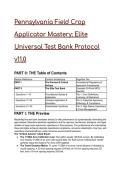
Pennsylvania Field Crop
Applicator Mastery: Elite
Universal Test Bank Protocol
v11.0
PART 0: THE Table of Contents
Section Reference Content Architecture Cognitive Tier
PART I The Preview & Critical Foundational Regulatory &
Axioms Agronomic Frameworks
PART II The Elite Test Bank Complete 30-Point MCQ
Gauntlet
- Questions 1–10 Foundational Syntax & Tier 1: Core Definitions,
Application Licensing, & Mechanics
- Questions 11–20 Complex Application & Tier 2: Analytical Agronomy,
Simulation Pathology, & Compliance
- Questions 21–30 Grandmaster Synthesis Tier 3: High-Stakes Operations
& Crisis Management
PART I: THE Preview
Mastering this test bank translates directly to elite performance by systematically eliminating the
gap between theoretical pesticide regulations and the rigorous mechanical, biological, and legal
realities of large-scale agronomic operations in Pennsylvania. The professional who internalizes
these principles achieves absolute operational compliance, prevents catastrophic crop loss, and
maximizes chemical efficacy under immense environmental pressure.
The "Critical Axioms" Cheat Sheet:
● The 1/128th Acre Calibration Law: One gallon equals 128 fluid ounces. By calibrating
over exactly 1/128th of an acre (340 square feet), the fluid ounces collected per nozzle
perfectly equal the Gallons Per Acre (GPA) applied.
● The Travel Distance Matrix: To cover 1/128th of an acre, travel distance is dictated by
nozzle spacing. A 20-inch spacing requires 204 feet, an 18-inch spacing requires 227
feet, and a 16-inch spacing requires 255 feet.
, ● The Supervisory Time-Space Continuum: Uncertified applicators require continuous
direct visual and voice contact. Registered Technicians may operate independently,
provided the supervising certified applicator can physically arrive on-site within exactly 5
hours.
● The Rule of 3 and 24: Official application records must be fully completed within 24 hours
of the application and securely retained for a minimum of 3 years.
● The Pathogen Triggers: Stewart's Wilt severity is mathematically linked to the sum of
average winter temperatures (December, January, February) surpassing 90. Gibberella
Ear Rot requires cool, wet conditions during silking and produces toxic Deoxynivalenol
(DON/Vomitoxin).
PART II: THE ELITE TEST BANK
Q1: A Pennsylvania commercial applicator holding a Category 01 (Agronomic Crops)
certification is preparing for license renewal. To maintain strict compliance with the Pennsylvania
Department of Agriculture (PDA) mandates, what is the precise continuing education credit
requirement the professional must satisfy every three years? A) 10 Core credits and 6 Category
01 credits. B) 6 Core credits and 10 Category 01 credits. C) 12 Category 01 credits and a
mandatory re-examination. D) 8 Core credits and 8 Category 01 credits.
● The Answer: B (6 Core credits and 10 Category 01 credits.)
● Distractor Analysis:
○ A is incorrect: The inversion of credit values represents a common novice trap that
leads to certification lapse; the state prioritizes specialized agronomic category
knowledge over general foundational core principles.
○ C is incorrect: Re-examination is exclusively mandated if the professional allows
their certification to expire and subsequently fails to complete delinquent credits
within the one-year grace period. Twelve credits represents the standard for
Category 05 (Forest Pest Control), not Category 01. * D is incorrect: This arbitrary,
balanced division of credits fails to reflect Pennsylvania's weighted regulatory
emphasis on specialized Category 01 field crop expertise.
The Mentor's Analysis: Professional continuity relies on persistent, specialized education
managed through strict statutory timelines. The Pennsylvania Department of Agriculture weights
the renewal heavily toward field-specific expertise, mandating 10 credits in the agronomic
specialty and 6 in foundational safety and legal core. By auditing credit totals annually, the
applicator bypasses the administrative failure of license suspension. Professional/Academic
Intuition: Core safety requires six credits; Agronomic mastery requires ten credits.
Q2: Following the broadcast application of a Restricted Use Pesticide (RUP) to a 100-acre
soybean field, a private applicator must document the intervention. According to the
Pennsylvania Pesticide Control Act, what is the maximum allowable timeframe for completing
this formal record, and how long must the document be preserved? A) Completed within 48
hours; maintained for 5 years. B) Completed before the applicator leaves the site; maintained
for 1 year. C) Completed within 24 hours; maintained for 3 years. D) Completed within 7 days;
maintained indefinitely.
● The Answer: C (Completed within 24 hours; maintained for 3 years.)
● Distractor Analysis:
○ A is incorrect: While the Federal Worker Protection Standard (WPS) sometimes
utilizes different posting timeframes for treated areas, Pennsylvania state law rigidly
, caps the record generation window at exactly 24 hours, and a 5-year retention is a
legacy commercial standard in other jurisdictions, not PA.
○ B is incorrect: Generating records geographically on-site is an elite operational best
practice, but the law grants a 24-hour administrative grace period for completion; a
1-year retention constitutes a severe legal violation of archival mandates.
○ D is incorrect: Permitting a seven-day delay represents extreme negligence; in the
event of an agricultural worker exposure incident, medical personnel require
immediate access to chemical data.
The Mentor's Analysis: Regulatory recordkeeping acts as the absolute legal bedrock of
chemical traceability. When an application concludes, the immediate priority is data lockdown
before operational amnesia obscures vital metrics like EPA registration numbers or exact
dosages. By strictly enforcing the 24-hour completion rule and the 3-year archive rule, the
operation bypasses catastrophic liability during unannounced PDA audits.
Professional/Academic Intuition: Ink the record before the sun sets tomorrow, and guard
it for three winters.
Q3: An agricultural operation intends to utilize a totally uncertified employee to assist in applying
a general-use herbicide to a leased corn field. To remain compliant with Pennsylvania direct
supervision laws, what spatial and communication constraints apply to the supervising certified
applicator? A) The supervisor must be capable of reaching the site within 5 hours. B) The
supervisor must be continuously physically present, within sight, and within hearing distance of
the uncertified employee. C) The supervisor must maintain cellular phone contact with the
employee at all times during the application. D) The supervisor must initiate the application, but
may leave the premises once the employee demonstrates mechanical competence.
● The Answer: B (The supervisor must be continuously physically present, within sight,
and within hearing distance of the uncertified employee.)
● Distractor Analysis:
○ A is incorrect: The 5-hour physical response window is the explicit legal standard
designated for a formally Registered Technician, not a completely uncertified,
untrained laborer.
○ C is incorrect: Cellular or radio contact fails to satisfy the stringent legal definition of
"direct supervision" for green laborers under Pennsylvania code; physical proximity
is mandatory.
○ D is incorrect: Demonstrating mechanical competence never transfers legal
authority; abandoning an uncertified applicator mid-job guarantees immediate
operational violation and severe department fines.
The Mentor's Analysis: Uncertified personnel represent the highest possible vector of
chemical liability. When deploying green labor, the immediate priority is absolute physical
overwatch to prevent environmental contamination. By maintaining uninterrupted line-of-sight
and vocal control, the certified professional bypasses the devastating consequences of an
uncorrected mechanical failure or off-target drift event. Professional/Academic Intuition: If the
supervisor cannot see the spray and shout a command, the uncertified applicator must
immediately shut down the boom.
Q4: A commercial field crop applicator is initiating the "Ounces-to-Gallons" calibration protocol
on a boom sprayer. If the implement is outfitted with nozzles spaced exactly 20 inches apart,
what specific linear distance must the rig travel to accurately capture 1/128th of an acre per
nozzle? A) 340 feet B) 255 feet C) 204 feet D) 170 feet
● The Answer: C (204 feet)
● Distractor Analysis:
Applicator Mastery: Elite
Universal Test Bank Protocol
v11.0
PART 0: THE Table of Contents
Section Reference Content Architecture Cognitive Tier
PART I The Preview & Critical Foundational Regulatory &
Axioms Agronomic Frameworks
PART II The Elite Test Bank Complete 30-Point MCQ
Gauntlet
- Questions 1–10 Foundational Syntax & Tier 1: Core Definitions,
Application Licensing, & Mechanics
- Questions 11–20 Complex Application & Tier 2: Analytical Agronomy,
Simulation Pathology, & Compliance
- Questions 21–30 Grandmaster Synthesis Tier 3: High-Stakes Operations
& Crisis Management
PART I: THE Preview
Mastering this test bank translates directly to elite performance by systematically eliminating the
gap between theoretical pesticide regulations and the rigorous mechanical, biological, and legal
realities of large-scale agronomic operations in Pennsylvania. The professional who internalizes
these principles achieves absolute operational compliance, prevents catastrophic crop loss, and
maximizes chemical efficacy under immense environmental pressure.
The "Critical Axioms" Cheat Sheet:
● The 1/128th Acre Calibration Law: One gallon equals 128 fluid ounces. By calibrating
over exactly 1/128th of an acre (340 square feet), the fluid ounces collected per nozzle
perfectly equal the Gallons Per Acre (GPA) applied.
● The Travel Distance Matrix: To cover 1/128th of an acre, travel distance is dictated by
nozzle spacing. A 20-inch spacing requires 204 feet, an 18-inch spacing requires 227
feet, and a 16-inch spacing requires 255 feet.
, ● The Supervisory Time-Space Continuum: Uncertified applicators require continuous
direct visual and voice contact. Registered Technicians may operate independently,
provided the supervising certified applicator can physically arrive on-site within exactly 5
hours.
● The Rule of 3 and 24: Official application records must be fully completed within 24 hours
of the application and securely retained for a minimum of 3 years.
● The Pathogen Triggers: Stewart's Wilt severity is mathematically linked to the sum of
average winter temperatures (December, January, February) surpassing 90. Gibberella
Ear Rot requires cool, wet conditions during silking and produces toxic Deoxynivalenol
(DON/Vomitoxin).
PART II: THE ELITE TEST BANK
Q1: A Pennsylvania commercial applicator holding a Category 01 (Agronomic Crops)
certification is preparing for license renewal. To maintain strict compliance with the Pennsylvania
Department of Agriculture (PDA) mandates, what is the precise continuing education credit
requirement the professional must satisfy every three years? A) 10 Core credits and 6 Category
01 credits. B) 6 Core credits and 10 Category 01 credits. C) 12 Category 01 credits and a
mandatory re-examination. D) 8 Core credits and 8 Category 01 credits.
● The Answer: B (6 Core credits and 10 Category 01 credits.)
● Distractor Analysis:
○ A is incorrect: The inversion of credit values represents a common novice trap that
leads to certification lapse; the state prioritizes specialized agronomic category
knowledge over general foundational core principles.
○ C is incorrect: Re-examination is exclusively mandated if the professional allows
their certification to expire and subsequently fails to complete delinquent credits
within the one-year grace period. Twelve credits represents the standard for
Category 05 (Forest Pest Control), not Category 01. * D is incorrect: This arbitrary,
balanced division of credits fails to reflect Pennsylvania's weighted regulatory
emphasis on specialized Category 01 field crop expertise.
The Mentor's Analysis: Professional continuity relies on persistent, specialized education
managed through strict statutory timelines. The Pennsylvania Department of Agriculture weights
the renewal heavily toward field-specific expertise, mandating 10 credits in the agronomic
specialty and 6 in foundational safety and legal core. By auditing credit totals annually, the
applicator bypasses the administrative failure of license suspension. Professional/Academic
Intuition: Core safety requires six credits; Agronomic mastery requires ten credits.
Q2: Following the broadcast application of a Restricted Use Pesticide (RUP) to a 100-acre
soybean field, a private applicator must document the intervention. According to the
Pennsylvania Pesticide Control Act, what is the maximum allowable timeframe for completing
this formal record, and how long must the document be preserved? A) Completed within 48
hours; maintained for 5 years. B) Completed before the applicator leaves the site; maintained
for 1 year. C) Completed within 24 hours; maintained for 3 years. D) Completed within 7 days;
maintained indefinitely.
● The Answer: C (Completed within 24 hours; maintained for 3 years.)
● Distractor Analysis:
○ A is incorrect: While the Federal Worker Protection Standard (WPS) sometimes
utilizes different posting timeframes for treated areas, Pennsylvania state law rigidly
, caps the record generation window at exactly 24 hours, and a 5-year retention is a
legacy commercial standard in other jurisdictions, not PA.
○ B is incorrect: Generating records geographically on-site is an elite operational best
practice, but the law grants a 24-hour administrative grace period for completion; a
1-year retention constitutes a severe legal violation of archival mandates.
○ D is incorrect: Permitting a seven-day delay represents extreme negligence; in the
event of an agricultural worker exposure incident, medical personnel require
immediate access to chemical data.
The Mentor's Analysis: Regulatory recordkeeping acts as the absolute legal bedrock of
chemical traceability. When an application concludes, the immediate priority is data lockdown
before operational amnesia obscures vital metrics like EPA registration numbers or exact
dosages. By strictly enforcing the 24-hour completion rule and the 3-year archive rule, the
operation bypasses catastrophic liability during unannounced PDA audits.
Professional/Academic Intuition: Ink the record before the sun sets tomorrow, and guard
it for three winters.
Q3: An agricultural operation intends to utilize a totally uncertified employee to assist in applying
a general-use herbicide to a leased corn field. To remain compliant with Pennsylvania direct
supervision laws, what spatial and communication constraints apply to the supervising certified
applicator? A) The supervisor must be capable of reaching the site within 5 hours. B) The
supervisor must be continuously physically present, within sight, and within hearing distance of
the uncertified employee. C) The supervisor must maintain cellular phone contact with the
employee at all times during the application. D) The supervisor must initiate the application, but
may leave the premises once the employee demonstrates mechanical competence.
● The Answer: B (The supervisor must be continuously physically present, within sight,
and within hearing distance of the uncertified employee.)
● Distractor Analysis:
○ A is incorrect: The 5-hour physical response window is the explicit legal standard
designated for a formally Registered Technician, not a completely uncertified,
untrained laborer.
○ C is incorrect: Cellular or radio contact fails to satisfy the stringent legal definition of
"direct supervision" for green laborers under Pennsylvania code; physical proximity
is mandatory.
○ D is incorrect: Demonstrating mechanical competence never transfers legal
authority; abandoning an uncertified applicator mid-job guarantees immediate
operational violation and severe department fines.
The Mentor's Analysis: Uncertified personnel represent the highest possible vector of
chemical liability. When deploying green labor, the immediate priority is absolute physical
overwatch to prevent environmental contamination. By maintaining uninterrupted line-of-sight
and vocal control, the certified professional bypasses the devastating consequences of an
uncorrected mechanical failure or off-target drift event. Professional/Academic Intuition: If the
supervisor cannot see the spray and shout a command, the uncertified applicator must
immediately shut down the boom.
Q4: A commercial field crop applicator is initiating the "Ounces-to-Gallons" calibration protocol
on a boom sprayer. If the implement is outfitted with nozzles spaced exactly 20 inches apart,
what specific linear distance must the rig travel to accurately capture 1/128th of an acre per
nozzle? A) 340 feet B) 255 feet C) 204 feet D) 170 feet
● The Answer: C (204 feet)
● Distractor Analysis:


