

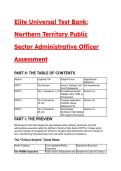
Elite Universal Test Bank:
Northern Territory Public
Sector Administrative Officer
Assessment
PART 0: THE TABLE OF CONTENTS
Section Cognitive Tier Subject Focus Page/Section
Reference
PART I The Preview Axioms, Statutes, and Pre-Assessment
Core Frameworks
PART II Tier 1 (Questions 1–15) Foundational Syntax: Section II.A
PSEMA, IPPs, TRM, &
Procurement
PART II Tier 2 (Questions Complex Application: Section II.B
16–35) Conflicts, Quote
Matrices & FOI
PART II Tier 3 (Questions Grandmaster Section II.C
36–42) Synthesis: High-Stakes
Inter-Agency Scenarios
PART I: THE PREVIEW
Mastering this test bank bridges the gap between basic statutory awareness and elite
administrative execution within the Northern Territory Public Sector (NTPS). It forges public
servants capable of navigating the Territory’s stringent legal frameworks with zero margin for
error, transforming theoretical policy into real-world operational compliance.
The "Critical Axioms" Cheat Sheet
Axiom Category Core Legislative/Policy Operational Execution
Framework
The PSEMA Imperative Public Sector Employment and Dictates the Code of Conduct
,Axiom Category Core Legislative/Policy Operational Execution
Framework
Management Act 1993 (EI 12), ensuring apolitical,
(PSEMA) efficient service rooted purely in
the merit principle.
The Information Triad Information Act 2002 Unifies FOI, Privacy (10 IPPs),
and Records Management into
a single statutory compliance
framework.
The Procurement Matrix NT Government Procurement Enforces 5 strict tiers.
Rules (2025/2026) Emphasizes Value for Territory
over lowest absolute cost.
The TRM Mandate Territory Records Manager The exclusive official repository.
(TRM/Content Manager) Destruction of records outside
of authorized Disposal
Schedules is unlawful.
The Formatting Absolute NTPS Recruitment and Mandates a one-page summary
Selection Policy paired with a resume for all
roles, irrespective of
classification level.
PART II: THE ELITE TEST BANK
Q1: An applicant submits a meticulously crafted, five-page cover letter addressing specific
selection criteria for a high-level Administrative Officer 7 (AO7) role. Based on the principles of
the NTPS Recruitment and Selection Policy, which action/conclusion is the MOST ACCURATE?
A) The application should be highly scored for demonstrating exceptional administrative
thoroughness and policy comprehension. B) The application must be evaluated but severely
penalized for failing to be concise in a high-volume recruitment environment. C) The application
is procedurally flawed as NTPS mandates a strict one-page summary and resume format across
all classifications. D) The application is valid because the one-page rule applies exclusively to
lower-tier Administrative Officer 1 and 2 positions.
● The Answer: C (The application is procedurally flawed as NTPS mandates a strict
one-page summary and resume format across all classifications.)
● Distractor Analysis:
○ A is incorrect: Rewarding the applicant violates strict NTPS application format
guidelines, establishing a dangerous precedent of ignoring systemic directives.
○ B is incorrect: Novices assume length is merely a scoring penalty; in the NTPS
ecosystem, it violates a direct administrative mandate that governs admissibility.
○ D is incorrect: The one-page mandate applies universally across all classifications,
from entry-level AO1 through to top-tier Executive Contract Officer (ECO) levels.
The Mentor's Analysis: Administrative efficiency begins precisely at the point of entry. When
facing NTPS recruitment, the immediate priority is enforcing structural compliance. By utilizing
the One-Page Summary Mandate , you bypass the common trap of evaluating non-compliant,
legacy-style criteria responses that consume excessive evaluation panel hours.
Professional/Academic Intuition: NTPS applications are binary in format: One-page
summary plus resume, non-negotiable at every level.
Q2: Under the Public Sector Employment and Management Act 1993 (PSEMA), who holds the
, ultimate statutory responsibility as the employer of all Northern Territory public sector
employees? A) The Chief Executive Officer of the respective hiring agency. B) The Fair Work
Ombudsman representing the Commonwealth. C) The Commissioner for Public Employment.
D) The Minister for Trade, Business and Asian Relations.
● The Answer: C (The Commissioner for Public Employment.)
● Distractor Analysis:
○ A is incorrect: Chief Executive Officers manage their specific agencies and wield
delegated powers, but the Commissioner remains the overarching statutory
employer.
○ B is incorrect: The Fair Work Ombudsman investigates federal workplace
compliance issues, not Northern Territory statutory employment administration.
○ D is incorrect: This specific Minister oversees procurement and business trade, not
the statutory functions of public employment.
The Mentor's Analysis: The architectural framework of the NTPS requires a unified employer
entity to ensure standardized human resource practices across decentralized departments.
When facing systemic HR inquiries, the immediate priority is acknowledging the apex authority.
By utilizing the Commissioner for Public Employment , the government bypasses the trap of
fragmented, agency-level employment rules that could lead to disparate treatment of public
servants. Professional/Academic Intuition: CEOs manage the daily workforce; the
Commissioner owns the statutory framework.
Q3: An Administrative Officer 2 (AO2) is tasked with disposing of routine telephone message
slips and short-term facilitative notes. Based on the principles of the Information Act 2002 and
NTG records management standards, which action is the MOST ACCURATE? A) The records
must be archived in TRM for a minimum of 7 years as they constitute official government
communications. B) The records may be destroyed immediately under the authority of the
Disposal Schedule for Short Term Value Records. C) The records must be sent directly to the
Information Commissioner for de-identification before physical disposal. D) The records must be
preserved indefinitely until a formal Freedom of Information (FOI) freeze is officially lifted.
● The Answer: B (The records may be destroyed immediately under the authority of the
Disposal Schedule for Short Term Value Records.)
● Distractor Analysis:
○ A is incorrect: Retaining ephemeral records clogs the digital architecture and
wastes server space, directly contravening efficient records management principles.
○ C is incorrect: The Information Commissioner oversees policy and complaints; they
do not process the physical or digital destruction of routine documents.
○ D is incorrect: Assuming an FOI freeze exists without evidence is an analytical
error; routine ephemeral records are exempt from long-term holds unless
specifically captured under an active freeze.
The Mentor's Analysis: Efficient records management distinguishes critically between core
historical evidence and administrative noise. When facing ephemeral documents, the immediate
priority is authorized elimination. By utilizing the Disposal Schedule for Short Term Value
Records , you bypass the common trap of digital hoarding which severely compromises system
searchability. Professional/Academic Intuition: If it holds no ongoing facilitative or
evidentiary value, authorize its destruction immediately.
Q4: A Department requires the purchase of specialized office chairs totaling $35,000 (including
GST). Based on the NT Government Procurement Rules, which sourcing action is the MOST
APPROPRIATE? A) Proceed via an open public tender on Quotations and Tenders Online
(QTOL). B) Obtain a minimum of three written quotes, with at least two strictly from Territory
Northern Territory Public
Sector Administrative Officer
Assessment
PART 0: THE TABLE OF CONTENTS
Section Cognitive Tier Subject Focus Page/Section
Reference
PART I The Preview Axioms, Statutes, and Pre-Assessment
Core Frameworks
PART II Tier 1 (Questions 1–15) Foundational Syntax: Section II.A
PSEMA, IPPs, TRM, &
Procurement
PART II Tier 2 (Questions Complex Application: Section II.B
16–35) Conflicts, Quote
Matrices & FOI
PART II Tier 3 (Questions Grandmaster Section II.C
36–42) Synthesis: High-Stakes
Inter-Agency Scenarios
PART I: THE PREVIEW
Mastering this test bank bridges the gap between basic statutory awareness and elite
administrative execution within the Northern Territory Public Sector (NTPS). It forges public
servants capable of navigating the Territory’s stringent legal frameworks with zero margin for
error, transforming theoretical policy into real-world operational compliance.
The "Critical Axioms" Cheat Sheet
Axiom Category Core Legislative/Policy Operational Execution
Framework
The PSEMA Imperative Public Sector Employment and Dictates the Code of Conduct
,Axiom Category Core Legislative/Policy Operational Execution
Framework
Management Act 1993 (EI 12), ensuring apolitical,
(PSEMA) efficient service rooted purely in
the merit principle.
The Information Triad Information Act 2002 Unifies FOI, Privacy (10 IPPs),
and Records Management into
a single statutory compliance
framework.
The Procurement Matrix NT Government Procurement Enforces 5 strict tiers.
Rules (2025/2026) Emphasizes Value for Territory
over lowest absolute cost.
The TRM Mandate Territory Records Manager The exclusive official repository.
(TRM/Content Manager) Destruction of records outside
of authorized Disposal
Schedules is unlawful.
The Formatting Absolute NTPS Recruitment and Mandates a one-page summary
Selection Policy paired with a resume for all
roles, irrespective of
classification level.
PART II: THE ELITE TEST BANK
Q1: An applicant submits a meticulously crafted, five-page cover letter addressing specific
selection criteria for a high-level Administrative Officer 7 (AO7) role. Based on the principles of
the NTPS Recruitment and Selection Policy, which action/conclusion is the MOST ACCURATE?
A) The application should be highly scored for demonstrating exceptional administrative
thoroughness and policy comprehension. B) The application must be evaluated but severely
penalized for failing to be concise in a high-volume recruitment environment. C) The application
is procedurally flawed as NTPS mandates a strict one-page summary and resume format across
all classifications. D) The application is valid because the one-page rule applies exclusively to
lower-tier Administrative Officer 1 and 2 positions.
● The Answer: C (The application is procedurally flawed as NTPS mandates a strict
one-page summary and resume format across all classifications.)
● Distractor Analysis:
○ A is incorrect: Rewarding the applicant violates strict NTPS application format
guidelines, establishing a dangerous precedent of ignoring systemic directives.
○ B is incorrect: Novices assume length is merely a scoring penalty; in the NTPS
ecosystem, it violates a direct administrative mandate that governs admissibility.
○ D is incorrect: The one-page mandate applies universally across all classifications,
from entry-level AO1 through to top-tier Executive Contract Officer (ECO) levels.
The Mentor's Analysis: Administrative efficiency begins precisely at the point of entry. When
facing NTPS recruitment, the immediate priority is enforcing structural compliance. By utilizing
the One-Page Summary Mandate , you bypass the common trap of evaluating non-compliant,
legacy-style criteria responses that consume excessive evaluation panel hours.
Professional/Academic Intuition: NTPS applications are binary in format: One-page
summary plus resume, non-negotiable at every level.
Q2: Under the Public Sector Employment and Management Act 1993 (PSEMA), who holds the
, ultimate statutory responsibility as the employer of all Northern Territory public sector
employees? A) The Chief Executive Officer of the respective hiring agency. B) The Fair Work
Ombudsman representing the Commonwealth. C) The Commissioner for Public Employment.
D) The Minister for Trade, Business and Asian Relations.
● The Answer: C (The Commissioner for Public Employment.)
● Distractor Analysis:
○ A is incorrect: Chief Executive Officers manage their specific agencies and wield
delegated powers, but the Commissioner remains the overarching statutory
employer.
○ B is incorrect: The Fair Work Ombudsman investigates federal workplace
compliance issues, not Northern Territory statutory employment administration.
○ D is incorrect: This specific Minister oversees procurement and business trade, not
the statutory functions of public employment.
The Mentor's Analysis: The architectural framework of the NTPS requires a unified employer
entity to ensure standardized human resource practices across decentralized departments.
When facing systemic HR inquiries, the immediate priority is acknowledging the apex authority.
By utilizing the Commissioner for Public Employment , the government bypasses the trap of
fragmented, agency-level employment rules that could lead to disparate treatment of public
servants. Professional/Academic Intuition: CEOs manage the daily workforce; the
Commissioner owns the statutory framework.
Q3: An Administrative Officer 2 (AO2) is tasked with disposing of routine telephone message
slips and short-term facilitative notes. Based on the principles of the Information Act 2002 and
NTG records management standards, which action is the MOST ACCURATE? A) The records
must be archived in TRM for a minimum of 7 years as they constitute official government
communications. B) The records may be destroyed immediately under the authority of the
Disposal Schedule for Short Term Value Records. C) The records must be sent directly to the
Information Commissioner for de-identification before physical disposal. D) The records must be
preserved indefinitely until a formal Freedom of Information (FOI) freeze is officially lifted.
● The Answer: B (The records may be destroyed immediately under the authority of the
Disposal Schedule for Short Term Value Records.)
● Distractor Analysis:
○ A is incorrect: Retaining ephemeral records clogs the digital architecture and
wastes server space, directly contravening efficient records management principles.
○ C is incorrect: The Information Commissioner oversees policy and complaints; they
do not process the physical or digital destruction of routine documents.
○ D is incorrect: Assuming an FOI freeze exists without evidence is an analytical
error; routine ephemeral records are exempt from long-term holds unless
specifically captured under an active freeze.
The Mentor's Analysis: Efficient records management distinguishes critically between core
historical evidence and administrative noise. When facing ephemeral documents, the immediate
priority is authorized elimination. By utilizing the Disposal Schedule for Short Term Value
Records , you bypass the common trap of digital hoarding which severely compromises system
searchability. Professional/Academic Intuition: If it holds no ongoing facilitative or
evidentiary value, authorize its destruction immediately.
Q4: A Department requires the purchase of specialized office chairs totaling $35,000 (including
GST). Based on the NT Government Procurement Rules, which sourcing action is the MOST
APPROPRIATE? A) Proceed via an open public tender on Quotations and Tenders Online
(QTOL). B) Obtain a minimum of three written quotes, with at least two strictly from Territory


