pTIA Security+ (SY0-701) Certification Exam 2026/2027 | Cybersecurity Review with Questions & Verified Answers 2026/2027 | Page 1 | Passing Score:
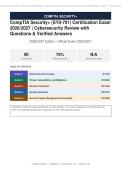
COMPTIA SECURITY+
CompTIA Security+ (SY0-701) Certification Exam
2026/2027 | Cybersecurity Review with
Questions & Verified Answers
2026/2027 Edition · Official Exam 2026/2027
90 75% N/A
QUESTIONS PASSING SCORE RECERTIFICATION
TABLE OF CONTENTS
Section 1 General Security Concepts Q1-Q18
Section 2 Threats, Vulnerabilities, and Mitigations Q19-Q36
Section 3 Security Architecture Q37-Q54
Section 4 Security Operations Q55-Q72
Section 5 Security Program Management and Oversight Q73-Q90
Instructions: Select the single best answer for each question. This exam is designed for CompTIA Security+
(SY0-701) certification preparation. Passing score: 75% (68 questions correct).
CompTIA Security+ — 2026/2027 | Passing Score: 75% | Page 1 of 46
, SECTION 1 | General Security Concepts | Q1-Q18 | CompTIA Security+ 2026/2027
Q1 Question 1 of 90
A financial institution is designing a new online banking platform. The security team must ensure
that customer transaction records cannot be disputed by either party after processing. The chief
compliance officer asks which control best satisfies this requirement.
A. Implementing multi-factor authentication for all user account logins
B. Deploying digital signatures with trusted timestamping on every transaction
C. Enforcing role-based access control on all backend database tables
D. Configuring TLS 1.3 encryption for all client-server data transmissions
Correct Answer: B
Rationale:
Digital signatures with trusted timestamping provide non-repudiation by cryptographically binding the sender's
identity and time to each transaction, preventing either party from denying participation. While TLS 1.3 protects
data confidentiality in transit, it does not provide non-repudiation guarantees for the transaction itself.
Q2 Question 2 of 90
A 42-year-old CISO at a regional hospital is classifying patient data assets for a new risk
assessment. The chief concern is that unauthorized modification of medical records could lead
to incorrect treatment decisions and potential patient harm. Which security principle is most
directly at risk in this scenario?
A. Confidentiality of sensitive health information
B. Availability of the electronic health record system
C. Integrity of stored medical records and treatment data
D. Non-repudiation of physician authentication logs
Correct Answer: C
Rationale:
Integrity ensures that data is not altered or destroyed in an unauthorized manner; unauthorized modification of
medical records directly threatens this principle. Confidentiality deals with unauthorized disclosure, while
availability concerns system uptime and accessibility.
CompTIA Security+ — 2026/2027 | Passing Score: 75% | Page 2 of 46
, Q3 Question 3 of 90
A manufacturing firm is implementing a new physical security program for its server room. The
security manager wants a control that prevents unauthorized personnel from entering the facility
while also creating an audit trail of who accessed the room and when. Which control type
combination best meets both requirements?
A. A badge reader with PIN entry connected to a centralized logging server
B. A security guard posted at the entrance with a paper sign-in sheet
C. A locked door with a standard metal key distributed to all IT staff
D. A biometric hand scanner with no recording or monitoring capabilities
Correct Answer: A
Rationale:
A badge reader with PIN entry provides both preventive access control and detective logging capabilities,
satisfying both requirements. A standard key offers no audit trail, while a biometric scanner without logging fails
the audit requirement.
Q4 Question 4 of 90
An e-commerce company is reviewing its authentication architecture. The security team wants
to implement a system where users verify their identity using something they know, something
they have, and something they are. Which authentication model is being described in this
scenario?
A. Single-factor authentication with password complexity rules
B. Two-factor authentication using SMS and email verification
C. Passwordless authentication using hardware tokens only
D. Multi-factor authentication combining three distinct factor categories
Correct Answer: D
Rationale:
Multi-factor authentication requires two or more different authentication factors from separate categories:
knowledge, possession, and inherence. Using all three categories provides the strongest assurance of user
identity.
CompTIA Security+ — 2026/2027 | Passing Score: 75% | Page 3 of 46
, Q5 Question 5 of 90
A government contractor is required to comply with a new regulation mandating encryption of
sensitive data at rest and in transit. The IT director needs to identify which type of security
control encryption represents in this context. What is the correct classification?
A. A managerial control that establishes security policies
B. A technical control that protects data through cryptographic means
C. An operational control that governs day-to-day procedures
D. A physical control that restricts access to hardware devices
Correct Answer: B
Rationale:
Encryption is a technical control because it uses technology mechanisms to protect data confidentiality and
integrity. Managerial controls involve policies and procedures, operational controls involve human activities, and
physical controls involve tangible barriers.
Q6 Question 6 of 90
A 28-year-old security analyst at a retail company is investigating a potential insider threat. The
analyst needs to determine the motivation, capability, and opportunity of the suspected
employee. Which framework component best describes these three attributes?
A. The CIA triad model for data classification
B. The AAA framework for access management
C. Threat actor attributes used in risk assessment
D. The zero trust architecture for network segmentation
Correct Answer: C
Rationale:
Threat actor attributes include motivation, capability, and opportunity, which are essential for assessing insider
threat risk. The CIA triad addresses data security properties, while AAA deals with authentication, authorization,
and accounting.
CompTIA Security+ — 2026/2027 | Passing Score: 75% | Page 4 of 46
COMPTIA SECURITY+
CompTIA Security+ (SY0-701) Certification Exam
2026/2027 | Cybersecurity Review with
Questions & Verified Answers
2026/2027 Edition · Official Exam 2026/2027
90 75% N/A
QUESTIONS PASSING SCORE RECERTIFICATION
TABLE OF CONTENTS
Section 1 General Security Concepts Q1-Q18
Section 2 Threats, Vulnerabilities, and Mitigations Q19-Q36
Section 3 Security Architecture Q37-Q54
Section 4 Security Operations Q55-Q72
Section 5 Security Program Management and Oversight Q73-Q90
Instructions: Select the single best answer for each question. This exam is designed for CompTIA Security+
(SY0-701) certification preparation. Passing score: 75% (68 questions correct).
CompTIA Security+ — 2026/2027 | Passing Score: 75% | Page 1 of 46
, SECTION 1 | General Security Concepts | Q1-Q18 | CompTIA Security+ 2026/2027
Q1 Question 1 of 90
A financial institution is designing a new online banking platform. The security team must ensure
that customer transaction records cannot be disputed by either party after processing. The chief
compliance officer asks which control best satisfies this requirement.
A. Implementing multi-factor authentication for all user account logins
B. Deploying digital signatures with trusted timestamping on every transaction
C. Enforcing role-based access control on all backend database tables
D. Configuring TLS 1.3 encryption for all client-server data transmissions
Correct Answer: B
Rationale:
Digital signatures with trusted timestamping provide non-repudiation by cryptographically binding the sender's
identity and time to each transaction, preventing either party from denying participation. While TLS 1.3 protects
data confidentiality in transit, it does not provide non-repudiation guarantees for the transaction itself.
Q2 Question 2 of 90
A 42-year-old CISO at a regional hospital is classifying patient data assets for a new risk
assessment. The chief concern is that unauthorized modification of medical records could lead
to incorrect treatment decisions and potential patient harm. Which security principle is most
directly at risk in this scenario?
A. Confidentiality of sensitive health information
B. Availability of the electronic health record system
C. Integrity of stored medical records and treatment data
D. Non-repudiation of physician authentication logs
Correct Answer: C
Rationale:
Integrity ensures that data is not altered or destroyed in an unauthorized manner; unauthorized modification of
medical records directly threatens this principle. Confidentiality deals with unauthorized disclosure, while
availability concerns system uptime and accessibility.
CompTIA Security+ — 2026/2027 | Passing Score: 75% | Page 2 of 46
, Q3 Question 3 of 90
A manufacturing firm is implementing a new physical security program for its server room. The
security manager wants a control that prevents unauthorized personnel from entering the facility
while also creating an audit trail of who accessed the room and when. Which control type
combination best meets both requirements?
A. A badge reader with PIN entry connected to a centralized logging server
B. A security guard posted at the entrance with a paper sign-in sheet
C. A locked door with a standard metal key distributed to all IT staff
D. A biometric hand scanner with no recording or monitoring capabilities
Correct Answer: A
Rationale:
A badge reader with PIN entry provides both preventive access control and detective logging capabilities,
satisfying both requirements. A standard key offers no audit trail, while a biometric scanner without logging fails
the audit requirement.
Q4 Question 4 of 90
An e-commerce company is reviewing its authentication architecture. The security team wants
to implement a system where users verify their identity using something they know, something
they have, and something they are. Which authentication model is being described in this
scenario?
A. Single-factor authentication with password complexity rules
B. Two-factor authentication using SMS and email verification
C. Passwordless authentication using hardware tokens only
D. Multi-factor authentication combining three distinct factor categories
Correct Answer: D
Rationale:
Multi-factor authentication requires two or more different authentication factors from separate categories:
knowledge, possession, and inherence. Using all three categories provides the strongest assurance of user
identity.
CompTIA Security+ — 2026/2027 | Passing Score: 75% | Page 3 of 46
, Q5 Question 5 of 90
A government contractor is required to comply with a new regulation mandating encryption of
sensitive data at rest and in transit. The IT director needs to identify which type of security
control encryption represents in this context. What is the correct classification?
A. A managerial control that establishes security policies
B. A technical control that protects data through cryptographic means
C. An operational control that governs day-to-day procedures
D. A physical control that restricts access to hardware devices
Correct Answer: B
Rationale:
Encryption is a technical control because it uses technology mechanisms to protect data confidentiality and
integrity. Managerial controls involve policies and procedures, operational controls involve human activities, and
physical controls involve tangible barriers.
Q6 Question 6 of 90
A 28-year-old security analyst at a retail company is investigating a potential insider threat. The
analyst needs to determine the motivation, capability, and opportunity of the suspected
employee. Which framework component best describes these three attributes?
A. The CIA triad model for data classification
B. The AAA framework for access management
C. Threat actor attributes used in risk assessment
D. The zero trust architecture for network segmentation
Correct Answer: C
Rationale:
Threat actor attributes include motivation, capability, and opportunity, which are essential for assessing insider
threat risk. The CIA triad addresses data security properties, while AAA deals with authentication, authorization,
and accounting.
CompTIA Security+ — 2026/2027 | Passing Score: 75% | Page 4 of 46