

WGU D455 Role Transition HESI - Nursing leadership competency 2026/2027 | Page 1 | Passing Score: 80%
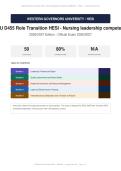
WESTERN GOVERNORS UNIVERSITY / HESI
U D455 Role Transition HESI - Nursing leadership compete
2026/2027 Edition . Official Exam 2026/2027
50 80% N/A
QUESTIONS PASSING SCORE RECERTIFICATION
TABLE OF CONTENTS
Section 1 Leadership Theories and Styles Q1-Q10
Section 2 Quality Improvement and Patient Safety Q11-Q20
Section 3 Healthcare Economics and Resource Management Q21-Q30
Section 4 Legal and Ethical Issues in Nursing Q31-Q40
Section 5 Interprofessional Collaboration and Transition to Practice Q41-Q50
Instructions: Select the single best answer for each question. This exam is designed for WGU D455 Role Transition HESI
certification preparation. Passing score: 80% (40 questions correct).
WGU D455 Role Transition HESI -- 2026/2027 | Passing Score: 80% | Page 1 of 1
, SECTION 1 | Leadership Theories and Styles | Q1-Q10 | WGU D455 Role Transition HESI 2026/2027
Q1 Question 1 of 50
A 42-year-old nurse manager on a medical-surgical unit consistently seeks input from staff nurses
before implementing schedule changes and encourages shared decision-making. During a staffing
crisis, she gathers the team to collaboratively develop a solution. This leader is demonstrating which
leadership theory?
A. Participative democratic leadership theory
B. Transformational leadership theory
C. Situational leadership theory
D. Autocratic leadership theory
Correct Answer: A
Rationale:
Participative democratic leadership involves seeking staff input and shared decision-making, which is exactly
what this nurse manager demonstrates. Transformational leadership focuses on inspiring and motivating
followers toward a vision, not specifically on collaborative decision-making processes.
Q2 Question 2 of 50
A newly appointed charge nurse on a telemetry unit, age 29, notices that experienced staff resist her
changes to the handoff protocol. She adapts her approach by slowing the pace of change and
building relationships before proposing further modifications. This scenario best illustrates which
concept from Hersey and Blanchard's Situational Leadership Model?
A. Telling style for low readiness followers
B. Participating style for moderately ready followers who are unwilling
C. Selling style for moderately ready followers
D. Delegating style for high readiness followers
Correct Answer: B
Rationale:
The nurse adjusts her approach by relationship-building rather than directing, reflecting the participating style
used when followers have moderate readiness but low willingness. Selling style involves more directive
behavior combined with supportive communication, which does not match the scenario's emphasis on
relationship-building.
WGU D455 Role Transition HESI -- 2026/2027 | Passing Score: 80% | Page 2 of 1
, SECTION 1 | Leadership Theories and Styles | Q1-Q10 | WGU D455 Role Transition HESI 2026/2027
Q3 Question 3 of 50
A 55-year-old director of nursing implements a vision where every unit achieves magnet designation
within five years and motivates staff by connecting daily tasks to this larger purpose. Staff report
feeling inspired and committed to the goal. Which leadership style is most evident?
A. Transactional leadership
B. Laissez-faire leadership
C. Transformational leadership
D. Bureaucratic leadership
Correct Answer: C
Rationale:
Transformational leadership is characterized by creating a vision, inspiring followers, and connecting daily
work to a larger purpose. Transactional leadership focuses on exchanges and rewards for meeting goals, not
on inspiring commitment through vision.
Q4 Question 4 of 50
An experienced ICU nurse, age 38, is appointed as interim manager during a leadership vacancy.
She maintains existing policies without change and defers all decisions to the department director.
The staff expresses frustration about slow responses to unit needs. This behavior is most consistent
with which leadership style?
A. Laissez-faire leadership
B. Autocratic leadership
C. Democratic leadership
D. Bureaucratic leadership
Correct Answer: D
Rationale:
Bureaucratic leadership involves rigid adherence to existing rules and policies with deference to authority, as
demonstrated by this nurse. Laissez-faire leadership involves minimal involvement and absence of direction,
which differs from actively maintaining policies and deferring to authority.
WGU D455 Role Transition HESI -- 2026/2027 | Passing Score: 80% | Page 3 of 1
WESTERN GOVERNORS UNIVERSITY / HESI
U D455 Role Transition HESI - Nursing leadership compete
2026/2027 Edition . Official Exam 2026/2027
50 80% N/A
QUESTIONS PASSING SCORE RECERTIFICATION
TABLE OF CONTENTS
Section 1 Leadership Theories and Styles Q1-Q10
Section 2 Quality Improvement and Patient Safety Q11-Q20
Section 3 Healthcare Economics and Resource Management Q21-Q30
Section 4 Legal and Ethical Issues in Nursing Q31-Q40
Section 5 Interprofessional Collaboration and Transition to Practice Q41-Q50
Instructions: Select the single best answer for each question. This exam is designed for WGU D455 Role Transition HESI
certification preparation. Passing score: 80% (40 questions correct).
WGU D455 Role Transition HESI -- 2026/2027 | Passing Score: 80% | Page 1 of 1
, SECTION 1 | Leadership Theories and Styles | Q1-Q10 | WGU D455 Role Transition HESI 2026/2027
Q1 Question 1 of 50
A 42-year-old nurse manager on a medical-surgical unit consistently seeks input from staff nurses
before implementing schedule changes and encourages shared decision-making. During a staffing
crisis, she gathers the team to collaboratively develop a solution. This leader is demonstrating which
leadership theory?
A. Participative democratic leadership theory
B. Transformational leadership theory
C. Situational leadership theory
D. Autocratic leadership theory
Correct Answer: A
Rationale:
Participative democratic leadership involves seeking staff input and shared decision-making, which is exactly
what this nurse manager demonstrates. Transformational leadership focuses on inspiring and motivating
followers toward a vision, not specifically on collaborative decision-making processes.
Q2 Question 2 of 50
A newly appointed charge nurse on a telemetry unit, age 29, notices that experienced staff resist her
changes to the handoff protocol. She adapts her approach by slowing the pace of change and
building relationships before proposing further modifications. This scenario best illustrates which
concept from Hersey and Blanchard's Situational Leadership Model?
A. Telling style for low readiness followers
B. Participating style for moderately ready followers who are unwilling
C. Selling style for moderately ready followers
D. Delegating style for high readiness followers
Correct Answer: B
Rationale:
The nurse adjusts her approach by relationship-building rather than directing, reflecting the participating style
used when followers have moderate readiness but low willingness. Selling style involves more directive
behavior combined with supportive communication, which does not match the scenario's emphasis on
relationship-building.
WGU D455 Role Transition HESI -- 2026/2027 | Passing Score: 80% | Page 2 of 1
, SECTION 1 | Leadership Theories and Styles | Q1-Q10 | WGU D455 Role Transition HESI 2026/2027
Q3 Question 3 of 50
A 55-year-old director of nursing implements a vision where every unit achieves magnet designation
within five years and motivates staff by connecting daily tasks to this larger purpose. Staff report
feeling inspired and committed to the goal. Which leadership style is most evident?
A. Transactional leadership
B. Laissez-faire leadership
C. Transformational leadership
D. Bureaucratic leadership
Correct Answer: C
Rationale:
Transformational leadership is characterized by creating a vision, inspiring followers, and connecting daily
work to a larger purpose. Transactional leadership focuses on exchanges and rewards for meeting goals, not
on inspiring commitment through vision.
Q4 Question 4 of 50
An experienced ICU nurse, age 38, is appointed as interim manager during a leadership vacancy.
She maintains existing policies without change and defers all decisions to the department director.
The staff expresses frustration about slow responses to unit needs. This behavior is most consistent
with which leadership style?
A. Laissez-faire leadership
B. Autocratic leadership
C. Democratic leadership
D. Bureaucratic leadership
Correct Answer: D
Rationale:
Bureaucratic leadership involves rigid adherence to existing rules and policies with deference to authority, as
demonstrated by this nurse. Laissez-faire leadership involves minimal involvement and absence of direction,
which differs from actively maintaining policies and deferring to authority.
WGU D455 Role Transition HESI -- 2026/2027 | Passing Score: 80% | Page 3 of 1


