

Class 9 Physics Notes - Vernier Calliper Prepared for quick revision
Class 9 Physics Notes
Topic: Vernier Calliper
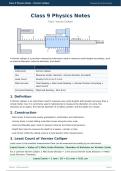
Fixed jaws
Sliding Vernier scale
0 1 2 3 4 5 6
Main scale
Depth rod
0 5 10
A Vernier calliper is a precision measuring instrument used to measure small lengths accurately, such
as internal diameter, external diameter, and depth.
Item Important Point
Instrument Vernier Calliper
Use Measures length, diameter, internal diameter and depth
Least Count Usually 0.01 cm or 0.1 mm
Main Formula Total Reading = Main Scale Reading + (Vernier Division Coinciding x
Least Count)
Corrected Reading Observed Reading - Zero Error
1. Definition
A Vernier calliper is an instrument used to measure very small lengths with greater accuracy than a
simple meter rule. It is commonly used in laboratories to measure the diameter of a wire, the
thickness of an object, the internal diameter of a hollow cylinder, and the depth of a vessel.
2. Construction
- Main Scale: A fixed scale usually graduated in centimeters and millimeters.
- Vernier Scale: A small sliding scale that moves along the main scale.
- Fixed and Movable Jaws: Used to measure external and internal dimensions.
- Depth Rod: Used to measure the depth of a beaker, cylinder or hole.
- Lock Screw: Holds the sliding scale at a fixed position after measurement.
3. Least Count of Vernier Calliper
Least count is the smallest measurement that can be measured accurately by an instrument.
Least Count = Value of 1 Main Scale Division / Number of divisions on Vernier Scale
For a common Vernier calliper: 1 Main Scale Division = 1 mm and 10 Vernier Scale Divisions = 9 Main
Scale Divisions. Therefore:
Least Count = 1 mm / 10 = 0.1 mm = 0.01 cm
Physics - Measurements Page 1
, Class 9 Physics Notes - Vernier Calliper Prepared for quick revision
4. How to Take a Reading
1. Place the object gently between the appropriate jaws of the Vernier calliper.
2. Note the Main Scale Reading (MSR) just before the zero mark of the Vernier scale.
3. Find the Vernier Scale Division (VSD) that exactly coincides with any main scale division.
4. Multiply the coinciding Vernier division by the least count.
5. Add this value to the main scale reading.
6. Apply zero-error correction if required.
Observed Reading = MSR + (Coinciding VSD x Least Count)
Corrected Reading = Observed Reading - Zero Error
Physics - Measurements Page 2
Class 9 Physics Notes
Topic: Vernier Calliper
Fixed jaws
Sliding Vernier scale
0 1 2 3 4 5 6
Main scale
Depth rod
0 5 10
A Vernier calliper is a precision measuring instrument used to measure small lengths accurately, such
as internal diameter, external diameter, and depth.
Item Important Point
Instrument Vernier Calliper
Use Measures length, diameter, internal diameter and depth
Least Count Usually 0.01 cm or 0.1 mm
Main Formula Total Reading = Main Scale Reading + (Vernier Division Coinciding x
Least Count)
Corrected Reading Observed Reading - Zero Error
1. Definition
A Vernier calliper is an instrument used to measure very small lengths with greater accuracy than a
simple meter rule. It is commonly used in laboratories to measure the diameter of a wire, the
thickness of an object, the internal diameter of a hollow cylinder, and the depth of a vessel.
2. Construction
- Main Scale: A fixed scale usually graduated in centimeters and millimeters.
- Vernier Scale: A small sliding scale that moves along the main scale.
- Fixed and Movable Jaws: Used to measure external and internal dimensions.
- Depth Rod: Used to measure the depth of a beaker, cylinder or hole.
- Lock Screw: Holds the sliding scale at a fixed position after measurement.
3. Least Count of Vernier Calliper
Least count is the smallest measurement that can be measured accurately by an instrument.
Least Count = Value of 1 Main Scale Division / Number of divisions on Vernier Scale
For a common Vernier calliper: 1 Main Scale Division = 1 mm and 10 Vernier Scale Divisions = 9 Main
Scale Divisions. Therefore:
Least Count = 1 mm / 10 = 0.1 mm = 0.01 cm
Physics - Measurements Page 1
, Class 9 Physics Notes - Vernier Calliper Prepared for quick revision
4. How to Take a Reading
1. Place the object gently between the appropriate jaws of the Vernier calliper.
2. Note the Main Scale Reading (MSR) just before the zero mark of the Vernier scale.
3. Find the Vernier Scale Division (VSD) that exactly coincides with any main scale division.
4. Multiply the coinciding Vernier division by the least count.
5. Add this value to the main scale reading.
6. Apply zero-error correction if required.
Observed Reading = MSR + (Coinciding VSD x Least Count)
Corrected Reading = Observed Reading - Zero Error
Physics - Measurements Page 2


