

Written by students who passed Immediately available after payment Read online or as PDF Wrong document? Swap it for free 4.6 TrustPilot
logo-home
Document preview thumbnail
Preview 2 out of 13 pages
Exam (elaborations)

BIO 116 Exam 1 Questions and Answers (80+ Verified Q&A) | Anatomy, Physiology, Cell Structure, Genetics, Metabolism & Enzymes

Document preview thumbnail
Preview 2 out of 13 pages

This comprehensive BIO 116 Exam 1 Questions and Answers study guide contains more than 80 exam-focused questions with detailed answers covering the foundational principles of human biology, anatomy, physiology, cellular biology, genetics, metabolism, and homeostatic regulation. The material is organized in a concise question-and-answer format designed to support active recall, knowledge retention, exam revision, and mastery of core biological concepts commonly assessed in introductory university-level biology courses. The document begins with essential biological foundations, including anatomy and physiology, levels of biological organization, atoms, molecules, macromolecules, cells, tissues, organs, organ systems, and the mechanisms responsible for maintaining homeostasis. Students will gain a strong understanding of feedback mechanisms, responsiveness, body cavities, and the structure and function of major human organ systems including the skeletal, muscular, integumentary, nervous, endocrine, cardiovascular, lymphatic, digestive, and urinary systems. Additional sections focus on chemistry for life sciences, covering atomic structure, protons, neutrons, electrons, ionic and covalent bonding, hydrogen bonding, polarity, pH regulation, acids and bases, monomers, polymers, and the biological importance of carbohydrates, lipids, proteins, and nucleic acids. The guide also explores ATP production, cellular energy transfer, hydrophilic and hydrophobic interactions, membrane structure, diffusion, osmosis, tonicity, active transport, facilitated diffusion, endocytosis, and exocytosis. The resource further examines cell biology and genetics, including organelle structure and function, vesicular transport, the endomembrane system, chromatin, chromosomes, DNA organization, transcription, translation, genes, codons, and the complete cell cycle. Detailed coverage of mitosis, checkpoints, telomeres, chromosome separation, and genetic information flow helps students understand the molecular basis of inheritance and cellular reproduction. Metabolism and bioenergetics topics include catabolism, anabolism, aerobic and anaerobic respiration, enzyme function, metabolic regulation, ATP generation, and the role of enzymes in cellular reactions. These concepts align closely with the learning outcomes typically found in introductory biology, anatomy and physiology, health sciences, nursing, and pre-medical curricula. The content is consistent with concepts presented in leading undergraduate biology references, including Campbell Biology (Urry et al., Pearson), Human Anatomy & Physiology (Marieb & Hoehn, Pearson), Biology 2e (OpenStax), Molecular Biology of the Cell (Alberts et al., Garland Science), and Principles of Anatomy and Physiology (Tortora & Derrickson, Wiley). These texts serve as foundational resources across universities worldwide and support the accuracy and academic relevance of the topics reviewed in this study guide. Relevant Students: Biology Students Anatomy and Physiology Students Pre-Med Students Nursing Students Health Science Students Biomedical Science Students Pharmacy Students Medical Laboratory Science Students Exercise Science Students Kinesiology Students Allied Health Students Healthcare Program Students University Freshman Biology Students College Biology Students Exam Preparation Candidates Keywords anatomy, physiology, biology exam 1, BIO 116, cell biology, human biology, homeostasis, negative feedback, positive feedback, body cavities, skeletal system, muscular system, nervous system, endocrine system, cardiovascular system, lymphatic system, digestive system, urinary system, atoms, molecules, macromolecules, cells, tissues, organs, organ systems, protons, neutrons, electrons, ionic bonds, covalent bonds, hydrogen bonds, pH scale, acids and bases, monomers, polymers, carbohydrates, lipids, proteins, nucleic acids, ATP, cell membrane, cytoplasm, nucleus, diffusion, facilitated diffusion, osmosis, tonicity, active transport, endocytosis, exocytosis, vesicles, mitochondria, ribosomes, endoplasmic reticulum, chromatin, chromosomes, cell cycle, mitosis, interphase, prophase, metaphase, anaphase, telophase, genes, codons, transcription, translation, metabolism, catabolism, anabolism, enzymes, aerobic respiration, anaerobic respiration, university biology study guide, biology questions and answers, exam revision, nursing biology, pre med biology

Content preview

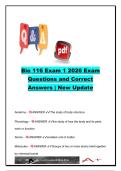
Bio 116 Exam 1 2026 Exam
Questions and Correct
Answers | New Update


Anatomy - ANSWER ✔✔The study of body structure


Physiology - ANSWER ✔✔the study of how the body and its parts

work or function


Atoms - ANSWER ✔✔smallest unit of matter


Molecules - ANSWER ✔✔Groups of two or more atoms held together

by chemical bonds

, Macromolecules - ANSWER ✔✔A very large organic molecule

composed of many smaller molecules


cells - ANSWER ✔✔The basic unit of structure and function in all

living things


Tissues - ANSWER ✔✔Groups of cells with a common structure and

function.


Organs - ANSWER ✔✔Groups of tissues that work together to

perform a specialized function or related functions


Organ systems - ANSWER ✔✔A group of two or more organs

working together for a specific job; e.g. the digestive system


organisms - ANSWER ✔✔organ systems functioning together


Homeostasis - ANSWER ✔✔When factors in the


external environment

(the outside world)

change, conditions in the

internal environment

(the fluid around

the body cells) must remain stable.

Document information

Uploaded on
June 8, 2026
Number of pages
13
Written in
2025/2026
Type
Exam (elaborations)
Contains
Questions & answers
$18.99

Wrong document? Swap it for free Within 14 days of purchase and before downloading, you can choose a different document. You can simply spend the amount again.
Written by students who passed
Immediately available after payment
Read online or as PDF

Seller avatar
Reputation scores are based on the amount of documents a seller has sold for a fee and the reviews they have received for those documents. There are three levels: Bronze, Silver and Gold. The better the reputation, the more your can rely on the quality of the sellers work.
NinjaNerd
3.4
(76)
Sold
406
Followers
6
Items
15556
Last sold
2 days ago


Why students choose Stuvia

Created by fellow students, verified by reviews

Quality you can trust: written by students who passed their tests and reviewed by others who've used these notes.

Didn't get what you expected? Choose another document

No worries! You can instantly pick a different document that better fits what you're looking for.

Pay as you like, start learning right away

No subscription, no commitments. Pay the way you're used to via credit card and download your PDF document instantly.

Student with book image

“Bought, downloaded, and aced it. It really can be that simple.”

Alisha Student

Working on your references?

Create accurate citations in APA, MLA and Harvard with our free citation generator.

Working on your references?

Frequently asked questions

