
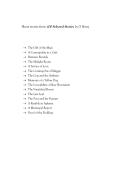
Short stories from 100 Selected Stories, by O Henry
The Gift of the Magi
A Cosmopolite in a Café
Between Rounds
The Skylight Room
A Service of Love
The Coming-Out of Maggie
The Cop and the Anthem
Memoirs of a Yellow Dog
The Love-philtre of Ikey Shoenstein
The Furnished Room
The Last Leaf
The Poet and the Peasant
A Ramble in Aphasia
A Municipal Report
Proof of the Pudding
,6 O HENRY - 100 S E L E C T E D STORIES
II
A Cosmopolite in a Café
A T MIDNIGHT THE CAFÉwas crowded. By some chance the little
table at which I sat had escaped the eye of incomers, and two
vacant chairs at it extended their arms with venal hospitality to the
influx of patrons.
And then a cosmopolite sat in one of them, and I was glad, for
I held a theory that since Adam no true citizen of the world has
existed. W e hear of them, and we see foreign labels on much
luggage, but we find travellers instead of cosmopolites.
I invoke your consideration of the scene - the marble-topped
tables, the range of leather-upholstered wall seats, the gay com
pany, the ladies dressed in demi-state toilets, speaking in an
exquisite visible chorus of taste, economy, opulence or art, the
sedulous and largess-loving garçons, the music wisely catering to all
with its raids upon the composers; the mélange of talk and laughter
- and, if you will, the Würzburger in the tall glass cones that bend
to your lips as a ripe cherry sways on its branch to the beak of a
robber jay. I was told by a sculptor from Mauch Chunk that the
scene was truly Parisian.
My cosmopolite was named E. Rushmore Coglan, and he will
be heard from next summer at Coney Island. He is to establish a
new 'attraction' there, he informed me, offering kingly diversion.
And then his conversation rang along parallels of latitude and lon
gitude. He took the great, round world in his hand, so to speak,
familiarly, contemptuously, and it seemed no larger than the seed
of a Maraschino cherry in a table-d'hôte grape fruit. He spoke dis
respectfully of the equator, he skipped from continent to conti
nent, he derided the zones, he mopped up the high seas with his
napkin. With a wave of his hand he would speak of a certain
bazaar in Hyderabad. Whiff! He would have you on skis in Lap
land. Zip! Now you rode the breakers with the Kanakas at
Kealaikahiki. Presto! He dragged you through an Arkansas post-
oak swamp, let you dry for a moment on the alkali plains of his
Idaho ranch, then whirled you into the society of Viennese arch
dukes. Anon he would be telling you of a cold he acquired in a
Chicago lake breeze and how old Escamila cured it in Buenos
Ayres with a hot infusion of the chuchula weed. You would have
, O HENRY - 100 S E L E C T E D STORIES 7
addressed the letter to 'E. Rushmore Coglan, Esq., the Earth,
Solar System, the Universe,' and have mailed it, feeling confident
that it would be delivered to him.
I was sure that I had at last found the one true cosmopolite since
Adam, and I listened to his world-wide discourse fearful lest I
should discover in it the local note of the mere globe-trotter. But
his opinions never fluttered or drooped; he was as impartial to
cities, countries and continents as the winds or gravitation.
And as E. Rushmore Coglan prattled of this little planet I
thought with glee of a great almost-cosmopolite who wrote for the
whole world and dedicated himself to Bombay. In a poem he has
to say that there is pride and rivalry between the cities of the
earth, and that 'the men that breed from them, they traffic up and
down, but cling to their cities' hem as a child to the mother's
gown.' And whenever they walk 'by roaring streets unknown' they
remember their native city 'most faithful, foolish, fond; making
her mere-breathed name their bond upon their bond.' And my
glee was roused because I had caught Mr. Kipling napping. Here I
had found a man not made from dust; one who had no narrow
boasts of birthplace or country, one who, if he bragged at all,
would brag of his whole round globe against the Martians and the
inhabitants of the Moon.
Expression on these subjects was precipitated from E. Rush-
more Coglan by the third corner to our table. While Coglan was
describing to me the topography along the Siberian Railway the
orchestra glided into a medley. The concluding air was 'Dixie,'
and as the exhilarating notes tumbled forth they were almost over
powered by a great clapping of hands from almost every table.
It is worth a paragraph to say that this remarkable scene can be
witnessed every evening in numerous cafés in the City of New
York. Tons of brew have been consumed over theories to account
for it. Some have conjectured hastily that all Southerners in town
hie themselves to cafés at nightfall. This applause of the 'rebel' air
in a Northern city does puzzle a little; but it is not insolvable. The
war with Spain, many years' generous mint and water-melon
crops, a few long-shot winners at the New Orleans race-track, and
the brilliant banquets given by the Indiana and Kansas citizens
who compose the North Carolina Society, have made the South
rather a 'fad' in Manhattan. Your manicure will lisp softly that
your left forefinger reminds her so much of a gentleman's in Rich
mond, Va. Oh, certainly; but many a lady has to work now - the
war, you know.
, 8 O HENRY - 100 S E L E C T E D STORIES
When 'Dixie' was being played a dark-haired young man
sprang up from somewhere with a Mosby guerrilla yell and waved
frantically his soft-brimmed hat. Then he strayed through the
smoke, dropped into the vacant chair at our table and pulled out
cigarettes.
The evening was at the period when reserve is thawed. One of
us mentioned three Würzburgers to the waiter; the dark-haired
young man acknowledged his inclusion in the order by a smile and
a nod. I hastened to ask him a question because I wanted to try out
a theory I had.
'Would you mind telling me,' I began, 'whether you are from - '
The fist of E. Rushmore Coglan banged the table and I was
jarred into silence.
'Excuse me,' said he, 'but that's a question I never like to hear
asked. What does it matter where a man is from? Is it fair to judge
a man by his post-office address? Why, I've seen Kentuckians who
hated whisky, Virginians who weren't descended from Pocahon
tas, Indianians who hadn't written a novel, Mexicans who didn't
wear velvet trousers with silver dollars sewed along the seams,
funny Englishmen, spendthrift Yankees, cold-blooded Southern
ers, narrow-minded Westerners, and New Yorkers who were too
busy to stop for an hour on the street to watch a one-armed
grocer's clerk do up cranberries in paper bags. Let a man be a man
and don't handicap him with the label of any section.'
'Pardon me,' I said, 'but my curiosity was not altogether an idle
one. I know the South, and when the band plays "Dixie" I like to
observe. I have formed the belief that the man who applauds that
air with special violence and ostensible sectional loyalty is invari
ably a native of either Secaucus, N.J., or the district between
Murray Hill Lyceum and the Harlem River, this city. I was about
to put my opinion to the test by inquiring of this gentleman when
you interrupted with your own - larger theory, I must confess.'
And now the dark-haired young man spoke to me, and it
became evident that his mind also moved along its own set of
grooves.
'I should like to be a periwinkle,' said he, mysteriously, 'on the
top of a valley, and sing too-ralloo-ralloo.'
This was clearly too obscure, so I turned again to Coglan.
'I've been around the world twelve times,' said he. 'I know an
Esquimau in Upernavik who sends to Cincinnati for his neckties,
and I saw a goat-herder in Uruguay who won a prize in a Battle
Creek breakfast-food puzzle competition. I pay rent on a room in
The Gift of the Magi
A Cosmopolite in a Café
Between Rounds
The Skylight Room
A Service of Love
The Coming-Out of Maggie
The Cop and the Anthem
Memoirs of a Yellow Dog
The Love-philtre of Ikey Shoenstein
The Furnished Room
The Last Leaf
The Poet and the Peasant
A Ramble in Aphasia
A Municipal Report
Proof of the Pudding
,6 O HENRY - 100 S E L E C T E D STORIES
II
A Cosmopolite in a Café
A T MIDNIGHT THE CAFÉwas crowded. By some chance the little
table at which I sat had escaped the eye of incomers, and two
vacant chairs at it extended their arms with venal hospitality to the
influx of patrons.
And then a cosmopolite sat in one of them, and I was glad, for
I held a theory that since Adam no true citizen of the world has
existed. W e hear of them, and we see foreign labels on much
luggage, but we find travellers instead of cosmopolites.
I invoke your consideration of the scene - the marble-topped
tables, the range of leather-upholstered wall seats, the gay com
pany, the ladies dressed in demi-state toilets, speaking in an
exquisite visible chorus of taste, economy, opulence or art, the
sedulous and largess-loving garçons, the music wisely catering to all
with its raids upon the composers; the mélange of talk and laughter
- and, if you will, the Würzburger in the tall glass cones that bend
to your lips as a ripe cherry sways on its branch to the beak of a
robber jay. I was told by a sculptor from Mauch Chunk that the
scene was truly Parisian.
My cosmopolite was named E. Rushmore Coglan, and he will
be heard from next summer at Coney Island. He is to establish a
new 'attraction' there, he informed me, offering kingly diversion.
And then his conversation rang along parallels of latitude and lon
gitude. He took the great, round world in his hand, so to speak,
familiarly, contemptuously, and it seemed no larger than the seed
of a Maraschino cherry in a table-d'hôte grape fruit. He spoke dis
respectfully of the equator, he skipped from continent to conti
nent, he derided the zones, he mopped up the high seas with his
napkin. With a wave of his hand he would speak of a certain
bazaar in Hyderabad. Whiff! He would have you on skis in Lap
land. Zip! Now you rode the breakers with the Kanakas at
Kealaikahiki. Presto! He dragged you through an Arkansas post-
oak swamp, let you dry for a moment on the alkali plains of his
Idaho ranch, then whirled you into the society of Viennese arch
dukes. Anon he would be telling you of a cold he acquired in a
Chicago lake breeze and how old Escamila cured it in Buenos
Ayres with a hot infusion of the chuchula weed. You would have
, O HENRY - 100 S E L E C T E D STORIES 7
addressed the letter to 'E. Rushmore Coglan, Esq., the Earth,
Solar System, the Universe,' and have mailed it, feeling confident
that it would be delivered to him.
I was sure that I had at last found the one true cosmopolite since
Adam, and I listened to his world-wide discourse fearful lest I
should discover in it the local note of the mere globe-trotter. But
his opinions never fluttered or drooped; he was as impartial to
cities, countries and continents as the winds or gravitation.
And as E. Rushmore Coglan prattled of this little planet I
thought with glee of a great almost-cosmopolite who wrote for the
whole world and dedicated himself to Bombay. In a poem he has
to say that there is pride and rivalry between the cities of the
earth, and that 'the men that breed from them, they traffic up and
down, but cling to their cities' hem as a child to the mother's
gown.' And whenever they walk 'by roaring streets unknown' they
remember their native city 'most faithful, foolish, fond; making
her mere-breathed name their bond upon their bond.' And my
glee was roused because I had caught Mr. Kipling napping. Here I
had found a man not made from dust; one who had no narrow
boasts of birthplace or country, one who, if he bragged at all,
would brag of his whole round globe against the Martians and the
inhabitants of the Moon.
Expression on these subjects was precipitated from E. Rush-
more Coglan by the third corner to our table. While Coglan was
describing to me the topography along the Siberian Railway the
orchestra glided into a medley. The concluding air was 'Dixie,'
and as the exhilarating notes tumbled forth they were almost over
powered by a great clapping of hands from almost every table.
It is worth a paragraph to say that this remarkable scene can be
witnessed every evening in numerous cafés in the City of New
York. Tons of brew have been consumed over theories to account
for it. Some have conjectured hastily that all Southerners in town
hie themselves to cafés at nightfall. This applause of the 'rebel' air
in a Northern city does puzzle a little; but it is not insolvable. The
war with Spain, many years' generous mint and water-melon
crops, a few long-shot winners at the New Orleans race-track, and
the brilliant banquets given by the Indiana and Kansas citizens
who compose the North Carolina Society, have made the South
rather a 'fad' in Manhattan. Your manicure will lisp softly that
your left forefinger reminds her so much of a gentleman's in Rich
mond, Va. Oh, certainly; but many a lady has to work now - the
war, you know.
, 8 O HENRY - 100 S E L E C T E D STORIES
When 'Dixie' was being played a dark-haired young man
sprang up from somewhere with a Mosby guerrilla yell and waved
frantically his soft-brimmed hat. Then he strayed through the
smoke, dropped into the vacant chair at our table and pulled out
cigarettes.
The evening was at the period when reserve is thawed. One of
us mentioned three Würzburgers to the waiter; the dark-haired
young man acknowledged his inclusion in the order by a smile and
a nod. I hastened to ask him a question because I wanted to try out
a theory I had.
'Would you mind telling me,' I began, 'whether you are from - '
The fist of E. Rushmore Coglan banged the table and I was
jarred into silence.
'Excuse me,' said he, 'but that's a question I never like to hear
asked. What does it matter where a man is from? Is it fair to judge
a man by his post-office address? Why, I've seen Kentuckians who
hated whisky, Virginians who weren't descended from Pocahon
tas, Indianians who hadn't written a novel, Mexicans who didn't
wear velvet trousers with silver dollars sewed along the seams,
funny Englishmen, spendthrift Yankees, cold-blooded Southern
ers, narrow-minded Westerners, and New Yorkers who were too
busy to stop for an hour on the street to watch a one-armed
grocer's clerk do up cranberries in paper bags. Let a man be a man
and don't handicap him with the label of any section.'
'Pardon me,' I said, 'but my curiosity was not altogether an idle
one. I know the South, and when the band plays "Dixie" I like to
observe. I have formed the belief that the man who applauds that
air with special violence and ostensible sectional loyalty is invari
ably a native of either Secaucus, N.J., or the district between
Murray Hill Lyceum and the Harlem River, this city. I was about
to put my opinion to the test by inquiring of this gentleman when
you interrupted with your own - larger theory, I must confess.'
And now the dark-haired young man spoke to me, and it
became evident that his mind also moved along its own set of
grooves.
'I should like to be a periwinkle,' said he, mysteriously, 'on the
top of a valley, and sing too-ralloo-ralloo.'
This was clearly too obscure, so I turned again to Coglan.
'I've been around the world twelve times,' said he. 'I know an
Esquimau in Upernavik who sends to Cincinnati for his neckties,
and I saw a goat-herder in Uruguay who won a prize in a Battle
Creek breakfast-food puzzle competition. I pay rent on a room in


