

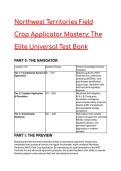
Northwest Territories Field
Crop Applicator Mastery: The
Elite Universal Test Bank
PART 0: THE NAVIGATOR
Cognitive Tier Question Range Primary Knowledge Domains
Assessed
Tier 1: Foundational Syntax & Q1 – Q10 Statutory authority (NWT
Application Pesticide Act), preliminary
screening (MVRMA), core
pest/disease identification
(Lygus bugs, Verticillium wilt),
and hard-deck regulatory
timelines.
Tier 2: Complex Application Q11 – Q20 Situational drift mitigation,
& Simulation W-A-L-E-S sequence
formulation overlapping,
environmental safety protocols,
riparian buffer management,
and specialized storage
compliance.
Tier 3: Grandmaster Q21 – Q30 High-stakes multi-variable
Synthesis incident management, pesticide
liability, compounding
regulatory failures, and
advanced agronomic
diagnostics in northern
climates.
PART I: THE PREVIEW
Mastering this elite test bank translates directly to operational superiority, transforming
candidates from procedural novices into legally invulnerable, highly analytical Northwest
Territories (NWT) Field Crop Applicators. By internalizing the rigid frameworks of the NWT
Pesticide Act and advanced agronomic principles, the student hardwires their ability to execute
flawless judgment under extreme field and administrative pressure.
,The "Critical Axioms" Cheat Sheet:
● The MVRMA Screening Axiom: Under NWT law, all first-time Pesticide Application
Permits are strictly subject to the preliminary screening process under the Mackenzie
Valley Resource Management Act. Subsequent renewals bypass this only if the project
scope remains perfectly identical.
● The Form 5 Hard Deck: Field crop applicators must submit a completed application
report (Form 5) to an inspector strictly within exactly ten (10) days of the expiry or
cancellation of a pesticide application permit.
● The Whistleblower Shield: The NWT Pesticide Act explicitly forbids employer retaliation
against employees who report environmental contamination; violations result in severe
summary convictions, including a fine not exceeding $5,000, or imprisonment for up to 90
days, or both.
● The Riparian Redline: Pesticide applications in natural riparian areas or on areas of
public land within 30 horizontal meters from an open body of water strictly require a
Pesticide Special Use Approval prior to application.
● The Storage Mandate: Chemical storage facilities must be locked, strictly inaccessible to
the public, used exclusively for pesticides, and must never drain directly or indirectly into a
storm sewer or water course.
## PART II: THE ELITE TEST BANK
Tier 1: Foundational Syntax & Application
Q1: An agricultural enterprise in Norman Wells intends to apply herbicides to a newly
established field crop operation. According to NWT environmental regulations, what regulatory
milestone FIRST must be achieved before a Pesticide Application Permit can be legally issued
for this new facility? A) The operation must submit a five-year retrospective yield analysis to the
Territorial Farmers Association. B) The application must undergo a preliminary screening
process under the Mackenzie Valley Resource Management Act (MVRMA). C) The applicator
must post bilingual English and French warning signs along the entire perimeter of the property.
D) The application must receive a direct, standalone environmental waiver from the Federal
Pest Management Regulatory Agency (PMRA).
● The Answer: B (The application must undergo a preliminary screening process under the
Mackenzie Valley Resource Management Act (MVRMA).)
● Distractor Analysis:
○ A is incorrect: Historical yield data has no bearing on environmental pesticide
regulation or permit issuance, and the Territorial Farmers Association is an
advocacy group, not a regulatory body.
○ C is incorrect: While signage is an operational requirement for specific storage
facilities, the statutory prerequisite for permit approval of a new operational footprint
is the environmental screening.
○ D is incorrect: The PMRA registers chemicals at the federal level, but the MVRMA
governs the territorial environmental screening process for the physical application
of those chemicals within the NWT.
The Mentor's Analysis: Territorial oversight prioritizes ecological preservation over agricultural
expediency. When establishing a new application footprint in the NWT, the immediate priority is
satisfying the Mackenzie Valley Resource Management Act. By utilizing the MVRMA screening
pipeline early, you bypass the common trap of operational delays caused by rejected permit
applications. Professional/Academic Intuition: First-time territorial applications inherently
, trigger MVRMA preliminary screening; scope modifications trigger it again.
Q2: Under the NWT Pesticide Regulations, what is the exact, non-negotiable statutory deadline
for a commercial permit holder to submit their pesticide application report (Form 5) to an
inspector? A) Annually on December 31st, regardless of application timing. B) Within 10 days of
the expiry or cancellation of the pesticide application permit. C) Exactly 24 hours after every
individual field application. D) Prior to the preliminary MVRMA environmental screening.
● The Answer: B (Within 10 days of the expiry or cancellation of the pesticide application
permit.)
● Distractor Analysis:
○ A is incorrect: This represents a common legacy reporting timeline in other
provincial jurisdictions, but NWT law specifically anchors reporting to the permit's
distinct lifecycle.
○ C is incorrect: While daily internal logging is an agronomic best practice for farm
management, the statutory Form 5 submission to the government is tied to permit
expiry, not daily field operations.
○ D is incorrect: Form 5 is a retrospective record of what was actually applied; it
cannot physically be submitted prior to the screening that allows the application to
occur.
The Mentor's Analysis: Regulatory deadlines are absolute and uncompromising. The reporting
mechanism is tethered directly to the lifecycle of the permit itself. By tracking the exact expiry
date of your permit, you bypass the common novice error of missing territorial reporting windows
and facing administrative penalties. Professional/Academic Intuition: Form 5 submission is
triggered by permit death; you have exactly ten days to report your chemical load to the
inspector.
Q3: During August scouting of a potato crop in the Sahtu Region, an applicator observes
premature yellowing and death of the foliage. Slicing the stems longitudinally reveals a distinct
tan discoloration plugging the vascular tissues. Based on these symptoms, which pathogen is
the MOST ACCURATE diagnosis? A) Lygus bugs (Lygus spp.) B) Verticillium Wilt C) True
Armyworm (Mythimna unipuncta) D) European Corn Borer (Ostrinia nubilalis)
● The Answer: B (Verticillium Wilt)
● Distractor Analysis:
○ A is incorrect: Lygus bugs cause "chalk spot" feeding damage on the seeds and
pods of pulse crops like peas and lentils, not internal vascular plugging in potatoes.
○ C is incorrect: Armyworms are defoliators that chew ragged holes in leaves; they do
not cause internal vascular discoloration or wilting through plumbing blockage.
○ D is incorrect: Corn borers tunnel into stalks causing structural failure, but the
classic tan vascular plugging and premature yellowing is the definitive signature of
a fungal wilt.
The Mentor's Analysis: Symptomatology dictates pathogen identification. Premature yellowing
combined with internal tan vascular tissue is the absolute hallmark of Verticillium, a fungal wilt
that physically chokes the plant's water transport system by invading through the roots. By
utilizing stem cross-sections, you bypass the common trap of misdiagnosing fungal wilt as
simple drought stress. Professional/Academic Intuition: Tan vascular plugging in potatoes
equals Verticillium Wilt; the fungus invades through root wounds and destroys the plant from the
inside out.
Q4: An agricultural worker in the NWT discovers an employer deliberately discharging surplus
tank-mix directly into a drainage ditch. The worker reports this to the environmental authority
and is immediately fired in retaliation. Under the NWT Pesticide Act, what is the MAXIMUM
Crop Applicator Mastery: The
Elite Universal Test Bank
PART 0: THE NAVIGATOR
Cognitive Tier Question Range Primary Knowledge Domains
Assessed
Tier 1: Foundational Syntax & Q1 – Q10 Statutory authority (NWT
Application Pesticide Act), preliminary
screening (MVRMA), core
pest/disease identification
(Lygus bugs, Verticillium wilt),
and hard-deck regulatory
timelines.
Tier 2: Complex Application Q11 – Q20 Situational drift mitigation,
& Simulation W-A-L-E-S sequence
formulation overlapping,
environmental safety protocols,
riparian buffer management,
and specialized storage
compliance.
Tier 3: Grandmaster Q21 – Q30 High-stakes multi-variable
Synthesis incident management, pesticide
liability, compounding
regulatory failures, and
advanced agronomic
diagnostics in northern
climates.
PART I: THE PREVIEW
Mastering this elite test bank translates directly to operational superiority, transforming
candidates from procedural novices into legally invulnerable, highly analytical Northwest
Territories (NWT) Field Crop Applicators. By internalizing the rigid frameworks of the NWT
Pesticide Act and advanced agronomic principles, the student hardwires their ability to execute
flawless judgment under extreme field and administrative pressure.
,The "Critical Axioms" Cheat Sheet:
● The MVRMA Screening Axiom: Under NWT law, all first-time Pesticide Application
Permits are strictly subject to the preliminary screening process under the Mackenzie
Valley Resource Management Act. Subsequent renewals bypass this only if the project
scope remains perfectly identical.
● The Form 5 Hard Deck: Field crop applicators must submit a completed application
report (Form 5) to an inspector strictly within exactly ten (10) days of the expiry or
cancellation of a pesticide application permit.
● The Whistleblower Shield: The NWT Pesticide Act explicitly forbids employer retaliation
against employees who report environmental contamination; violations result in severe
summary convictions, including a fine not exceeding $5,000, or imprisonment for up to 90
days, or both.
● The Riparian Redline: Pesticide applications in natural riparian areas or on areas of
public land within 30 horizontal meters from an open body of water strictly require a
Pesticide Special Use Approval prior to application.
● The Storage Mandate: Chemical storage facilities must be locked, strictly inaccessible to
the public, used exclusively for pesticides, and must never drain directly or indirectly into a
storm sewer or water course.
## PART II: THE ELITE TEST BANK
Tier 1: Foundational Syntax & Application
Q1: An agricultural enterprise in Norman Wells intends to apply herbicides to a newly
established field crop operation. According to NWT environmental regulations, what regulatory
milestone FIRST must be achieved before a Pesticide Application Permit can be legally issued
for this new facility? A) The operation must submit a five-year retrospective yield analysis to the
Territorial Farmers Association. B) The application must undergo a preliminary screening
process under the Mackenzie Valley Resource Management Act (MVRMA). C) The applicator
must post bilingual English and French warning signs along the entire perimeter of the property.
D) The application must receive a direct, standalone environmental waiver from the Federal
Pest Management Regulatory Agency (PMRA).
● The Answer: B (The application must undergo a preliminary screening process under the
Mackenzie Valley Resource Management Act (MVRMA).)
● Distractor Analysis:
○ A is incorrect: Historical yield data has no bearing on environmental pesticide
regulation or permit issuance, and the Territorial Farmers Association is an
advocacy group, not a regulatory body.
○ C is incorrect: While signage is an operational requirement for specific storage
facilities, the statutory prerequisite for permit approval of a new operational footprint
is the environmental screening.
○ D is incorrect: The PMRA registers chemicals at the federal level, but the MVRMA
governs the territorial environmental screening process for the physical application
of those chemicals within the NWT.
The Mentor's Analysis: Territorial oversight prioritizes ecological preservation over agricultural
expediency. When establishing a new application footprint in the NWT, the immediate priority is
satisfying the Mackenzie Valley Resource Management Act. By utilizing the MVRMA screening
pipeline early, you bypass the common trap of operational delays caused by rejected permit
applications. Professional/Academic Intuition: First-time territorial applications inherently
, trigger MVRMA preliminary screening; scope modifications trigger it again.
Q2: Under the NWT Pesticide Regulations, what is the exact, non-negotiable statutory deadline
for a commercial permit holder to submit their pesticide application report (Form 5) to an
inspector? A) Annually on December 31st, regardless of application timing. B) Within 10 days of
the expiry or cancellation of the pesticide application permit. C) Exactly 24 hours after every
individual field application. D) Prior to the preliminary MVRMA environmental screening.
● The Answer: B (Within 10 days of the expiry or cancellation of the pesticide application
permit.)
● Distractor Analysis:
○ A is incorrect: This represents a common legacy reporting timeline in other
provincial jurisdictions, but NWT law specifically anchors reporting to the permit's
distinct lifecycle.
○ C is incorrect: While daily internal logging is an agronomic best practice for farm
management, the statutory Form 5 submission to the government is tied to permit
expiry, not daily field operations.
○ D is incorrect: Form 5 is a retrospective record of what was actually applied; it
cannot physically be submitted prior to the screening that allows the application to
occur.
The Mentor's Analysis: Regulatory deadlines are absolute and uncompromising. The reporting
mechanism is tethered directly to the lifecycle of the permit itself. By tracking the exact expiry
date of your permit, you bypass the common novice error of missing territorial reporting windows
and facing administrative penalties. Professional/Academic Intuition: Form 5 submission is
triggered by permit death; you have exactly ten days to report your chemical load to the
inspector.
Q3: During August scouting of a potato crop in the Sahtu Region, an applicator observes
premature yellowing and death of the foliage. Slicing the stems longitudinally reveals a distinct
tan discoloration plugging the vascular tissues. Based on these symptoms, which pathogen is
the MOST ACCURATE diagnosis? A) Lygus bugs (Lygus spp.) B) Verticillium Wilt C) True
Armyworm (Mythimna unipuncta) D) European Corn Borer (Ostrinia nubilalis)
● The Answer: B (Verticillium Wilt)
● Distractor Analysis:
○ A is incorrect: Lygus bugs cause "chalk spot" feeding damage on the seeds and
pods of pulse crops like peas and lentils, not internal vascular plugging in potatoes.
○ C is incorrect: Armyworms are defoliators that chew ragged holes in leaves; they do
not cause internal vascular discoloration or wilting through plumbing blockage.
○ D is incorrect: Corn borers tunnel into stalks causing structural failure, but the
classic tan vascular plugging and premature yellowing is the definitive signature of
a fungal wilt.
The Mentor's Analysis: Symptomatology dictates pathogen identification. Premature yellowing
combined with internal tan vascular tissue is the absolute hallmark of Verticillium, a fungal wilt
that physically chokes the plant's water transport system by invading through the roots. By
utilizing stem cross-sections, you bypass the common trap of misdiagnosing fungal wilt as
simple drought stress. Professional/Academic Intuition: Tan vascular plugging in potatoes
equals Verticillium Wilt; the fungus invades through root wounds and destroys the plant from the
inside out.
Q4: An agricultural worker in the NWT discovers an employer deliberately discharging surplus
tank-mix directly into a drainage ditch. The worker reports this to the environmental authority
and is immediately fired in retaliation. Under the NWT Pesticide Act, what is the MAXIMUM


