

The Elite Universal Test Bank:
Alabama Cosmetology and
Barbering State Law
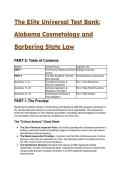
PART 0: Table of Contents
Section Content Focus Cognitive Tier
PART I The Preview: Mission & Critical Strategic Overview
Axioms
PART II The Elite Test Bank: 30-Point Comprehensive Assessment
MCQ Gauntlet
Questions 1–10 Foundational Syntax & Tier 1: Core Mechanics
Statutory Application
Questions 11–20 Complex Application & Tier 2: Real-World Dynamics
Regulatory Simulation
Questions 21–30 Grandmaster Synthesis & Tier 3: Elite Mastery
Crisis Mitigation
PART I: The Preview
Mastering the Alabama Board of Cosmetology and Barbering (ABOCB) regulatory framework is
the ultimate delineator between a licensed professional and a legal liability. This assessment
forces the internalization of strict statutory parameters, translating abstract legislative mandates
into immediate, elite-level operational compliance on the clinic floor.
The "Critical Axioms" Cheat Sheet
● The Zero-Tolerance Inspection Rule: Any facility operating with unlicensed personnel or
lacking a valid shop license immediately triggers an inspection score of zero and severe
administrative tribunal sanctions.
● The Master-Apprentice Paradigm: A sponsor must hold five continuous years of active
licensure, train only one apprentice at a time, and rigorously submit cumulative hours by
the 15th of each month to prevent forfeiture.
● The Disinfection Absolute: Standard tools require an EPA-registered hospital
bactericidal, virucidal, and fungicidal agent. Implements exposed to blood or bodily fluids
unequivocally demand complete immersion in an EPA-registered hospital-grade
tuberculocidal.
, ● The Prohibited Arsenal: Styptic pencils, methyl methacrylate (MMA), callus shavers
(Credo blades), and modified craft/hobby tools are strictly prohibited. In regulatory law,
mere possession equates to use.
● The License Cadence: Personal licenses for cosmetologists, estheticians, and
manicurists expire in odd-numbered years by the practitioner's birth month. Class 2
Barbers renew in even-numbered years by birth month. All shop and facility licenses
definitively expire October 31 of odd-numbered years.
Foundational Operational Metrics
To establish baseline parameters before entering the assessment, the following table
synthesizes the mandatory educational hour requirements for full state licensure versus the
corresponding apprenticeship ratios :
License Classification Formal School Hours Apprenticeship Hours Maximum
Apprenticeship
Duration
Cosmetologist 1,500 3,000 3 Years
Esthetician 1,000 2,000 3 Years
Class 2 Barber 1,000 2,000 2 Years
Manicurist 750 1,200 2 Years
Natural Hair Stylist 210 420 6 Months
Shampoo Assistant 0 0 N/A
PART II: THE ELITE TEST BANK
Tier 1: Foundational Syntax & Application (Questions 1–10)
Q1: A candidate wishes to become a licensed cosmetologist in Alabama via the apprenticeship
pathway rather than attending a formal cosmetology school. Based on ABOCB regulations,
which of the following outlines the EXACT minimum requirements the candidate must satisfy?
A) 1,500 apprentice clock hours completed over a maximum of two years under a sponsor with
three years of experience. B) 2,000 apprentice clock hours completed over a maximum of three
years under a sponsor with five years of experience. C) 3,000 apprentice clock hours completed
over a maximum of three years under a sponsor with five years of continuous licensure. D)
3,000 apprentice clock hours completed over a maximum of two years under a sponsor holding
an active instructor's license.
● The Answer: C (3,000 apprentice clock hours completed over a maximum of three years
under a sponsor with five years of continuous licensure.)
● Distractor Analysis:
○ A is incorrect: 1,500 hours is the statutory requirement for a formal institutional
school program, not an apprenticeship. Furthermore, the sponsor must hold five
years of experience, not three.
○ B is incorrect: 2,000 apprentice hours is the legal requirement for Estheticians,
Natural Hair Stylists, and Class 2 Barbers, not Cosmetologists.
○ D is incorrect: Cosmetology apprentices are granted a maximum of three years to
complete their training, not two. Additionally, the sponsor is not required to hold an
instructor's license, only a standard practitioner license active for five continuous
, years.
The Mentor's Analysis: The state of Alabama mandates a rigorous 2:1 ratio for apprenticeship
hours versus formal academic hours. A cosmetologist requires 1,500 school hours; therefore,
the apprentice equivalent is exactly 3,000 hours. The chronological timeline to complete this is
strictly capped at three years to prevent perpetual apprenticeships. Professional/Academic
Intuition: Apprenticeship hours are always double the formal school hours, requiring a
sponsor vetted by half a decade of uninterrupted professional practice.
Q2: During a routine ABOCB inspection, an inspector observes a manicurist utilizing a
distinctively odoriferous liquid nail monomer. The inspector immediately flags a catastrophic
violation, issues a citation, and confiscates the product. Which chemical substance was the
manicurist MOST LIKELY possessing? A) Ethyl Methacrylate (EMA) B) Methyl Methacrylate
(MMA) C) Cyanoacrylate adhesive D) Acetone-based monomer solvent
● The Answer: B (Methyl Methacrylate (MMA))
● Distractor Analysis:
○ A is incorrect: Ethyl Methacrylate (EMA) is the legally approved, industry-standard
alternative to MMA. It provides necessary flexibility and is universally safe for
human nail enhancements.
○ C is incorrect: Cyanoacrylate is the standard active ingredient in commercial nail
glues, wraps, and resin systems, which are perfectly legal under current board
rules.
○ D is incorrect: While acetone is an aggressive solvent, it is not a banned substance;
it is standard for acrylic removal. This distractor assumes the novice conflates all
harsh chemical families.
The Mentor's Analysis: Methyl Methacrylate (MMA) is universally banned by the ABOCB due
to its severe systemic toxicity, extreme risk of allergic sensitization, and a molecular structure
that cures so rigidly it frequently tears the natural nail plate from the nail bed upon impact. Its
mere possession in an Alabama salon is illegal and constitutes a major disciplinary breach.
Professional/Academic Intuition: In regulatory compliance, MMA is the absolute "third
rail" of nail chemistry. Its presence equates to immediate, severe disciplinary action.
Q3: A licensed cosmetologist born in April 1990 is preparing to renew their personal license.
Under the statutory renewal cadence mandated by the ABOCB, when is the LATEST this
professional can renew without incurring a financial penalty? A) April 30 of the next
even-numbered year. B) October 31 of the next odd-numbered year. C) April 30 of the next
odd-numbered year. D) September 30 of the next even-numbered year.
● The Answer: C (April 30 of the next odd-numbered year.)
● Distractor Analysis:
○ A is incorrect: Even-numbered years are reserved strictly for the renewal of Class 2
Barbers. Cosmetologists operate exclusively on an odd-year cycle.
○ B is incorrect: October 31 of odd-numbered years is the absolute deadline for Shop
and School license renewals, not personal practitioner licenses.
○ D is incorrect: This blends the shop license expiration month (September 30) with
the barbering renewal year (even), demonstrating a complete failure to synthesize
the regulatory timeline.
The Mentor's Analysis: Alabama specifically bifurcates its licensing cycles to prevent
catastrophic administrative bottlenecks at the state level. Personal licenses for cosmetologists,
estheticians, and manicurists expire exactly on the last day of the licensee's birth month in
odd-numbered years. Any renewal postmarked past this date triggers an immediate $54 late
fee. Professional/Academic Intuition: Cosmetology equals Odd years. Barbering equals
Alabama Cosmetology and
Barbering State Law
PART 0: Table of Contents
Section Content Focus Cognitive Tier
PART I The Preview: Mission & Critical Strategic Overview
Axioms
PART II The Elite Test Bank: 30-Point Comprehensive Assessment
MCQ Gauntlet
Questions 1–10 Foundational Syntax & Tier 1: Core Mechanics
Statutory Application
Questions 11–20 Complex Application & Tier 2: Real-World Dynamics
Regulatory Simulation
Questions 21–30 Grandmaster Synthesis & Tier 3: Elite Mastery
Crisis Mitigation
PART I: The Preview
Mastering the Alabama Board of Cosmetology and Barbering (ABOCB) regulatory framework is
the ultimate delineator between a licensed professional and a legal liability. This assessment
forces the internalization of strict statutory parameters, translating abstract legislative mandates
into immediate, elite-level operational compliance on the clinic floor.
The "Critical Axioms" Cheat Sheet
● The Zero-Tolerance Inspection Rule: Any facility operating with unlicensed personnel or
lacking a valid shop license immediately triggers an inspection score of zero and severe
administrative tribunal sanctions.
● The Master-Apprentice Paradigm: A sponsor must hold five continuous years of active
licensure, train only one apprentice at a time, and rigorously submit cumulative hours by
the 15th of each month to prevent forfeiture.
● The Disinfection Absolute: Standard tools require an EPA-registered hospital
bactericidal, virucidal, and fungicidal agent. Implements exposed to blood or bodily fluids
unequivocally demand complete immersion in an EPA-registered hospital-grade
tuberculocidal.
, ● The Prohibited Arsenal: Styptic pencils, methyl methacrylate (MMA), callus shavers
(Credo blades), and modified craft/hobby tools are strictly prohibited. In regulatory law,
mere possession equates to use.
● The License Cadence: Personal licenses for cosmetologists, estheticians, and
manicurists expire in odd-numbered years by the practitioner's birth month. Class 2
Barbers renew in even-numbered years by birth month. All shop and facility licenses
definitively expire October 31 of odd-numbered years.
Foundational Operational Metrics
To establish baseline parameters before entering the assessment, the following table
synthesizes the mandatory educational hour requirements for full state licensure versus the
corresponding apprenticeship ratios :
License Classification Formal School Hours Apprenticeship Hours Maximum
Apprenticeship
Duration
Cosmetologist 1,500 3,000 3 Years
Esthetician 1,000 2,000 3 Years
Class 2 Barber 1,000 2,000 2 Years
Manicurist 750 1,200 2 Years
Natural Hair Stylist 210 420 6 Months
Shampoo Assistant 0 0 N/A
PART II: THE ELITE TEST BANK
Tier 1: Foundational Syntax & Application (Questions 1–10)
Q1: A candidate wishes to become a licensed cosmetologist in Alabama via the apprenticeship
pathway rather than attending a formal cosmetology school. Based on ABOCB regulations,
which of the following outlines the EXACT minimum requirements the candidate must satisfy?
A) 1,500 apprentice clock hours completed over a maximum of two years under a sponsor with
three years of experience. B) 2,000 apprentice clock hours completed over a maximum of three
years under a sponsor with five years of experience. C) 3,000 apprentice clock hours completed
over a maximum of three years under a sponsor with five years of continuous licensure. D)
3,000 apprentice clock hours completed over a maximum of two years under a sponsor holding
an active instructor's license.
● The Answer: C (3,000 apprentice clock hours completed over a maximum of three years
under a sponsor with five years of continuous licensure.)
● Distractor Analysis:
○ A is incorrect: 1,500 hours is the statutory requirement for a formal institutional
school program, not an apprenticeship. Furthermore, the sponsor must hold five
years of experience, not three.
○ B is incorrect: 2,000 apprentice hours is the legal requirement for Estheticians,
Natural Hair Stylists, and Class 2 Barbers, not Cosmetologists.
○ D is incorrect: Cosmetology apprentices are granted a maximum of three years to
complete their training, not two. Additionally, the sponsor is not required to hold an
instructor's license, only a standard practitioner license active for five continuous
, years.
The Mentor's Analysis: The state of Alabama mandates a rigorous 2:1 ratio for apprenticeship
hours versus formal academic hours. A cosmetologist requires 1,500 school hours; therefore,
the apprentice equivalent is exactly 3,000 hours. The chronological timeline to complete this is
strictly capped at three years to prevent perpetual apprenticeships. Professional/Academic
Intuition: Apprenticeship hours are always double the formal school hours, requiring a
sponsor vetted by half a decade of uninterrupted professional practice.
Q2: During a routine ABOCB inspection, an inspector observes a manicurist utilizing a
distinctively odoriferous liquid nail monomer. The inspector immediately flags a catastrophic
violation, issues a citation, and confiscates the product. Which chemical substance was the
manicurist MOST LIKELY possessing? A) Ethyl Methacrylate (EMA) B) Methyl Methacrylate
(MMA) C) Cyanoacrylate adhesive D) Acetone-based monomer solvent
● The Answer: B (Methyl Methacrylate (MMA))
● Distractor Analysis:
○ A is incorrect: Ethyl Methacrylate (EMA) is the legally approved, industry-standard
alternative to MMA. It provides necessary flexibility and is universally safe for
human nail enhancements.
○ C is incorrect: Cyanoacrylate is the standard active ingredient in commercial nail
glues, wraps, and resin systems, which are perfectly legal under current board
rules.
○ D is incorrect: While acetone is an aggressive solvent, it is not a banned substance;
it is standard for acrylic removal. This distractor assumes the novice conflates all
harsh chemical families.
The Mentor's Analysis: Methyl Methacrylate (MMA) is universally banned by the ABOCB due
to its severe systemic toxicity, extreme risk of allergic sensitization, and a molecular structure
that cures so rigidly it frequently tears the natural nail plate from the nail bed upon impact. Its
mere possession in an Alabama salon is illegal and constitutes a major disciplinary breach.
Professional/Academic Intuition: In regulatory compliance, MMA is the absolute "third
rail" of nail chemistry. Its presence equates to immediate, severe disciplinary action.
Q3: A licensed cosmetologist born in April 1990 is preparing to renew their personal license.
Under the statutory renewal cadence mandated by the ABOCB, when is the LATEST this
professional can renew without incurring a financial penalty? A) April 30 of the next
even-numbered year. B) October 31 of the next odd-numbered year. C) April 30 of the next
odd-numbered year. D) September 30 of the next even-numbered year.
● The Answer: C (April 30 of the next odd-numbered year.)
● Distractor Analysis:
○ A is incorrect: Even-numbered years are reserved strictly for the renewal of Class 2
Barbers. Cosmetologists operate exclusively on an odd-year cycle.
○ B is incorrect: October 31 of odd-numbered years is the absolute deadline for Shop
and School license renewals, not personal practitioner licenses.
○ D is incorrect: This blends the shop license expiration month (September 30) with
the barbering renewal year (even), demonstrating a complete failure to synthesize
the regulatory timeline.
The Mentor's Analysis: Alabama specifically bifurcates its licensing cycles to prevent
catastrophic administrative bottlenecks at the state level. Personal licenses for cosmetologists,
estheticians, and manicurists expire exactly on the last day of the licensee's birth month in
odd-numbered years. Any renewal postmarked past this date triggers an immediate $54 late
fee. Professional/Academic Intuition: Cosmetology equals Odd years. Barbering equals


