

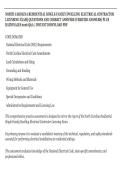
NORTH CAROLINA RESIDENTIAL SINGLE-FAMILY DWELLING ELECTRICAL CONTRACTOR
LICENSING EXAM] QUESTIONS AND CORRECT ANSWERS (VERIFIED ANSWERS) PLUS
RATIONALES 2026 Q&A | INSTANT DOWNLOAD PDF
CORE DOMAINS
National Electrical Code (NEC) Requirements
North Carolina Electrical Code Amendments
Load Calculations and Sizing
Grounding and Bonding
Wiring Methods and Materials
Equipment for General Use
Special Occupancies and Conditions
Administrative Requirements and Licensing Law
This comprehensive practice assessment is designed to mirror the rigors of the North Carolina Residential
Single-Family Dwelling Electrical Contractor Licensing Exam.
Its primary purpose is to evaluate a candidate's mastery of the technical, regulatory, and safety standards
essential for performing electrical installations in residential settings.
The assessment evaluates knowledge of the National Electrical Code, state-specific amendments, and
professional ethics.
,Through a blend of multiple-choice questions and complex real-world scenarios, the exam challenges the
candidate's ability to apply theoretical concepts to practical decision-making.
This ensures that licensed contractors possess the critical thinking skills necessary to maintain safety and
compliance in the field.
The exam consists of 200 multiple-choice and scenario-based questions divided into two sections, emphasizing
real-world application and decision-making in residential electrical contracting.
SECTION ONE: QUESTIONS 1–100
Question 1
According to NEC 2020, what is the minimum number of wall-sized outlets required in a residential bedroom?
A. One
B. Two
C. Three
D. Four
🟢 Correct answer: B
🔴 RATIONALE: NEC 2020 Section 210.70(A)(1) requires at least two wall outlets in bedrooms to ensure
adequate access to power and prevent overloading of single outlets.
,Question 2
In North Carolina, what is the required minimum clearance above a driveway for overhead electrical
conductors?
A. 10 feet
B. 12 feet
C. 15 feet
D. 18 feet
🟢 Correct answer: C
🔴 RATIONALE: North Carolina Electrical Code Amendment 210.24 specifies 15 feet minimum clearance
above driveways to prevent vehicle contact with overhead conductors.
Question 3
Which of the following is required for grounding a single-family dwelling electrical system?
A. Copper grounding electrode conductor
B. Aluminum grounding electrode conductor
C. Steel grounding electrode
D. PVC grounding conduit
🟢 Correct answer: A
🔴 RATIONALE: NEC 2020 Section 250.62 mandates copper grounding electrode conductors for residential
systems due to superior conductivity and corrosion resistance.
, Question 4
What is the maximum load allowed on a 15-ampere residential circuit?
A. 1,200 watts
B. 1,440 watts
C. 1,800 watts
D. 2,000 watts
🟢 Correct answer: B
🔴 RATIONALE: Maximum load = 15A × 120V × 0.8 (80% safety factor) = 1,440 watts, per NEC 2020 Section
210.20(A).
Question 5
Which wiring method is prohibited in North Carolina residential single-family dwellings?
A. NM-B cable
B. MC cable
C. SE cable
D. Aluminum servic eentrance cable without proper bonding
🟢 Correct answer: D
🔴 RATIONALE: North Carolina Electrical Code Amendment 300.20 prohibits aluminum service entrance
cable without proper bonding due to fire and corrosion risks.
LICENSING EXAM] QUESTIONS AND CORRECT ANSWERS (VERIFIED ANSWERS) PLUS
RATIONALES 2026 Q&A | INSTANT DOWNLOAD PDF
CORE DOMAINS
National Electrical Code (NEC) Requirements
North Carolina Electrical Code Amendments
Load Calculations and Sizing
Grounding and Bonding
Wiring Methods and Materials
Equipment for General Use
Special Occupancies and Conditions
Administrative Requirements and Licensing Law
This comprehensive practice assessment is designed to mirror the rigors of the North Carolina Residential
Single-Family Dwelling Electrical Contractor Licensing Exam.
Its primary purpose is to evaluate a candidate's mastery of the technical, regulatory, and safety standards
essential for performing electrical installations in residential settings.
The assessment evaluates knowledge of the National Electrical Code, state-specific amendments, and
professional ethics.
,Through a blend of multiple-choice questions and complex real-world scenarios, the exam challenges the
candidate's ability to apply theoretical concepts to practical decision-making.
This ensures that licensed contractors possess the critical thinking skills necessary to maintain safety and
compliance in the field.
The exam consists of 200 multiple-choice and scenario-based questions divided into two sections, emphasizing
real-world application and decision-making in residential electrical contracting.
SECTION ONE: QUESTIONS 1–100
Question 1
According to NEC 2020, what is the minimum number of wall-sized outlets required in a residential bedroom?
A. One
B. Two
C. Three
D. Four
🟢 Correct answer: B
🔴 RATIONALE: NEC 2020 Section 210.70(A)(1) requires at least two wall outlets in bedrooms to ensure
adequate access to power and prevent overloading of single outlets.
,Question 2
In North Carolina, what is the required minimum clearance above a driveway for overhead electrical
conductors?
A. 10 feet
B. 12 feet
C. 15 feet
D. 18 feet
🟢 Correct answer: C
🔴 RATIONALE: North Carolina Electrical Code Amendment 210.24 specifies 15 feet minimum clearance
above driveways to prevent vehicle contact with overhead conductors.
Question 3
Which of the following is required for grounding a single-family dwelling electrical system?
A. Copper grounding electrode conductor
B. Aluminum grounding electrode conductor
C. Steel grounding electrode
D. PVC grounding conduit
🟢 Correct answer: A
🔴 RATIONALE: NEC 2020 Section 250.62 mandates copper grounding electrode conductors for residential
systems due to superior conductivity and corrosion resistance.
, Question 4
What is the maximum load allowed on a 15-ampere residential circuit?
A. 1,200 watts
B. 1,440 watts
C. 1,800 watts
D. 2,000 watts
🟢 Correct answer: B
🔴 RATIONALE: Maximum load = 15A × 120V × 0.8 (80% safety factor) = 1,440 watts, per NEC 2020 Section
210.20(A).
Question 5
Which wiring method is prohibited in North Carolina residential single-family dwellings?
A. NM-B cable
B. MC cable
C. SE cable
D. Aluminum servic eentrance cable without proper bonding
🟢 Correct answer: D
🔴 RATIONALE: North Carolina Electrical Code Amendment 300.20 prohibits aluminum service entrance
cable without proper bonding due to fire and corrosion risks.


