
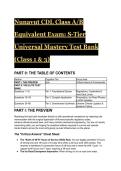
Nunavut CDL Class A/B
Equivalent Exam: S-Tier
Universal Mastery Test Bank
(Class 1 & 3)
PART 0: THE TABLE OF CONTENTS
Section Cognitive Tier Focus Area
PART I: THE PREVIEW Zero Critical Axioms & Frameworks
PART II: THE ELITE TEST
BANK
Questions 1–15 Tier 1: Foundational Syntax Regulations, Credentials &
Hard Deck Limits
Questions 16–35 Tier 2: Complex Application Pneumatics, Ice Road Physics
& HOS Variables
Questions 36–60 Tier 3: Grandmaster Synthesis Extreme Climate Logistics &
Systemic Failure
PART I: THE PREVIEW
Mastering this test bank translates directly to elite operational competence by replacing rote
memorization with the surgical application of Nunavut-specific regulatory codes,
extreme-climate physical laws, and heavy-vehicle mechanical engineering. You are not merely
memorizing data; you are forging the analytical reflexes required to survive and operate
tractor-trailers across the most unforgiving ice-road infrastructure on the planet.
The "Critical Axioms" Cheat Sheet
● The "North of 60°N" Hours of Service (HOS) Rule: You are legally permitted 15 hours
of driving time and 18 hours of on-duty time within a 20-hour work shift window. This
requires a mandatory 8 consecutive hours of off-duty rest to reset the shift. Cycle 1 is
capped at 80 hours over 7 days, requiring a 36-hour reset.
● The Ice Road Entrapment Imperative: When driving on an ice road over water,
, seatbelts are strictly forbidden, doors must remain unlocked, and windows must be
accessible. In a breakthrough event, water pressure instantly seals the cabin; immediate
egress is the only survival variable.
● The Hydrodynamic Wave Law: Heavy vehicle speed on ice is strictly capped (typically
25 km/h loaded). Exceeding the critical speed forces the under-ice water displacement
bowl to amplify into a flexural wave, systematically shattering the ice sheet ahead of the
vehicle.
● Pneumatic Baselines (Air Brakes): Low-air warning systems must activate before
pressure drops below 55 psi (commonly tested at 60 psi). An uncoupled tractor-trailer
cannot leak more than 4 psi per minute during an applied brake test. The tractor
protection valve must automatically pop out and exhaust between 20 and 45 psi.
Vehicle Configuration Maximum Applied Air Loss (per minute)
Straight Truck / Bus 3 psi (21 kPa)
Tractor & 1 Trailer 4 psi (28 kPa)
Tractor & 2+ Trailers 6 psi (41 kPa)
● Gold's Formula (P = Ah^2): Ice bearing capacity is a function of the square of the ice
thickness. Clear blue ice offers maximum strength; white/opaque snow ice offers less;
grey ice indicates hazardous thawing.
PART II: THE ELITE TEST BANK
Q1: An applicant in Nunavut intends to operate a semi-trailer truck combination. Based on
territorial licensing standards, which combination of prerequisites is MOST ACCURATE? A)
Minimum age 16, a Class 3 license, and a bi-annual medical assessment. B) Minimum age 18,
a Class 5 license, an Air Brake endorsement, and a medical report. C) Minimum age 18, a Class
1 license, an Air Brake endorsement, and a medical report. D) Minimum age 21, a Class A
license, and Mandatory Entry-Level Training (MELT).
● The Answer: C (Minimum age 18, a Class 1 license, an Air Brake endorsement, and a
medical report.)
● Distractor Analysis:
○ A is incorrect: Class 3 limits towed vehicles to under 4,500 kg unless they lack air
brakes. The minimum age for commercial classes is 18.
○ B is incorrect: A Class 5 license permits the operation of standard passenger
vehicles, not semi-trailer truck combinations.
○ D is incorrect: This references Ontario's Class A nomenclature and MELT
requirements, which are not currently mandated in Nunavut.
The Mentor's Analysis: Foundational legal compliance precedes mechanical operation. The
Class 1 designation is the apex credential in Nunavut for tractor-trailer combinations,
demanding both specialized pneumatic certification and rigorous physiological baselines.
Professional/Academic Intuition: Never operate outside your classification; regulatory
ignorance is indistinguishable from intentional negligence.
Q2: A driver operates exclusively North of Latitude 60°N maintaining a daily logbook. Under the
Federal Hours of Service regulations for this region, what is the MAXIMUM allowable driving
time within a single work shift? A) 11 hours B) 13 hours C) 14 hours D) 15 hours
● The Answer: D (15 hours)
● Distractor Analysis:
○ A is incorrect: This is the United States FMCSA daily driving limit.
, ○ B is incorrect: This is the standard Canadian daily driving limit South of 60°N.
○ C is incorrect: This represents the on-duty limit for southern Canada, not the driving
limit.
The Mentor's Analysis: The Arctic logistics environment dictates unique physiological pacing.
North of 60°N, the operational window expands to accommodate the vast, isolated distances,
increasing driving time to 15 hours within a 20-hour elapsed shift. Professional/Academic
Intuition: Geographic latitude fundamentally alters legal fatigue constraints; memorize
the 60th parallel boundary.
Q3: According to the Nunavut dimension limits, what is the MAXIMUM legal height for a
commercial vehicle operating without an oversize permit? A) 4.15 meters B) 4.20 meters C)
4.30 meters D) 13.6 feet
● The Answer: B (4.20 meters)
● Distractor Analysis:
○ A is incorrect: 4.15m is the standard height limit across the majority of southern
Canadian provinces.
○ C is incorrect: This exceeds all standard North American legal height limits without
an oversize permit.
○ D is incorrect: 13.6 feet is the standard US measurement, which translates to
approximately 4.15 meters.
The Mentor's Analysis: Dimensional uniformity shifts near the Arctic. Both Nunavut and the
Northwest Territories permit a slightly higher maximum vehicle height of 4.2 meters (compared
to the 4.15m southern standard) to accommodate specialized northern freight and suspension
profiles. Professional/Academic Intuition: Clearance is absolute; the difference between
4.15m and 4.20m is the difference between safe passage and a bridge strike.
Q4: When preparing to navigate an ice road crossing over water, the driver's IMMEDIATE action
regarding the vehicle's interior environment MUST be to: A) Engage the differential locks and
turn on the cab heater. B) Unbuckle the seatbelt, unlock the doors, and lower the windows
slightly. C) Secure the seatbelt tightly and lock the doors to prevent ejection. D) Empty the air
tanks to reduce the vehicle's gross weight.
● The Answer: B (Unbuckle the seatbelt, unlock the doors, and lower the windows slightly.)
● Distractor Analysis:
○ A is incorrect: These are mechanical steps, ignoring the primary life-safety directive
of an ice crossing.
○ C is incorrect: This is a lethal action. If the ice fails, water pressure seals locked
doors, and a seatbelt acts as a fatal restraint.
○ D is incorrect: Emptying air tanks disables the spring brakes and drops negligible
weight, rendering the vehicle uncontrollable.
The Mentor's Analysis: Ice road protocol upends traditional road safety. If the ice fractures, a
heavy vehicle will submerge in seconds. The operator must establish an immediate,
unobstructed egress path. A seatbelt becomes an anchor, and a locked door becomes a vault.
Professional/Academic Intuition: On the ice, survival relies on extraction speed, not
restraint.
Q5: Under the "North of 60°N" Hours of Service regulations, a driver operating on Cycle 1 must
cease driving when they accumulate how many on-duty hours? A) 70 hours in 7 days B) 80
hours in 7 days C) 120 hours in 14 days D) 80 hours in 14 days
● The Answer: B (80 hours in 7 days)
● Distractor Analysis:
○ A is incorrect: This is the Cycle 1 limit for operations South of 60°N.
Equivalent Exam: S-Tier
Universal Mastery Test Bank
(Class 1 & 3)
PART 0: THE TABLE OF CONTENTS
Section Cognitive Tier Focus Area
PART I: THE PREVIEW Zero Critical Axioms & Frameworks
PART II: THE ELITE TEST
BANK
Questions 1–15 Tier 1: Foundational Syntax Regulations, Credentials &
Hard Deck Limits
Questions 16–35 Tier 2: Complex Application Pneumatics, Ice Road Physics
& HOS Variables
Questions 36–60 Tier 3: Grandmaster Synthesis Extreme Climate Logistics &
Systemic Failure
PART I: THE PREVIEW
Mastering this test bank translates directly to elite operational competence by replacing rote
memorization with the surgical application of Nunavut-specific regulatory codes,
extreme-climate physical laws, and heavy-vehicle mechanical engineering. You are not merely
memorizing data; you are forging the analytical reflexes required to survive and operate
tractor-trailers across the most unforgiving ice-road infrastructure on the planet.
The "Critical Axioms" Cheat Sheet
● The "North of 60°N" Hours of Service (HOS) Rule: You are legally permitted 15 hours
of driving time and 18 hours of on-duty time within a 20-hour work shift window. This
requires a mandatory 8 consecutive hours of off-duty rest to reset the shift. Cycle 1 is
capped at 80 hours over 7 days, requiring a 36-hour reset.
● The Ice Road Entrapment Imperative: When driving on an ice road over water,
, seatbelts are strictly forbidden, doors must remain unlocked, and windows must be
accessible. In a breakthrough event, water pressure instantly seals the cabin; immediate
egress is the only survival variable.
● The Hydrodynamic Wave Law: Heavy vehicle speed on ice is strictly capped (typically
25 km/h loaded). Exceeding the critical speed forces the under-ice water displacement
bowl to amplify into a flexural wave, systematically shattering the ice sheet ahead of the
vehicle.
● Pneumatic Baselines (Air Brakes): Low-air warning systems must activate before
pressure drops below 55 psi (commonly tested at 60 psi). An uncoupled tractor-trailer
cannot leak more than 4 psi per minute during an applied brake test. The tractor
protection valve must automatically pop out and exhaust between 20 and 45 psi.
Vehicle Configuration Maximum Applied Air Loss (per minute)
Straight Truck / Bus 3 psi (21 kPa)
Tractor & 1 Trailer 4 psi (28 kPa)
Tractor & 2+ Trailers 6 psi (41 kPa)
● Gold's Formula (P = Ah^2): Ice bearing capacity is a function of the square of the ice
thickness. Clear blue ice offers maximum strength; white/opaque snow ice offers less;
grey ice indicates hazardous thawing.
PART II: THE ELITE TEST BANK
Q1: An applicant in Nunavut intends to operate a semi-trailer truck combination. Based on
territorial licensing standards, which combination of prerequisites is MOST ACCURATE? A)
Minimum age 16, a Class 3 license, and a bi-annual medical assessment. B) Minimum age 18,
a Class 5 license, an Air Brake endorsement, and a medical report. C) Minimum age 18, a Class
1 license, an Air Brake endorsement, and a medical report. D) Minimum age 21, a Class A
license, and Mandatory Entry-Level Training (MELT).
● The Answer: C (Minimum age 18, a Class 1 license, an Air Brake endorsement, and a
medical report.)
● Distractor Analysis:
○ A is incorrect: Class 3 limits towed vehicles to under 4,500 kg unless they lack air
brakes. The minimum age for commercial classes is 18.
○ B is incorrect: A Class 5 license permits the operation of standard passenger
vehicles, not semi-trailer truck combinations.
○ D is incorrect: This references Ontario's Class A nomenclature and MELT
requirements, which are not currently mandated in Nunavut.
The Mentor's Analysis: Foundational legal compliance precedes mechanical operation. The
Class 1 designation is the apex credential in Nunavut for tractor-trailer combinations,
demanding both specialized pneumatic certification and rigorous physiological baselines.
Professional/Academic Intuition: Never operate outside your classification; regulatory
ignorance is indistinguishable from intentional negligence.
Q2: A driver operates exclusively North of Latitude 60°N maintaining a daily logbook. Under the
Federal Hours of Service regulations for this region, what is the MAXIMUM allowable driving
time within a single work shift? A) 11 hours B) 13 hours C) 14 hours D) 15 hours
● The Answer: D (15 hours)
● Distractor Analysis:
○ A is incorrect: This is the United States FMCSA daily driving limit.
, ○ B is incorrect: This is the standard Canadian daily driving limit South of 60°N.
○ C is incorrect: This represents the on-duty limit for southern Canada, not the driving
limit.
The Mentor's Analysis: The Arctic logistics environment dictates unique physiological pacing.
North of 60°N, the operational window expands to accommodate the vast, isolated distances,
increasing driving time to 15 hours within a 20-hour elapsed shift. Professional/Academic
Intuition: Geographic latitude fundamentally alters legal fatigue constraints; memorize
the 60th parallel boundary.
Q3: According to the Nunavut dimension limits, what is the MAXIMUM legal height for a
commercial vehicle operating without an oversize permit? A) 4.15 meters B) 4.20 meters C)
4.30 meters D) 13.6 feet
● The Answer: B (4.20 meters)
● Distractor Analysis:
○ A is incorrect: 4.15m is the standard height limit across the majority of southern
Canadian provinces.
○ C is incorrect: This exceeds all standard North American legal height limits without
an oversize permit.
○ D is incorrect: 13.6 feet is the standard US measurement, which translates to
approximately 4.15 meters.
The Mentor's Analysis: Dimensional uniformity shifts near the Arctic. Both Nunavut and the
Northwest Territories permit a slightly higher maximum vehicle height of 4.2 meters (compared
to the 4.15m southern standard) to accommodate specialized northern freight and suspension
profiles. Professional/Academic Intuition: Clearance is absolute; the difference between
4.15m and 4.20m is the difference between safe passage and a bridge strike.
Q4: When preparing to navigate an ice road crossing over water, the driver's IMMEDIATE action
regarding the vehicle's interior environment MUST be to: A) Engage the differential locks and
turn on the cab heater. B) Unbuckle the seatbelt, unlock the doors, and lower the windows
slightly. C) Secure the seatbelt tightly and lock the doors to prevent ejection. D) Empty the air
tanks to reduce the vehicle's gross weight.
● The Answer: B (Unbuckle the seatbelt, unlock the doors, and lower the windows slightly.)
● Distractor Analysis:
○ A is incorrect: These are mechanical steps, ignoring the primary life-safety directive
of an ice crossing.
○ C is incorrect: This is a lethal action. If the ice fails, water pressure seals locked
doors, and a seatbelt acts as a fatal restraint.
○ D is incorrect: Emptying air tanks disables the spring brakes and drops negligible
weight, rendering the vehicle uncontrollable.
The Mentor's Analysis: Ice road protocol upends traditional road safety. If the ice fractures, a
heavy vehicle will submerge in seconds. The operator must establish an immediate,
unobstructed egress path. A seatbelt becomes an anchor, and a locked door becomes a vault.
Professional/Academic Intuition: On the ice, survival relies on extraction speed, not
restraint.
Q5: Under the "North of 60°N" Hours of Service regulations, a driver operating on Cycle 1 must
cease driving when they accumulate how many on-duty hours? A) 70 hours in 7 days B) 80
hours in 7 days C) 120 hours in 14 days D) 80 hours in 14 days
● The Answer: B (80 hours in 7 days)
● Distractor Analysis:
○ A is incorrect: This is the Cycle 1 limit for operations South of 60°N.


