
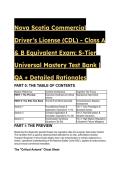
Nova Scotia Commercial
Driver’s License (CDL) - Class A
& B Equivalent Exam: S-Tier
Universal Mastery Test Bank |
QA + Detailed Rationales
PART 0: THE TABLE OF CONTENTS
Section Reference Content Architecture Cognitive Tier Focus
PART I: The Preview Executive Synthesis & Critical Operational Hard Deck
Axioms
PART II: The Elite Test Bank The 60-Point MCQ Gauntlet Comprehensive Mastery
Assessment
Section 1 Foundational Syntax & Tier 1: Core Paradigms &
Application (Questions 1–15) Standard Syntax
Section 2 Complex Application & Tier 2: Field Simulation &
Simulation (Questions 16–35) Variable Interaction
Section 3 Grandmaster Synthesis Tier 3: High-Stakes Regulatory
(Questions 36–60) & Systemic Failure Mitigation
PART I: THE PREVIEW
Mastering this diagnostic gauntlet forges raw regulatory data into surgical, field-ready intuition.
The transition from a passive steering-wheel attendant to an elite, authoritative Surface
Transport Engineer in Nova Scotia begins here; rote memorization is entirely replaced by a
kinetic, operational understanding of the National Safety Code (NSC), applied air brake physics,
and provincial commercial mandates.
The "Critical Axioms" Cheat Sheet
, ● The Atmospheric Hard Deck (Air Brakes): The compressor must build pressure from
50 to 90 psi within strictly 3 minutes. Governor cut-out occurs between 115 and 135 psi.
System leakage on a fully applied tractor-trailer combination must NEVER exceed 4 psi
per minute (3 psi for a straight truck).
● The Pushrod Limit Matrix: For standard Type 30 brake chambers, maximum allowable
stroke during a full service brake application is 2 inches. Using the pry-bar method, free
stroke must not exceed 3/4 of an inch. Anything beyond this is a Schedule 1 Major Defect.
● The Chronological Governor (Hours of Service): A driver is bound by the 13/14/16
rule: maximum 13 hours driving, maximum 14 hours on-duty, and no driving allowed after
16 hours of elapsed time from the last 8-hour consecutive off-duty period.
● Cycle Physics: Cycle 1 permits 70 on-duty hours over 7 days (requires 36 consecutive
hours to reset). Cycle 2 permits 120 on-duty hours over 14 days (requires 72 consecutive
hours to reset).
● The Pre-Trip Binary (Schedule 1): Minor defects require documentation and carrier
notification but permit continued operation. Major defects instantly trigger an
out-of-service condition; driving a vehicle with a recorded major defect is a direct violation
of the Nova Scotia Motor Vehicle Act.
PART II: THE ELITE TEST BANK
Tier 1: Foundational Syntax & Application (Questions 1–15)
Q1: Under the Nova Scotia Graduated Driver Licensing and classification system, a driver
wishes to operate a tractor-trailer combination weighing 36,300 kg. Which operational license
and endorsement MUST the driver legally hold as a minimum? A) Class 3 License with a
Condition 15 endorsement B) Class 2 License with a Z endorsement C) Class 1 License with an
Air Brake Endorsement D) Class 5 License with a Heavy Vehicle restriction removal
● The Answer: C (Class 1 License with an Air Brake Endorsement)
● Distractor Analysis:
○ A is incorrect: A Class 3 license strictly governs single-axle or multi-axle straight
trucks exceeding 14,000 kg, not articulated tractor-trailer combinations.
○ B is incorrect: A Class 2 license is designated for operating buses exceeding 24
passengers.
○ D is incorrect: A Class 5 license is strictly for standard passenger vehicles and light
trucks.
The Mentor's Analysis: The Class 1 license is the apex credential of the Nova Scotia
commercial transport grid, encompassing the legal authority to drive all lower-class vehicles
(excluding motorcycles). Because all modern heavy articulated units utilize pneumatic braking
systems, the Air Brake Endorsement is a non-negotiable tandem requirement.
Professional/Academic Intuition: Class 1 equals Articulation. If the vehicle hinges and
hauls heavy freight, Class 1 is the baseline.
Q2: A candidate is applying for a Nova Scotia Class 1 driver's license. What is the absolute
MINIMUM age and experience prerequisite required to initiate this specific testing protocol? A)
18 years of age with a valid Class 5 license B) 19 years of age with 1 year of experience holding
at least a Class 5 license C) 21 years of age with 2 years of experience holding a Class 3
license D) 18 years of age with 1 year of experience holding a Class 7 learner's permit
● The Answer: B (19 years of age with 1 year of experience holding at least a Class 5
, license)
● Distractor Analysis:
○ A is incorrect: 18 years of age is the threshold for a Class 3 license, not Class 1.
○ C is incorrect: This age and experience barrier is unnecessarily restrictive and does
not reflect Nova Scotia statutes.
○ D is incorrect: A Class 7 is a learner's permit; upgrading to commercial requires full
Class 5 status.
The Mentor's Analysis: Commercial articulation demands a baseline of neurological maturity
and proven highway experience. Nova Scotia legally throttles entry into the Class 1 category to
individuals who are at least 19 years old and have spent a minimum of one year operating a
standard Class 5 vehicle. Professional/Academic Intuition: Class 1 entry is 19 years and 1
year of Class 5 experience. You must master the car before you master the rig.
Q3: During a Schedule 1 daily trip inspection on a Class 1 tractor, a driver utilizes a tread depth
gauge to inspect the active steering axle tires. According to Nova Scotia's NSC Standard 11
adoption, what is the ABSOLUTE MINIMUM permissible tread depth for these specific tires? A)
1.5 mm B) 2.0 mm C) 3.0 mm D) 4/32 inches
● The Answer: C (3.0 mm)
● Distractor Analysis:
○ A is incorrect: 1.5 mm is the minimum for standard passenger vehicles, not
commercial heavy vehicles.
○ B is incorrect: 2.0 mm is the minimum tread depth for non-steering (drive and
trailer) axles.
○ D is incorrect: Nova Scotia relies strictly on the metric NSC Standard 11 which
mandates a 3.0 mm limit.
The Mentor's Analysis: The active steering axle bears the kinetic brunt of vehicle control. NSC
Standard 11 legally enforces a higher tread baseline (3.0 mm) on steering axles compared to
drive/trailer axles (2.0 mm) to mitigate hydroplaning and blowout risks. Professional/Academic
Intuition: Steer tires demand premium rubber: 3.0 mm minimum. Drive/trailer tires run to
2.0 mm.
Q4: A driver initiates the air brake system build-up test after depleting the primary and
secondary reservoirs. With the engine running at a fast idle, the system MUST build air pressure
from 50 psi to 90 psi within what specific timeframe? A) 1 minute B) 2 minutes C) 3 minutes D) 5
minutes
● The Answer: C (3 minutes)
● Distractor Analysis:
○ A is incorrect: 1 minute is not the regulatory threshold.
○ B is incorrect: 2 minutes is a diagnostic benchmark, but not the legal failure limit.
○ D is incorrect: 5 minutes indicates catastrophic compressor failure.
**The Mentor's Analysis: The 50-to-90 psi metric is the universal heartbeat of an air brake
system. If a compressor cannot achieve this within 3 minutes, it lacks the volumetric efficiency
required to recover from sequential brake applications on steep grades.
Professional/Academic Intuition: 3 minutes is the absolute boundary between operational
compliance and a catastrophic loss of braking capacity.
Q5: Under the Nova Scotia Commercial Vehicle Drivers' Hours of Service Regulations, a driver
operating strictly under Cycle 1 is governed by specific maximum on-duty limits. Which
statement MOST ACCURATELY defines the Cycle 1 boundary? A) The driver cannot exceed 70
hours of on-duty time over a 7-day period. B) The driver cannot exceed 120 hours of on-duty
time over a 14-day period. C) The driver must take 72 consecutive hours off-duty to reset their
Driver’s License (CDL) - Class A
& B Equivalent Exam: S-Tier
Universal Mastery Test Bank |
QA + Detailed Rationales
PART 0: THE TABLE OF CONTENTS
Section Reference Content Architecture Cognitive Tier Focus
PART I: The Preview Executive Synthesis & Critical Operational Hard Deck
Axioms
PART II: The Elite Test Bank The 60-Point MCQ Gauntlet Comprehensive Mastery
Assessment
Section 1 Foundational Syntax & Tier 1: Core Paradigms &
Application (Questions 1–15) Standard Syntax
Section 2 Complex Application & Tier 2: Field Simulation &
Simulation (Questions 16–35) Variable Interaction
Section 3 Grandmaster Synthesis Tier 3: High-Stakes Regulatory
(Questions 36–60) & Systemic Failure Mitigation
PART I: THE PREVIEW
Mastering this diagnostic gauntlet forges raw regulatory data into surgical, field-ready intuition.
The transition from a passive steering-wheel attendant to an elite, authoritative Surface
Transport Engineer in Nova Scotia begins here; rote memorization is entirely replaced by a
kinetic, operational understanding of the National Safety Code (NSC), applied air brake physics,
and provincial commercial mandates.
The "Critical Axioms" Cheat Sheet
, ● The Atmospheric Hard Deck (Air Brakes): The compressor must build pressure from
50 to 90 psi within strictly 3 minutes. Governor cut-out occurs between 115 and 135 psi.
System leakage on a fully applied tractor-trailer combination must NEVER exceed 4 psi
per minute (3 psi for a straight truck).
● The Pushrod Limit Matrix: For standard Type 30 brake chambers, maximum allowable
stroke during a full service brake application is 2 inches. Using the pry-bar method, free
stroke must not exceed 3/4 of an inch. Anything beyond this is a Schedule 1 Major Defect.
● The Chronological Governor (Hours of Service): A driver is bound by the 13/14/16
rule: maximum 13 hours driving, maximum 14 hours on-duty, and no driving allowed after
16 hours of elapsed time from the last 8-hour consecutive off-duty period.
● Cycle Physics: Cycle 1 permits 70 on-duty hours over 7 days (requires 36 consecutive
hours to reset). Cycle 2 permits 120 on-duty hours over 14 days (requires 72 consecutive
hours to reset).
● The Pre-Trip Binary (Schedule 1): Minor defects require documentation and carrier
notification but permit continued operation. Major defects instantly trigger an
out-of-service condition; driving a vehicle with a recorded major defect is a direct violation
of the Nova Scotia Motor Vehicle Act.
PART II: THE ELITE TEST BANK
Tier 1: Foundational Syntax & Application (Questions 1–15)
Q1: Under the Nova Scotia Graduated Driver Licensing and classification system, a driver
wishes to operate a tractor-trailer combination weighing 36,300 kg. Which operational license
and endorsement MUST the driver legally hold as a minimum? A) Class 3 License with a
Condition 15 endorsement B) Class 2 License with a Z endorsement C) Class 1 License with an
Air Brake Endorsement D) Class 5 License with a Heavy Vehicle restriction removal
● The Answer: C (Class 1 License with an Air Brake Endorsement)
● Distractor Analysis:
○ A is incorrect: A Class 3 license strictly governs single-axle or multi-axle straight
trucks exceeding 14,000 kg, not articulated tractor-trailer combinations.
○ B is incorrect: A Class 2 license is designated for operating buses exceeding 24
passengers.
○ D is incorrect: A Class 5 license is strictly for standard passenger vehicles and light
trucks.
The Mentor's Analysis: The Class 1 license is the apex credential of the Nova Scotia
commercial transport grid, encompassing the legal authority to drive all lower-class vehicles
(excluding motorcycles). Because all modern heavy articulated units utilize pneumatic braking
systems, the Air Brake Endorsement is a non-negotiable tandem requirement.
Professional/Academic Intuition: Class 1 equals Articulation. If the vehicle hinges and
hauls heavy freight, Class 1 is the baseline.
Q2: A candidate is applying for a Nova Scotia Class 1 driver's license. What is the absolute
MINIMUM age and experience prerequisite required to initiate this specific testing protocol? A)
18 years of age with a valid Class 5 license B) 19 years of age with 1 year of experience holding
at least a Class 5 license C) 21 years of age with 2 years of experience holding a Class 3
license D) 18 years of age with 1 year of experience holding a Class 7 learner's permit
● The Answer: B (19 years of age with 1 year of experience holding at least a Class 5
, license)
● Distractor Analysis:
○ A is incorrect: 18 years of age is the threshold for a Class 3 license, not Class 1.
○ C is incorrect: This age and experience barrier is unnecessarily restrictive and does
not reflect Nova Scotia statutes.
○ D is incorrect: A Class 7 is a learner's permit; upgrading to commercial requires full
Class 5 status.
The Mentor's Analysis: Commercial articulation demands a baseline of neurological maturity
and proven highway experience. Nova Scotia legally throttles entry into the Class 1 category to
individuals who are at least 19 years old and have spent a minimum of one year operating a
standard Class 5 vehicle. Professional/Academic Intuition: Class 1 entry is 19 years and 1
year of Class 5 experience. You must master the car before you master the rig.
Q3: During a Schedule 1 daily trip inspection on a Class 1 tractor, a driver utilizes a tread depth
gauge to inspect the active steering axle tires. According to Nova Scotia's NSC Standard 11
adoption, what is the ABSOLUTE MINIMUM permissible tread depth for these specific tires? A)
1.5 mm B) 2.0 mm C) 3.0 mm D) 4/32 inches
● The Answer: C (3.0 mm)
● Distractor Analysis:
○ A is incorrect: 1.5 mm is the minimum for standard passenger vehicles, not
commercial heavy vehicles.
○ B is incorrect: 2.0 mm is the minimum tread depth for non-steering (drive and
trailer) axles.
○ D is incorrect: Nova Scotia relies strictly on the metric NSC Standard 11 which
mandates a 3.0 mm limit.
The Mentor's Analysis: The active steering axle bears the kinetic brunt of vehicle control. NSC
Standard 11 legally enforces a higher tread baseline (3.0 mm) on steering axles compared to
drive/trailer axles (2.0 mm) to mitigate hydroplaning and blowout risks. Professional/Academic
Intuition: Steer tires demand premium rubber: 3.0 mm minimum. Drive/trailer tires run to
2.0 mm.
Q4: A driver initiates the air brake system build-up test after depleting the primary and
secondary reservoirs. With the engine running at a fast idle, the system MUST build air pressure
from 50 psi to 90 psi within what specific timeframe? A) 1 minute B) 2 minutes C) 3 minutes D) 5
minutes
● The Answer: C (3 minutes)
● Distractor Analysis:
○ A is incorrect: 1 minute is not the regulatory threshold.
○ B is incorrect: 2 minutes is a diagnostic benchmark, but not the legal failure limit.
○ D is incorrect: 5 minutes indicates catastrophic compressor failure.
**The Mentor's Analysis: The 50-to-90 psi metric is the universal heartbeat of an air brake
system. If a compressor cannot achieve this within 3 minutes, it lacks the volumetric efficiency
required to recover from sequential brake applications on steep grades.
Professional/Academic Intuition: 3 minutes is the absolute boundary between operational
compliance and a catastrophic loss of braking capacity.
Q5: Under the Nova Scotia Commercial Vehicle Drivers' Hours of Service Regulations, a driver
operating strictly under Cycle 1 is governed by specific maximum on-duty limits. Which
statement MOST ACCURATELY defines the Cycle 1 boundary? A) The driver cannot exceed 70
hours of on-duty time over a 7-day period. B) The driver cannot exceed 120 hours of on-duty
time over a 14-day period. C) The driver must take 72 consecutive hours off-duty to reset their


