
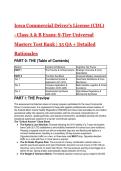
Iowa Commercial Driver’s License (CDL)
- Class A & B Exam: S-Tier Universal
Mastery Test Bank | 35 QA + Detailed
Rationales
PART 0: THE (Table of Contents)
Section Content Architecture Cognitive Tier Focus
PART I The Preview & Critical Axioms Strategic Overview & Core
Data Matrix
PART II The Elite Test Bank Universal Mastery Assessment
Tier 1 Foundational Syntax & Hard Deck Definitions & Core
Application (Q1–Q15) Mechanics
Tier 2 Complex Application & Multi-Variable Logistics & Crisis
Simulation (Q16–Q25) Avoidance
Tier 3 Grandmaster Synthesis High-Stakes Regulatory &
(Q26–Q35) Mechanical Synthesis
PART I: THE Preview
This assessment architecture does not merely prepare candidates for the Iowa Commercial
Driver’s License exam; it is engineered to forge elite logistics professionals whose mastery of
the Federal Motor Carrier Safety Regulations (FMCSR) and Iowa Code translates to zero-defect
operational safety. By replacing rote memorization with the structural comprehension of
pneumatic physics, spatial geometry, and statutory frameworks, candidates develop the intuitive
situational awareness required of a top-tier commercial operator.
The "Critical Axioms" Cheat Sheet
● The Kadyn’s Law Absolute: Enacted following the 2011 fatality of a 7-year-old student,
Iowa Code 321.372 establishes a strict-liability framework for school bus zone violations.
Passing a stopped school bus with an extended stop arm and flashing red lights is a
criminal misdemeanor resulting in a mandatory 30-day license suspension.
Opposite-direction traffic on a two- or three-lane road MUST stop. Opposite-direction
traffic on a road with four or more lanes is exempt.
● The Air Brake Physics Rule: The survival of a heavy combination vehicle relies on
specific pound-per-square-inch (psi) thresholds. Governor cut-out occurs at 100-125 psi.
Governor cut-in occurs no lower than 85 psi. The low-pressure warning must trigger at or
before 55 psi. Spring brakes automatically deploy between 20-45 psi.
● The Weight & Tolerance Matrix: The federal baseline maximum gross weight is 80,000
, lbs, with a 20,000 lb single-axle limit and a 34,000 lb tandem-axle limit. Iowa grants a
strict 10% weight tolerance for construction materials transported to or from a site, and a
25% registration weight tolerance for raw agricultural products, provided the vehicle
complies with the Bridge Formula wheelbase maximums.
● The 150-Mile Ag Radius (MAP-21): The Covered Farm Vehicle exemption strips away
CDL, Hours of Service (HOS), and Medical Examiner's Certificate requirements strictly
within a 150 air-mile radius of the farm operation. Breaching this radius immediately
subjects the driver to full federal interstate commerce regulations.
● The Self-Certification Protocol: Certifying as Intrastate Only (Excepted or
Non-Excepted) legally binds the driver to operate strictly within the borders of Iowa,
resulting in a mandatory "K" restriction on the CDL.
Iowa Statutory Weight Maximum Allowance Qualifying Cargo / Condition
Tolerances
Standard Commercial 5% over registration General non-agricultural freight
Construction/Borrow 10% over registration/axle Dirt, aggregate to/from
construction sites
Raw Agricultural 25% over registration Raw crops, livestock from point
of origin
PART II: THE ELITE TEST BANK
Tier 1 - Foundational Syntax & Application
Q1: An operator is conducting a pre-trip air brake inspection on a 5-axle tractor-semitrailer
combination. After fully charging the air system to 125 psi, turning the engine off, releasing the
parking brakes, and allowing the system to settle, the operator begins the static leakage test.
Based on FMCSR pneumatic parameters, what is the MAXIMUM allowable air loss before the
vehicle must be placed Out of Service (OOS)? A) 2 psi in one minute B) 3 psi in one minute C) 4
psi in one minute D) 5 psi in one minute
● The Answer: B (3 psi in one minute)
● Distractor Analysis:
○ A is incorrect: A loss rate of 2 psi in one minute is the static standard for a single
commercial vehicle (straight truck or bus), not a combination vehicle.
○ C is incorrect: A loss rate of 4 psi in one minute is the maximum limit for an applied
pressure test (holding the foot brake down) on a combination vehicle, not the static
test.
○ D is incorrect: 5 psi is a severe leak and represents a critical safety failure outside
any legal parameter.
The Mentor's Analysis: The distinction between static and applied leakage rates serves as the
primary diagnostic for pneumatic integrity. When evaluating a combination vehicle, the additional
air volume required to charge the trailer's secondary lines inherently increases the acceptable
baseline bleed rate. By isolating the static variable, the operator bypasses the common
analytical error of conflating static metrics with applied metrics. Professional/Academic
Intuition: Baseline your leakage limits by vehicle architecture: 2 psi (static) / 3 psi
(applied) for straight trucks; 3 psi (static) / 4 psi (applied) for combinations.
Q2: Under the statutory provisions of Iowa’s Kadyn’s Law (Iowa Code 321.372), what is the
definitive legal consequence for a commercial driver’s FIRST offense of unlawfully passing a
stopped school bus with its stop arm extended and red warning lights flashing? A) A simple
, misdemeanor criminal citation, a mandatory 30-day driver’s license suspension, and a minimum
fine of $250. B) A serious misdemeanor citation, a 90-day driver's license suspension, and a
minimum fine of $500. C) A civil traffic infraction resulting in a mandatory defensive driving
course and a $1,000 fine. D) A Class D felony charge resulting in immediate commercial vehicle
impoundment and permanent CDL revocation.
● The Answer: A (A simple misdemeanor criminal citation, a mandatory 30-day driver’s
license suspension, and a minimum fine of $250.)
● Distractor Analysis:
○ B is incorrect: While Kadyn's Law significantly elevated penalties across the board,
the first offense is explicitly classified as a simple misdemeanor, not a serious
misdemeanor, and carries a 30-day suspension.
○ C is incorrect: Passing a stopped school bus in Iowa is prosecuted as a criminal
citation, not merely a civil moving violation.
○ D is incorrect: Unless the unlawful passing results in unintentional serious injury or
death (which escalates the charge to a Class C or D felony under vehicular
homicide/injury statutes), the baseline passing violation remains a misdemeanor.
The Mentor's Analysis: Kadyn’s Law fundamentally restructured the legal risk matrix for school
bus zone violations in Iowa, eliminating administrative leniency following the tragic 2011 fatality
of Kadyn Halverson. The law's architecture ensures that passing a bus is treated with the
severity of a major criminal traffic offense. By recognizing the strict-liability nature of the 30-day
administrative suspension, operators bypass the fatal assumption that bus zone violations can
be resolved with a simple fine. Professional/Academic Intuition: Passing a stopped school
bus in Iowa is an automatic criminal citation and a guaranteed license suspension; it is
never treated as a routine traffic ticket.
Q3: An Iowa-based commercial operator self-certifies their medical status with the Department
of Transportation as Non-Excepted Intrastate. Based on this explicit classification, which
regulatory action will the Iowa DOT IMMEDIATELY apply to the driver's CDL? A) The DOT will
revoke the driver's CDL until a federal medical variance is approved by the FMCSA. B) The
DOT will apply a "K" restriction to the license, legally limiting commercial operation exclusively to
within Iowa state lines. C) The DOT will apply a "V" restriction, indicating a medical variance is
on file for an otherwise disqualifying condition. D) The DOT will grant an automatic exemption
from carrying a Medical Examiner's Certificate while on duty.
● The Answer: B (The DOT will apply a "K" restriction to the license, legally limiting
commercial operation exclusively to within Iowa state lines.)
● Distractor Analysis:
○ A is incorrect: Non-Excepted Intrastate drivers do not inherently require a federal
medical variance; they simply limit their operational geography.
○ C is incorrect: A "V" restriction is strictly designated for drivers operating under a
specific federal medical variance (e.g., vision, diabetes, or seizure exemptions).
○ D is incorrect: Non-Excepted drivers are explicitly required to hold and carry a valid
Medical Examiner's Certificate; only Excepted drivers are granted relief from this
mandate.
The Mentor's Analysis: Medical self-certification dictates the legal geography of a commercial
driver's career. When a driver selects the "Intrastate" classification, they voluntarily forfeit the
right to engage in interstate commerce. By utilizing the "K" restriction, the state creates a hard
boundary that compliance officers can audit instantly during roadside inspections.
Professional/Academic Intuition: "Excepted" dictates whether you need a medical card;
"Intrastate" dictates where you can drive. The "K" restriction locks your wheels inside
- Class A & B Exam: S-Tier Universal
Mastery Test Bank | 35 QA + Detailed
Rationales
PART 0: THE (Table of Contents)
Section Content Architecture Cognitive Tier Focus
PART I The Preview & Critical Axioms Strategic Overview & Core
Data Matrix
PART II The Elite Test Bank Universal Mastery Assessment
Tier 1 Foundational Syntax & Hard Deck Definitions & Core
Application (Q1–Q15) Mechanics
Tier 2 Complex Application & Multi-Variable Logistics & Crisis
Simulation (Q16–Q25) Avoidance
Tier 3 Grandmaster Synthesis High-Stakes Regulatory &
(Q26–Q35) Mechanical Synthesis
PART I: THE Preview
This assessment architecture does not merely prepare candidates for the Iowa Commercial
Driver’s License exam; it is engineered to forge elite logistics professionals whose mastery of
the Federal Motor Carrier Safety Regulations (FMCSR) and Iowa Code translates to zero-defect
operational safety. By replacing rote memorization with the structural comprehension of
pneumatic physics, spatial geometry, and statutory frameworks, candidates develop the intuitive
situational awareness required of a top-tier commercial operator.
The "Critical Axioms" Cheat Sheet
● The Kadyn’s Law Absolute: Enacted following the 2011 fatality of a 7-year-old student,
Iowa Code 321.372 establishes a strict-liability framework for school bus zone violations.
Passing a stopped school bus with an extended stop arm and flashing red lights is a
criminal misdemeanor resulting in a mandatory 30-day license suspension.
Opposite-direction traffic on a two- or three-lane road MUST stop. Opposite-direction
traffic on a road with four or more lanes is exempt.
● The Air Brake Physics Rule: The survival of a heavy combination vehicle relies on
specific pound-per-square-inch (psi) thresholds. Governor cut-out occurs at 100-125 psi.
Governor cut-in occurs no lower than 85 psi. The low-pressure warning must trigger at or
before 55 psi. Spring brakes automatically deploy between 20-45 psi.
● The Weight & Tolerance Matrix: The federal baseline maximum gross weight is 80,000
, lbs, with a 20,000 lb single-axle limit and a 34,000 lb tandem-axle limit. Iowa grants a
strict 10% weight tolerance for construction materials transported to or from a site, and a
25% registration weight tolerance for raw agricultural products, provided the vehicle
complies with the Bridge Formula wheelbase maximums.
● The 150-Mile Ag Radius (MAP-21): The Covered Farm Vehicle exemption strips away
CDL, Hours of Service (HOS), and Medical Examiner's Certificate requirements strictly
within a 150 air-mile radius of the farm operation. Breaching this radius immediately
subjects the driver to full federal interstate commerce regulations.
● The Self-Certification Protocol: Certifying as Intrastate Only (Excepted or
Non-Excepted) legally binds the driver to operate strictly within the borders of Iowa,
resulting in a mandatory "K" restriction on the CDL.
Iowa Statutory Weight Maximum Allowance Qualifying Cargo / Condition
Tolerances
Standard Commercial 5% over registration General non-agricultural freight
Construction/Borrow 10% over registration/axle Dirt, aggregate to/from
construction sites
Raw Agricultural 25% over registration Raw crops, livestock from point
of origin
PART II: THE ELITE TEST BANK
Tier 1 - Foundational Syntax & Application
Q1: An operator is conducting a pre-trip air brake inspection on a 5-axle tractor-semitrailer
combination. After fully charging the air system to 125 psi, turning the engine off, releasing the
parking brakes, and allowing the system to settle, the operator begins the static leakage test.
Based on FMCSR pneumatic parameters, what is the MAXIMUM allowable air loss before the
vehicle must be placed Out of Service (OOS)? A) 2 psi in one minute B) 3 psi in one minute C) 4
psi in one minute D) 5 psi in one minute
● The Answer: B (3 psi in one minute)
● Distractor Analysis:
○ A is incorrect: A loss rate of 2 psi in one minute is the static standard for a single
commercial vehicle (straight truck or bus), not a combination vehicle.
○ C is incorrect: A loss rate of 4 psi in one minute is the maximum limit for an applied
pressure test (holding the foot brake down) on a combination vehicle, not the static
test.
○ D is incorrect: 5 psi is a severe leak and represents a critical safety failure outside
any legal parameter.
The Mentor's Analysis: The distinction between static and applied leakage rates serves as the
primary diagnostic for pneumatic integrity. When evaluating a combination vehicle, the additional
air volume required to charge the trailer's secondary lines inherently increases the acceptable
baseline bleed rate. By isolating the static variable, the operator bypasses the common
analytical error of conflating static metrics with applied metrics. Professional/Academic
Intuition: Baseline your leakage limits by vehicle architecture: 2 psi (static) / 3 psi
(applied) for straight trucks; 3 psi (static) / 4 psi (applied) for combinations.
Q2: Under the statutory provisions of Iowa’s Kadyn’s Law (Iowa Code 321.372), what is the
definitive legal consequence for a commercial driver’s FIRST offense of unlawfully passing a
stopped school bus with its stop arm extended and red warning lights flashing? A) A simple
, misdemeanor criminal citation, a mandatory 30-day driver’s license suspension, and a minimum
fine of $250. B) A serious misdemeanor citation, a 90-day driver's license suspension, and a
minimum fine of $500. C) A civil traffic infraction resulting in a mandatory defensive driving
course and a $1,000 fine. D) A Class D felony charge resulting in immediate commercial vehicle
impoundment and permanent CDL revocation.
● The Answer: A (A simple misdemeanor criminal citation, a mandatory 30-day driver’s
license suspension, and a minimum fine of $250.)
● Distractor Analysis:
○ B is incorrect: While Kadyn's Law significantly elevated penalties across the board,
the first offense is explicitly classified as a simple misdemeanor, not a serious
misdemeanor, and carries a 30-day suspension.
○ C is incorrect: Passing a stopped school bus in Iowa is prosecuted as a criminal
citation, not merely a civil moving violation.
○ D is incorrect: Unless the unlawful passing results in unintentional serious injury or
death (which escalates the charge to a Class C or D felony under vehicular
homicide/injury statutes), the baseline passing violation remains a misdemeanor.
The Mentor's Analysis: Kadyn’s Law fundamentally restructured the legal risk matrix for school
bus zone violations in Iowa, eliminating administrative leniency following the tragic 2011 fatality
of Kadyn Halverson. The law's architecture ensures that passing a bus is treated with the
severity of a major criminal traffic offense. By recognizing the strict-liability nature of the 30-day
administrative suspension, operators bypass the fatal assumption that bus zone violations can
be resolved with a simple fine. Professional/Academic Intuition: Passing a stopped school
bus in Iowa is an automatic criminal citation and a guaranteed license suspension; it is
never treated as a routine traffic ticket.
Q3: An Iowa-based commercial operator self-certifies their medical status with the Department
of Transportation as Non-Excepted Intrastate. Based on this explicit classification, which
regulatory action will the Iowa DOT IMMEDIATELY apply to the driver's CDL? A) The DOT will
revoke the driver's CDL until a federal medical variance is approved by the FMCSA. B) The
DOT will apply a "K" restriction to the license, legally limiting commercial operation exclusively to
within Iowa state lines. C) The DOT will apply a "V" restriction, indicating a medical variance is
on file for an otherwise disqualifying condition. D) The DOT will grant an automatic exemption
from carrying a Medical Examiner's Certificate while on duty.
● The Answer: B (The DOT will apply a "K" restriction to the license, legally limiting
commercial operation exclusively to within Iowa state lines.)
● Distractor Analysis:
○ A is incorrect: Non-Excepted Intrastate drivers do not inherently require a federal
medical variance; they simply limit their operational geography.
○ C is incorrect: A "V" restriction is strictly designated for drivers operating under a
specific federal medical variance (e.g., vision, diabetes, or seizure exemptions).
○ D is incorrect: Non-Excepted drivers are explicitly required to hold and carry a valid
Medical Examiner's Certificate; only Excepted drivers are granted relief from this
mandate.
The Mentor's Analysis: Medical self-certification dictates the legal geography of a commercial
driver's career. When a driver selects the "Intrastate" classification, they voluntarily forfeit the
right to engage in interstate commerce. By utilizing the "K" restriction, the state creates a hard
boundary that compliance officers can audit instantly during roadside inspections.
Professional/Academic Intuition: "Excepted" dictates whether you need a medical card;
"Intrastate" dictates where you can drive. The "K" restriction locks your wheels inside


