

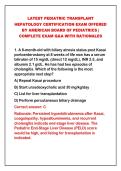
LATEST PEDIATRIC TRANSPLANT
HEPATOLOGY CERTIFICATION EXAM OFFERED
BY AMERICAN BOARD OF PEDIATRICS |
COMPLETE EXAM Q&A WITH RATIONALES
1. A 6-month-old with biliary atresia status post Kasai
portoenterostomy at 8 weeks of life now has a serum
bilirubin of 15 mg/dL (direct 12 mg/dL), INR 2.5, and
albumin 2.1 g/dL. He has had two episodes of
cholangitis. Which of the following is the most
appropriate next step?
A) Repeat Kasai procedure
B) Start ursodeoxycholic acid 30 mg/kg/day
C) List for liver transplantation
D) Perform percutaneous biliary drainage
Correct answer: C
Rationale: Persistent hyperbilirubinemia after Kasai,
coagulopathy, hypoalbuminemia, and recurrent
cholangitis indicate end-stage liver disease. The
Pediatric End-Stage Liver Disease (PELD) score
would be high, and listing for transplantation is
indicated.
,2. Which of the following is the most common
indication for liver transplantation in children under 1
year of age?
A) Acute liver failure
B) Biliary atresia
C) Alagille syndrome
D) Hepatoblastoma
Correct answer: B
Rationale: Biliary atresia is the single most common
indication for pediatric liver transplantation across
all age groups and accounts for approximately 50% of
transplants in children under 1 year.
3. A 4-year-old with alpha-1-antitrypsin deficiency
(PiZZ phenotype) has developed progressive portal
hypertension with variceal bleeding and synthetic
dysfunction. Which of the following is the most
appropriate definitive therapy?
A) Intravenous alpha-1-antitrypsin replacement
B) Liver transplantation
C) Portosystemic shunt surgery
D) Chronic endoscopic variceal banding
Correct answer: B
,Rationale: Liver transplantation is the only definitive
treatment for end-stage liver disease from alpha-1-
antitrypsin deficiency. Medical therapy and shunts
are palliative. IV replacement does not reverse
established cirrhosis.
4. A 12-year-old recipient of a living donor liver
transplant 6 months ago presents with fever, right
upper quadrant pain, and elevated liver enzymes
(AST 450, ALT 400, GGT 300). Doppler ultrasound
shows normal hepatic artery flow and patent portal
vein. Liver biopsy shows portal lymphocytic infiltrate
with endothelitis. Which of the following is the most
likely diagnosis?
A) Hepatic artery thrombosis
B) Biliary anastomotic stricture
C) Acute cellular rejection
D) Recurrent autoimmune hepatitis
Correct answer: C
Rationale: Endothelitis (lymphocytic infiltration of
endothelium) is the histologic hallmark of acute
cellular rejection. Timing (6 months post-transplant)
and presentation with graft dysfunction are
consistent with rejection. Hepatic artery thrombosis
would show absent flow on Doppler.
, 5. A 2-year-old with biliary atresia and
portopulmonary hypertension has a mean pulmonary
artery pressure of 45 mmHg by cardiac
catheterization. Which of the following pre-transplant
interventions is most appropriate?
A) Proceed directly to liver transplantation
B) Combination pulmonary vasodilator therapy with
repeat catheterization
C) Atrial septostomy
D) List for combined liver-lung transplantation
Correct answer: B
Rationale: Moderate to severe portopulmonary
hypertension (mPAP >35 mmHg) requires pre-
transplant medical therapy to reduce pulmonary
pressures. mPAP >50 mmHg is a contraindication.
Vasodilators (prostacyclin analogs,
phosphodiesterase-5 inhibitors, endothelin
antagonists) are used.
6. A 14-year-old with cystic fibrosis and cirrhosis is
being evaluated for liver transplantation. Which of the
following extrahepatic manifestations would most
influence transplant candidacy and timing?
HEPATOLOGY CERTIFICATION EXAM OFFERED
BY AMERICAN BOARD OF PEDIATRICS |
COMPLETE EXAM Q&A WITH RATIONALES
1. A 6-month-old with biliary atresia status post Kasai
portoenterostomy at 8 weeks of life now has a serum
bilirubin of 15 mg/dL (direct 12 mg/dL), INR 2.5, and
albumin 2.1 g/dL. He has had two episodes of
cholangitis. Which of the following is the most
appropriate next step?
A) Repeat Kasai procedure
B) Start ursodeoxycholic acid 30 mg/kg/day
C) List for liver transplantation
D) Perform percutaneous biliary drainage
Correct answer: C
Rationale: Persistent hyperbilirubinemia after Kasai,
coagulopathy, hypoalbuminemia, and recurrent
cholangitis indicate end-stage liver disease. The
Pediatric End-Stage Liver Disease (PELD) score
would be high, and listing for transplantation is
indicated.
,2. Which of the following is the most common
indication for liver transplantation in children under 1
year of age?
A) Acute liver failure
B) Biliary atresia
C) Alagille syndrome
D) Hepatoblastoma
Correct answer: B
Rationale: Biliary atresia is the single most common
indication for pediatric liver transplantation across
all age groups and accounts for approximately 50% of
transplants in children under 1 year.
3. A 4-year-old with alpha-1-antitrypsin deficiency
(PiZZ phenotype) has developed progressive portal
hypertension with variceal bleeding and synthetic
dysfunction. Which of the following is the most
appropriate definitive therapy?
A) Intravenous alpha-1-antitrypsin replacement
B) Liver transplantation
C) Portosystemic shunt surgery
D) Chronic endoscopic variceal banding
Correct answer: B
,Rationale: Liver transplantation is the only definitive
treatment for end-stage liver disease from alpha-1-
antitrypsin deficiency. Medical therapy and shunts
are palliative. IV replacement does not reverse
established cirrhosis.
4. A 12-year-old recipient of a living donor liver
transplant 6 months ago presents with fever, right
upper quadrant pain, and elevated liver enzymes
(AST 450, ALT 400, GGT 300). Doppler ultrasound
shows normal hepatic artery flow and patent portal
vein. Liver biopsy shows portal lymphocytic infiltrate
with endothelitis. Which of the following is the most
likely diagnosis?
A) Hepatic artery thrombosis
B) Biliary anastomotic stricture
C) Acute cellular rejection
D) Recurrent autoimmune hepatitis
Correct answer: C
Rationale: Endothelitis (lymphocytic infiltration of
endothelium) is the histologic hallmark of acute
cellular rejection. Timing (6 months post-transplant)
and presentation with graft dysfunction are
consistent with rejection. Hepatic artery thrombosis
would show absent flow on Doppler.
, 5. A 2-year-old with biliary atresia and
portopulmonary hypertension has a mean pulmonary
artery pressure of 45 mmHg by cardiac
catheterization. Which of the following pre-transplant
interventions is most appropriate?
A) Proceed directly to liver transplantation
B) Combination pulmonary vasodilator therapy with
repeat catheterization
C) Atrial septostomy
D) List for combined liver-lung transplantation
Correct answer: B
Rationale: Moderate to severe portopulmonary
hypertension (mPAP >35 mmHg) requires pre-
transplant medical therapy to reduce pulmonary
pressures. mPAP >50 mmHg is a contraindication.
Vasodilators (prostacyclin analogs,
phosphodiesterase-5 inhibitors, endothelin
antagonists) are used.
6. A 14-year-old with cystic fibrosis and cirrhosis is
being evaluated for liver transplantation. Which of the
following extrahepatic manifestations would most
influence transplant candidacy and timing?


