

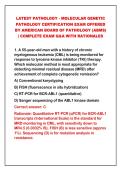
LATEST PATHOLOGY - MOLECULAR GENETIC
PATHOLOGY CERTIFICATION EXAM OFFERED
BY AMERICAN BOARD OF PATHOLOGY (ABMS)
| COMPLETE EXAM Q&A WITH RATIONALES
1. A 55-year-old man with a history of chronic
myelogenous leukemia (CML) is being monitored for
response to tyrosine kinase inhibitor (TKI) therapy.
Which molecular method is most appropriate for
detecting minimal residual disease (MRD) after
achievement of complete cytogenetic remission?
A) Conventional karyotyping
B) FISH (fluorescence in situ hybridization)
C) RT-PCR for BCR-ABL1 (quantitative)
D) Sanger sequencing of the ABL1 kinase domain
Correct answer: C
Rationale: Quantitative RT-PCR (qPCR) for BCR-ABL1
transcripts (International Scale) is the standard for
MRD monitoring in CML, with sensitivity down to
MR4.5 (0.0032% IS). FISH (B) is less sensitive (approx
1%). Sequencing (D) is for mutation analysis in
resistance.
,2. A 45-year-old woman with a strong family history of
breast and ovarian cancer undergoes genetic
testing. A deletion is detected in BRCA1. Which
method is most appropriate to determine whether the
deletion is present in her asymptomatic daughter?
A) Whole exome sequencing (WES)
B) BRCA1-specific deletion analysis by multiplex
ligation-dependent probe amplification (MLPA)
C) Karyotype
D) BRCA1 Sanger sequencing
Correct answer: B
Rationale: MLPA is the preferred method for
detecting large deletions/duplications in BRCA1/2
(and other genes) that are not detected by standard
Sanger sequencing. Sanger sequencing (D) would
miss a deletion if primers are not spanning the
breakpoint.
3. A 60-year-old man with metastatic colorectal
cancer is being considered for anti-EGFR therapy
(cetuximab). Which molecular test is required to
predict response?
A) BRAF V600E mutation testing
B) KRAS/NRAS mutation testing (exons 2, 3, 4)
,C) MSI (microsatellite instability) testing
D) HER2 amplification
Correct answer: B
Rationale: KRAS/NRAS mutations (exons 2, 3, 4)
confer primary resistance to anti-EGFR antibodies
(cetuximab, panitumumab) in colorectal cancer. Only
patients with RAS wild-type tumors should receive
these agents. BRAF (A) is prognostic but not
predictive.
4. A 35-year-old man presents with episodic flushing,
diarrhea, and wheezing. A neuroendocrine tumor
(NET) is suspected. Which molecular alteration is
most commonly associated with sporadic well-
differentiated midgut NETs (ileal)?
A) MEN1 mutation
B) DAXX/ATRX mutation
C) BRAF V600E mutation
D) RET mutation
Correct answer: B
Rationale: DAXX or ATRX mutations are common in
sporadic pancreatic (and midgut) NETs, associated
with alternative lengthening of telomeres (ALT).
MEN1 (A) is more common in pancreatic NETs
, (hereditary or sporadic). BRAF (C) is in colorectal
cancer.
5. A 45-year-old woman presents with a
pheochromocytoma. Genetic testing is performed.
Which of the following hereditary syndromes is most
strongly associated with a pathogenic variant in the
SDHB gene?
A) Multiple endocrine neoplasia type 2 (MEN2)
B) Neurofibromatosis type 1 (NF1)
C) Von Hippel-Lindau (VHL)
D) Hereditary paraganglioma-pheochromocytoma
syndrome (PGL/PCC)
Correct answer: D
Rationale: SDHB mutations are associated with
hereditary paraganglioma-pheochromocytoma
syndrome (PGL/PCC type 4). These tumors have a
higher risk of malignancy. MEN2 (A) is associated
with RET mutations. VHL (C) with VHL gene.
6. A 28-year-old woman with a strong family history of
gastric cancer undergoes endoscopy, which reveals
signet ring cells in the gastric mucosa. A germline
mutation in which gene is most likely?
PATHOLOGY CERTIFICATION EXAM OFFERED
BY AMERICAN BOARD OF PATHOLOGY (ABMS)
| COMPLETE EXAM Q&A WITH RATIONALES
1. A 55-year-old man with a history of chronic
myelogenous leukemia (CML) is being monitored for
response to tyrosine kinase inhibitor (TKI) therapy.
Which molecular method is most appropriate for
detecting minimal residual disease (MRD) after
achievement of complete cytogenetic remission?
A) Conventional karyotyping
B) FISH (fluorescence in situ hybridization)
C) RT-PCR for BCR-ABL1 (quantitative)
D) Sanger sequencing of the ABL1 kinase domain
Correct answer: C
Rationale: Quantitative RT-PCR (qPCR) for BCR-ABL1
transcripts (International Scale) is the standard for
MRD monitoring in CML, with sensitivity down to
MR4.5 (0.0032% IS). FISH (B) is less sensitive (approx
1%). Sequencing (D) is for mutation analysis in
resistance.
,2. A 45-year-old woman with a strong family history of
breast and ovarian cancer undergoes genetic
testing. A deletion is detected in BRCA1. Which
method is most appropriate to determine whether the
deletion is present in her asymptomatic daughter?
A) Whole exome sequencing (WES)
B) BRCA1-specific deletion analysis by multiplex
ligation-dependent probe amplification (MLPA)
C) Karyotype
D) BRCA1 Sanger sequencing
Correct answer: B
Rationale: MLPA is the preferred method for
detecting large deletions/duplications in BRCA1/2
(and other genes) that are not detected by standard
Sanger sequencing. Sanger sequencing (D) would
miss a deletion if primers are not spanning the
breakpoint.
3. A 60-year-old man with metastatic colorectal
cancer is being considered for anti-EGFR therapy
(cetuximab). Which molecular test is required to
predict response?
A) BRAF V600E mutation testing
B) KRAS/NRAS mutation testing (exons 2, 3, 4)
,C) MSI (microsatellite instability) testing
D) HER2 amplification
Correct answer: B
Rationale: KRAS/NRAS mutations (exons 2, 3, 4)
confer primary resistance to anti-EGFR antibodies
(cetuximab, panitumumab) in colorectal cancer. Only
patients with RAS wild-type tumors should receive
these agents. BRAF (A) is prognostic but not
predictive.
4. A 35-year-old man presents with episodic flushing,
diarrhea, and wheezing. A neuroendocrine tumor
(NET) is suspected. Which molecular alteration is
most commonly associated with sporadic well-
differentiated midgut NETs (ileal)?
A) MEN1 mutation
B) DAXX/ATRX mutation
C) BRAF V600E mutation
D) RET mutation
Correct answer: B
Rationale: DAXX or ATRX mutations are common in
sporadic pancreatic (and midgut) NETs, associated
with alternative lengthening of telomeres (ALT).
MEN1 (A) is more common in pancreatic NETs
, (hereditary or sporadic). BRAF (C) is in colorectal
cancer.
5. A 45-year-old woman presents with a
pheochromocytoma. Genetic testing is performed.
Which of the following hereditary syndromes is most
strongly associated with a pathogenic variant in the
SDHB gene?
A) Multiple endocrine neoplasia type 2 (MEN2)
B) Neurofibromatosis type 1 (NF1)
C) Von Hippel-Lindau (VHL)
D) Hereditary paraganglioma-pheochromocytoma
syndrome (PGL/PCC)
Correct answer: D
Rationale: SDHB mutations are associated with
hereditary paraganglioma-pheochromocytoma
syndrome (PGL/PCC type 4). These tumors have a
higher risk of malignancy. MEN2 (A) is associated
with RET mutations. VHL (C) with VHL gene.
6. A 28-year-old woman with a strong family history of
gastric cancer undergoes endoscopy, which reveals
signet ring cells in the gastric mucosa. A germline
mutation in which gene is most likely?


