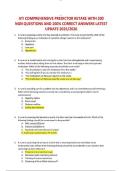
ATI Comprehensive Predictor Retake [200 NGN Questions + Verified Answers] Real Exit Exam Study Guide Bundle
Pass Your Nursing Exit Exam on the Second Try: The Ultimate Remediation ResourceSecuring your green light for graduation and the NCLEX-RN depends entirely on one monumental milestone: passing the ATI RN Comprehensive Predictor Exam. If you are preparing for a critical retake version of this high-stakes test, facing a massive 200-question pool can feel overwhelming. The pressure is on, the clinical concepts are vast, and the Next Generation NCLEX (NGN) question formats demand a level of critical clinical judgment that standard multiple-choice practice simply cannot replicate.This ATI Comprehensive Predictor Retake with 200 NGN Questions and 100% Correct Answers (Latest Updated 2025/2026 Edition) is specifically built to relieve that testing anxiety, structure your remediation, and guarantee a passing probability score on your final attempt. Developed to perfectly mimic the real layout, formatting, and blueprint of the current academic cycle's proctored exam, this file is the definitive ultimate guide for nursing students who need to master high-yield concepts efficiently. What’s Included Inside This Premium 200-Question Study Pack?This download contains a full, meticulously verified test bank and study guide featuring 200 Next-Generation NCLEX (NGN) aligned questions, each complete with its corresponding 100% verified correct answer and comprehensive clinical rationales. Unlike general study sheets, this document focuses directly on the specific testing trends, prioritization logic, and safe-care principles evaluated during the 2025 and 2026 ATI testing windows. Every question is fully formatted to reflect exactly what you will see on the testing screen, allowing you to build the mental stamina required for the rigorous 4-hour exit evaluation. Next-Generation NCLEX (NGN) Formats Covered:Unfolding Clinical Case Studies: Multi-step scenarios that track a patient’s status from admission through discharge. Bow-Tie and Matrix Grid Items: High-yield question layouts requiring you to cross-reference multiple symptoms, diagnoses, and pharmacology interventions simultaneously. Select All That Apply (SATA): Optimized drills designed to help you recognize the precise clinical nuances that separate correct interventions from unsafe distractions. Drag-and-Drop / Prioritization Lists: Interactive practice determining which unstable client to assess first using established emergency protocols.Deep-Dive Analysis of Core Exam DomainsTo ensure your remediation covers every potential weak point flagged by your individual performance profile, this 200-question collection is strategically distributed across all core nursing specialties and Client Need Categories outlined in the latest testing blueprint:1. Management of Care & Safety Infection ControlA massive portion of the predictor evaluates your leadership capabilities and legal-ethical responsibilities. This section provides absolute clarity on:Delegation and Assignment: Identifying exactly which tasks can be safely passed to Licensed Practical Nurses (LPNs) or Assistive Personnel (AP) versus what must be retained by the Registered Nurse (RN) (e.g., assessment, teaching, clinical judgment).Prioritization Frameworks: Utilizing Maslow’s Hierarchy of Needs, ABCs (Airway, Breathing, Circulation), and "Survival Potential" triage to choose the most critical client in a multi-patient assignment. Informed Consent & Ethical Principles: Real-world scenarios testing your mastery of veracity (truth-telling), fidelity (keeping promises), paternalism, and the proper steps to take if a medication error occurs.Advance Directives & Living Wills: Clarifying the nurse’s exact legal scope in upholding client self-determination and handling end-of-life care requests.2. Advanced Adult Medical-Surgical NursingMastering complex physiological systems is crucial to boosting your predictor probability score. This document breaks down the highest-yield med-surg priorities:Cardiovascular Care: Managing unstable heart failure, understanding pacemaker postoperative safety (e.g., cell phone usage restrictions), and monitoring hemodynamic shifts.Respiratory & Thoracic Nursing: Managing chest tube systems post-thoracotomy, recognizing critical intervention markers (e.g., interpreting water seal chamber behavior vs. suction chamber pressures), and correcting hypoxemia.Endocrine & Metabolic Emergencies: Rapid identification of Diabetic Ketoacidosis (DKA) vs. HHS, monitoring critical lab values (potassium, sodium, BUN, serum albumin), and administering complex insulin regimens safely.Renal & Fluid Management: Identifying manifestations of urolithiasis and implementing strict nursing interventions like urine straining and continuous fluid volume status calculations. 3. Pharmacological and Parenteral TherapiesMedication safety remains one of the single most heavily failed areas on the ATI Predictor. Our detailed rationales guide you through:High-Alert Medications: Safely managing anticoagulants like Warfarin (including essential PT/INR lab tracking), titrating IV fluids during fluid overloads, and identifying absolute contraindications for diagnostic agents (e.g., iodine allergies during thyroid scans).Safe Administration Practices: Step-by-step priority actions when an incorrect dosage is discovered, medication reconciliation protocols, and mixed insulin rules (e.g., combining regular insulin with rapid-acting analogs like Aspart or Lispro).4. Maternal-Newborn and Pediatric NursingEnsure you secure an excellent grade across the lifespan with highly targeted OB and Peds scenarios:Labor & Delivery Interventions: Understanding non-pharmacological comfort techniques like effleurage (light abdominal stroking) and immediate postpartum safety.Newborn Care and Safety: High-yield protocols targeting the immediate post-birth phase (e.g., erythromycin ophthalmic placement), assessing maternal-infant bonding, and implementing strict identification systems to mitigate infant abduction risks.Pediatric Development & Immunology: Recognizing absolute contraindications for childhood immunizations (such as long-term immunosuppressant therapy and live vaccines like MMR) and managing end-of-life sibling dynamics in pediatric oncology.5. Psychiatric and Mental Health NursingCrisis & Suicide Intervention: Immediate nursing safety protocols for clients post-suicide attempt, including environmental safety adjustments (e.g., plastic utensils, continuous observation). Behavioral Restraints: Legal parameters, mandatory documentation, monitoring intervals, and specific clinical milestones required to safely discontinue mechanical restraints.Therapeutic Communication: Selecting the most empathetic, open-ended, non-defensive verbal responses when dealing with aggressive, anxious, or cognitively impaired clients.Why Use This 2025/2026 Retake Guide for Your Remediation?When preparing for a retake, studying the entire nursing curriculum from scratch is inefficient and exhausting. You need to align your mind with the actual logic of the test authors.Real Rationales, No Fluff: Every question features a comprehensive explanation detailing why the correct answer is the safest clinical action, and exactly why the distracting alternatives are inappropriate, unsafe, or delayed interventions. Clinical Judgment Model Integration: The questions are specifically structured around the NCSBN Clinical Judgment Measurement Model (NCJMM)—forcing you to practice recognizing cues, analyzing hypotheses, and evaluating outcomes smoothly. Boosted Stamina and Confidence: Walking through 200 high-quality, comprehensive questions sharpens your test-taking speed, helping you combat exam fatigue so you stay sharp from question 1 all the way to question 200.Whether your personal goal is reaching an explicit Level 2 or Level 3 proficiency benchmark, elevating your ATI predictability percentage past 95%, or generating premium remediation content for your nursing portfolio, this 2025/2026 update provides an elite, highly reliable blueprint for success. Download today, focus your study sessions, and walk into your retake exam with absolute confidence!Pass Your Nursing Exit Exam on the Second Try: The Ultimate Remediation ResourceSecuring your green light for graduation and the NCLEX-RN depends entirely on one monumental milestone: passing the ATI RN Comprehensive Predictor Exam. If you are preparing for a critical retake version of this high-stakes test, facing a massive 200-question pool can feel overwhelming. The pressure is on, the clinical concepts are vast, and the Next Generation NCLEX (NGN) question formats demand a level of critical clinical judgment that standard multiple-choice practice simply cannot replicate.This ATI Comprehensive Predictor Retake with 200 NGN Questions and 100% Correct Answers (Latest Updated 2025/2026 Edition) is specifically built to relieve that testing anxiety, structure your remediation, and guarantee a passing probability score on your final attempt. Developed to perfectly mimic the real layout, formatting, and blueprint of the current academic cycle's proctored exam, this file is the definitive ultimate guide for nursing students who need to master high-yield concepts efficiently. What’s Included Inside This Premium 200-Question Study Pack?This download contains a full, meticulously verified test bank and study guide featuring 200 Next-Generation NCLEX (NGN) aligned questions, each complete with its corresponding 100% verified correct answer and comprehensive clinical rationales. Unlike general study sheets, this document focuses directly on the specific testing trends, prioritization logic, and safe-care principles evaluated during the 2025 and 2026 ATI testing windows. Every question is fully formatted to reflect exactly what you will see on the testing screen, allowing you to build the mental stamina required for the rigorous 4-hour exit evaluation. Next-Generation NCLEX (NGN) Formats Covered:Unfolding Clinical Case Studies: Multi-step scenarios that track a patient’s status from admission through discharge. Bow-Tie and Matrix Grid Items: High-yield question layouts requiring you to cross-reference multiple symptoms, diagnoses, and pharmacology interventions simultaneously. Select All That Apply (SATA): Optimized drills designed to help you recognize the precise clinical nuances that separate correct interventions from unsafe distractions. Drag-and-Drop / Prioritization Lists: Interactive practice determining which unstable client to assess first using established emergency protocols.Deep-Dive Analysis of Core Exam DomainsTo ensure your remediation covers every potential weak point flagged by your individual performance profile, this 200-question collection is strategically distributed across all core nursing specialties and Client Need Categories outlined in the latest testing blueprint:1. Management of Care & Safety Infection ControlA massive portion of the predictor evaluates your leadership capabilities and legal-ethical responsibilities. This section provides absolute clarity on:Delegation and Assignment: Identifying exactly which tasks can be safely passed to Licensed Practical Nurses (LPNs) or Assistive Personnel (AP) versus what must be retained by the Registered Nurse (RN) (e.g., assessment, teaching, clinical judgment).Prioritization Frameworks: Utilizing Maslow’s Hierarchy of Needs, ABCs (Airway, Breathing, Circulation), and "Survival Potential" triage to choose the most critical client in a multi-patient assignment. Informed Consent & Ethical Principles: Real-world scenarios testing your mastery of veracity (truth-telling), fidelity (keeping promises), paternalism, and the proper steps to take if a medication error occurs.Advance Directives & Living Wills: Clarifying the nurse’s exact legal scope in upholding client self-determination and handling end-of-life care requests.2. Advanced Adult Medical-Surgical NursingMastering complex physiological systems is crucial to boosting your predictor probability score. This document breaks down the highest-yield med-surg priorities:Cardiovascular Care: Managing unstable heart failure, understanding pacemaker postoperative safety (e.g., cell phone usage restrictions), and monitoring hemodynamic shifts.Respiratory & Thoracic Nursing: Managing chest tube systems post-thoracotomy, recognizing critical intervention markers (e.g., interpreting water seal chamber behavior vs. suction chamber pressures), and correcting hypoxemia.Endocrine & Metabolic Emergencies: Rapid identification of Diabetic Ketoacidosis (DKA) vs. HHS, monitoring critical lab values (potassium, sodium, BUN, serum albumin), and administering complex insulin regimens safely.Renal & Fluid Management: Identifying manifestations of urolithiasis and implementing strict nursing interventions like urine straining and continuous fluid volume status calculations. 3. Pharmacological and Parenteral TherapiesMedication safety remains one of the single most heavily failed areas on the ATI Predictor. Our detailed rationales guide you through:High-Alert Medications: Safely managing anticoagulants like Warfarin (including essential PT/INR lab tracking), titrating IV fluids during fluid overloads, and identifying absolute contraindications for diagnostic agents (e.g., iodine allergies during thyroid scans).Safe Administration Practices: Step-by-step priority actions when an incorrect dosage is discovered, medication reconciliation protocols, and mixed insulin rules (e.g., combining regular insulin with rapid-acting analogs like Aspart or Lispro).4. Maternal-Newborn and Pediatric NursingEnsure you secure an excellent grade across the lifespan with highly targeted OB and Peds scenarios:Labor & Delivery Interventions: Understanding non-pharmacological comfort techniques like effleurage (light abdominal stroking) and immediate postpartum safety.Newborn Care and Safety: High-yield protocols targeting the immediate post-birth phase (e.g., erythromycin ophthalmic placement), assessing maternal-infant bonding, and implementing strict identification systems to mitigate infant abduction risks.Pediatric Development & Immunology: Recognizing absolute contraindications for childhood immunizations (such as long-term immunosuppressant therapy and live vaccines like MMR) and managing end-of-life sibling dynamics in pediatric oncology.5. Psychiatric and Mental Health NursingCrisis & Suicide Intervention: Immediate nursing safety protocols for clients post-suicide attempt, including environmental safety adjustments (e.g., plastic utensils, continuous observation). Behavioral Restraints: Legal parameters, mandatory documentation, monitoring intervals, and specific clinical milestones required to safely discontinue mechanical restraints.Therapeutic Communication: Selecting the most empathetic, open-ended, non-defensive verbal responses when dealing with aggressive, anxious, or cognitively impaired clients.Why Use This 2025/2026 Retake Guide for Your Remediation?When preparing for a retake, studying the entire nursing curriculum from scratch is inefficient and exhausting. You need to align your mind with the actual logic of the test authors.Real Rationales, No Fluff: Every question features a comprehensive explanation detailing why the correct answer is the safest clinical action, and exactly why the distracting alternatives are inappropriate, unsafe, or delayed interventions. Clinical Judgment Model Integration: The questions are specifically structured around the NCSBN Clinical Judgment Measurement Model (NCJMM)—forcing you to practice recognizing cues, analyzing hypotheses, and evaluating outcomes smoothly. Boosted Stamina and Confidence: Walking through 200 high-quality, comprehensive questions sharpens your test-taking speed, helping you combat exam fatigue so you stay sharp from question 1 all the way to question 200.Whether your personal goal is reaching an explicit Level 2 or Level 3 proficiency benchmark, elevating your ATI predictability percentage past 95%, or generating premium remediation content for your nursing portfolio, this 2025/2026 update provides an elite, highly reliable blueprint for success. Download today, focus your study sessions, and walk into your retake exam with absolute confidence!
Document information
- Uploaded on
- June 4, 2026
- Number of pages
- 36
- Written in
- 2025/2026
- Type
- Exam (elaborations)
- Contains
- Questions & answers