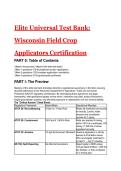
Elite Universal Test Bank:
Wisconsin Field Crop
Applicators Certification
PART 0: Table of Contents
*(#part-i-the-preview) *(#part-ii-the-elite-test-bank)
*(#tier-1-questions-110-foundational-syntax--application)
*(#tier-2-questions-1120-complex-application--simulation)
*(#tier-3-questions-2130-grandmaster-synthesis)
PART I: The Preview
Mastery of this elite test bank translates directly to operational supremacy in the field, ensuring
absolute adherence to the Wisconsin Department of Agriculture, Trade and Consumer
Protection (DATCP) regulatory architecture. By internalizing these agronomic and legal
frameworks, elite applicators bypass novice errors, maximize crop yield, protect Wisconsin’s
fragile groundwater systems, and eliminate exposure to catastrophic civil and criminal liability.
The "Critical Axioms" Cheat Sheet:
Regulatory Framework Axiom/Metric Operational Mandate
ATCP 29: Recordkeeping 2-Year vs. 3-Year Rule Retain all restricted-use records
for exactly 2 years; retain
atrazine and isoxaflutole
records for 3 years.
ATCP 29: Containment 100-Foot & 1,500-lb Rule Pads are required if mixing
within 100 ft of a well/water, OR
mixing >1,500 lbs of active
ingredient annually.
ATCP 30: Atrazine 3.0 ppb Enforcement Standard Atrazine application is strictly
banned in Prohibition Areas
(PAs) and legally restricted to
an April 1 – July 31 window.
NR 706: Spill Reporting De Minimis Exemptions Report spills to DNR unless
<25 gal liquid fertilizer, <250 lbs
dry fertilizer, or fully contained
on a mixing pad.
,Regulatory Framework Axiom/Metric Operational Mandate
ATCP 29: Apiary Notice 24-Hour / 1.5-Mile Rule Notify beekeepers within 1.5
miles at least 24 hours prior to
applying pesticides labeled
"Highly Toxic to Bees".
Agronomic Thresholds Pathological / Insect Dynamics Soybean Aphids: 250/plant
(increasing). Corn Rootworm:
0.75 beetles/plant. Alfalfa
Leafhopper: Height-dependent.
PART II: The Elite Test Bank
Tier 1 (Questions 1–10): Foundational Syntax & Application
Q1: A commercial applicator for-hire completes a pre-emergent application of an
isoxaflutole-based herbicide and an atrazine-based herbicide on a medium-texture soil corn
field. According to Wisconsin Administrative Code ATCP 29 and ATCP 30, what is the MOST
ACCURATE required retention period for this specific application record? A) 2 years, as is
standard for all general and restricted-use agricultural pesticides in Wisconsin. B) 3 years,
specifically mandated due to the presence of both atrazine and isoxaflutole active ingredients.
C) 5 years, because the application was performed by a commercial applicator for-hire on
agricultural land. D) 1 year, provided the field is not located within a designated Atrazine
Prohibition Area (PA).
● The Answer: B (3 years, specifically mandated due to the presence of both atrazine and
isoxaflutole active ingredients.)
● Distractor Analysis:
○ A is incorrect: While ATCP 29 standardizes a 2-year retention period for most
commercial pesticide application records, products containing atrazine or
isoxaflutole trigger an explicit regulatory exception requiring 3 years.
○ C is incorrect: A 5-year retention protocol does not exist under Wisconsin ATCP 29
for standard commercial agricultural pesticide applications. This is a common
novice confusion with worker protection standards in other jurisdictions.
○ D is incorrect: Recordkeeping retention dictates are uniform regardless of proximity
to an Atrazine Prohibition Area (PA). PAs dictate the outright legality of the
application, not the lifespan of the compliance record.
The Mentor's Analysis: Wisconsin DATCP maintains aggressive oversight over atrazine and
isoxaflutole due to their high mobility in groundwater and historical accumulation above the 3.0
ppb Enforcement Standard. When facing state audits, the immediate priority is producing exact
documentation for these highly scrutinized active ingredients. By utilizing the 3-year retention
mandate, you bypass the common trap of defaulting to the standard ATCP 29 baseline.
Professional/Academic Intuition: Never default to the baseline when handling severe
groundwater contaminants; atrazine and isoxaflutole inherently extend your legal liability
and documentation requirements by 12 months.
Q2: Under the definitions provided by Wisconsin ATCP 29, which scenario unequivocally
represents the legal definition of pesticide overspray rather than pesticide drift? A) An applicator
utilizing an airblast sprayer allows fine pesticide droplets to be carried by a 12 MPH crosswind
onto an adjacent organic soybean field. B) Volatilization of a dicamba-based herbicide occurs 24
hours after application due to a temperature inversion, causing cupping in a neighboring tomato
, crop. C) A boom sprayer operator fails to shut off the exterior boom section while making a
turning maneuver, applying pesticide directly over the property line onto a neighbor's lawn. D)
Pesticide vapor diffuses outside the target application site during a mid-summer thermal updraft.
● The Answer: C (A boom sprayer operator fails to shut off the exterior boom section while
making a turning maneuver, applying pesticide directly over the property line onto a
neighbor's lawn.)
● Distractor Analysis:
○ A is incorrect: The physical movement of pesticide droplets outside the target area
caused by air currents at the time of application legally defines pesticide drift, not
overspray.
○ B is incorrect: Volatilization and subsequent vapor movement due to atmospheric
conditions falls under the legal definition of significant drift.
○ D is incorrect: Diffusion of vapor outside the target area is explicitly included in the
ATCP 29 statutory definition of pesticide drift.
The Mentor's Analysis: The distinction between drift and overspray dictates the regulatory
response and liability severity under ATCP 29.50. When facing a misapplication investigation,
the immediate priority is determining mechanical intent versus environmental interference. By
utilizing the direct mechanical placement definition, you bypass the common trap of confusing
wind-borne off-target movement with operator negligence. Professional/Academic Intuition:
Drift is the environment moving your chemical; overspray is you physically putting the
boom where it does not belong. Both are illegal, but overspray is an inexcusable
mechanical failure.
Q3: A facility manager is designing a new mixing and loading pad for an agricultural
cooperative. According to ATCP 29, what is the MINIMUM required capacity for the spill
containment pad if the largest container stored on the pad holds 600 gallons of liquid pesticide?
A) 600 gallons, matching the volume of the largest primary container. B) 750 gallons,
representing 125% of the largest container. C) 1,000 gallons, representing the absolute
minimum capacity for any pad housing a container under 800 gallons. D) 1,500 gallons, aligning
with the annual active ingredient threshold weight limit.
● The Answer: C (1,000 gallons, representing the absolute minimum capacity for any pad
housing a container under 800 gallons.)
● Distractor Analysis:
○ A is incorrect: Designing secondary containment to match exactly 100% of the
primary container fails to account for precipitation, displacement, or catastrophic
hydraulic failure.
○ B is incorrect: While 125% of 600 gallons is 750 gallons, the law explicitly dictates a
minimum floor of 1,000 gallons for containers holding 800 gallons or less.
○ D is incorrect: 1,500 is a unit of weight (pounds) representing the annual
mixing/loading threshold that triggers the need for a pad in the first place, not a
volumetric capacity metric.
The Mentor's Analysis: Containment architecture must withstand absolute worst-case
catastrophic failure plus environmental loading from rainwater. When facing facility design, the
immediate priority is ensuring volumetric superiority over the largest stored asset. By utilizing
the 1,000-gallon minimum rule, you bypass the common trap of merely calculating 125% for
smaller tanks. Professional/Academic Intuition: Secondary containment capacity is never
a 1:1 ratio. If the largest tank is under 800 gallons, the pad must hold 1,000 gallons; if it is
over 800 gallons, the pad must hold 125% of that largest tank.
Q4: A commercial applicator is preparing to apply a restricted-use pesticide labeled "Highly
Wisconsin Field Crop
Applicators Certification
PART 0: Table of Contents
*(#part-i-the-preview) *(#part-ii-the-elite-test-bank)
*(#tier-1-questions-110-foundational-syntax--application)
*(#tier-2-questions-1120-complex-application--simulation)
*(#tier-3-questions-2130-grandmaster-synthesis)
PART I: The Preview
Mastery of this elite test bank translates directly to operational supremacy in the field, ensuring
absolute adherence to the Wisconsin Department of Agriculture, Trade and Consumer
Protection (DATCP) regulatory architecture. By internalizing these agronomic and legal
frameworks, elite applicators bypass novice errors, maximize crop yield, protect Wisconsin’s
fragile groundwater systems, and eliminate exposure to catastrophic civil and criminal liability.
The "Critical Axioms" Cheat Sheet:
Regulatory Framework Axiom/Metric Operational Mandate
ATCP 29: Recordkeeping 2-Year vs. 3-Year Rule Retain all restricted-use records
for exactly 2 years; retain
atrazine and isoxaflutole
records for 3 years.
ATCP 29: Containment 100-Foot & 1,500-lb Rule Pads are required if mixing
within 100 ft of a well/water, OR
mixing >1,500 lbs of active
ingredient annually.
ATCP 30: Atrazine 3.0 ppb Enforcement Standard Atrazine application is strictly
banned in Prohibition Areas
(PAs) and legally restricted to
an April 1 – July 31 window.
NR 706: Spill Reporting De Minimis Exemptions Report spills to DNR unless
<25 gal liquid fertilizer, <250 lbs
dry fertilizer, or fully contained
on a mixing pad.
,Regulatory Framework Axiom/Metric Operational Mandate
ATCP 29: Apiary Notice 24-Hour / 1.5-Mile Rule Notify beekeepers within 1.5
miles at least 24 hours prior to
applying pesticides labeled
"Highly Toxic to Bees".
Agronomic Thresholds Pathological / Insect Dynamics Soybean Aphids: 250/plant
(increasing). Corn Rootworm:
0.75 beetles/plant. Alfalfa
Leafhopper: Height-dependent.
PART II: The Elite Test Bank
Tier 1 (Questions 1–10): Foundational Syntax & Application
Q1: A commercial applicator for-hire completes a pre-emergent application of an
isoxaflutole-based herbicide and an atrazine-based herbicide on a medium-texture soil corn
field. According to Wisconsin Administrative Code ATCP 29 and ATCP 30, what is the MOST
ACCURATE required retention period for this specific application record? A) 2 years, as is
standard for all general and restricted-use agricultural pesticides in Wisconsin. B) 3 years,
specifically mandated due to the presence of both atrazine and isoxaflutole active ingredients.
C) 5 years, because the application was performed by a commercial applicator for-hire on
agricultural land. D) 1 year, provided the field is not located within a designated Atrazine
Prohibition Area (PA).
● The Answer: B (3 years, specifically mandated due to the presence of both atrazine and
isoxaflutole active ingredients.)
● Distractor Analysis:
○ A is incorrect: While ATCP 29 standardizes a 2-year retention period for most
commercial pesticide application records, products containing atrazine or
isoxaflutole trigger an explicit regulatory exception requiring 3 years.
○ C is incorrect: A 5-year retention protocol does not exist under Wisconsin ATCP 29
for standard commercial agricultural pesticide applications. This is a common
novice confusion with worker protection standards in other jurisdictions.
○ D is incorrect: Recordkeeping retention dictates are uniform regardless of proximity
to an Atrazine Prohibition Area (PA). PAs dictate the outright legality of the
application, not the lifespan of the compliance record.
The Mentor's Analysis: Wisconsin DATCP maintains aggressive oversight over atrazine and
isoxaflutole due to their high mobility in groundwater and historical accumulation above the 3.0
ppb Enforcement Standard. When facing state audits, the immediate priority is producing exact
documentation for these highly scrutinized active ingredients. By utilizing the 3-year retention
mandate, you bypass the common trap of defaulting to the standard ATCP 29 baseline.
Professional/Academic Intuition: Never default to the baseline when handling severe
groundwater contaminants; atrazine and isoxaflutole inherently extend your legal liability
and documentation requirements by 12 months.
Q2: Under the definitions provided by Wisconsin ATCP 29, which scenario unequivocally
represents the legal definition of pesticide overspray rather than pesticide drift? A) An applicator
utilizing an airblast sprayer allows fine pesticide droplets to be carried by a 12 MPH crosswind
onto an adjacent organic soybean field. B) Volatilization of a dicamba-based herbicide occurs 24
hours after application due to a temperature inversion, causing cupping in a neighboring tomato
, crop. C) A boom sprayer operator fails to shut off the exterior boom section while making a
turning maneuver, applying pesticide directly over the property line onto a neighbor's lawn. D)
Pesticide vapor diffuses outside the target application site during a mid-summer thermal updraft.
● The Answer: C (A boom sprayer operator fails to shut off the exterior boom section while
making a turning maneuver, applying pesticide directly over the property line onto a
neighbor's lawn.)
● Distractor Analysis:
○ A is incorrect: The physical movement of pesticide droplets outside the target area
caused by air currents at the time of application legally defines pesticide drift, not
overspray.
○ B is incorrect: Volatilization and subsequent vapor movement due to atmospheric
conditions falls under the legal definition of significant drift.
○ D is incorrect: Diffusion of vapor outside the target area is explicitly included in the
ATCP 29 statutory definition of pesticide drift.
The Mentor's Analysis: The distinction between drift and overspray dictates the regulatory
response and liability severity under ATCP 29.50. When facing a misapplication investigation,
the immediate priority is determining mechanical intent versus environmental interference. By
utilizing the direct mechanical placement definition, you bypass the common trap of confusing
wind-borne off-target movement with operator negligence. Professional/Academic Intuition:
Drift is the environment moving your chemical; overspray is you physically putting the
boom where it does not belong. Both are illegal, but overspray is an inexcusable
mechanical failure.
Q3: A facility manager is designing a new mixing and loading pad for an agricultural
cooperative. According to ATCP 29, what is the MINIMUM required capacity for the spill
containment pad if the largest container stored on the pad holds 600 gallons of liquid pesticide?
A) 600 gallons, matching the volume of the largest primary container. B) 750 gallons,
representing 125% of the largest container. C) 1,000 gallons, representing the absolute
minimum capacity for any pad housing a container under 800 gallons. D) 1,500 gallons, aligning
with the annual active ingredient threshold weight limit.
● The Answer: C (1,000 gallons, representing the absolute minimum capacity for any pad
housing a container under 800 gallons.)
● Distractor Analysis:
○ A is incorrect: Designing secondary containment to match exactly 100% of the
primary container fails to account for precipitation, displacement, or catastrophic
hydraulic failure.
○ B is incorrect: While 125% of 600 gallons is 750 gallons, the law explicitly dictates a
minimum floor of 1,000 gallons for containers holding 800 gallons or less.
○ D is incorrect: 1,500 is a unit of weight (pounds) representing the annual
mixing/loading threshold that triggers the need for a pad in the first place, not a
volumetric capacity metric.
The Mentor's Analysis: Containment architecture must withstand absolute worst-case
catastrophic failure plus environmental loading from rainwater. When facing facility design, the
immediate priority is ensuring volumetric superiority over the largest stored asset. By utilizing
the 1,000-gallon minimum rule, you bypass the common trap of merely calculating 125% for
smaller tanks. Professional/Academic Intuition: Secondary containment capacity is never
a 1:1 ratio. If the largest tank is under 800 gallons, the pad must hold 1,000 gallons; if it is
over 800 gallons, the pad must hold 125% of that largest tank.
Q4: A commercial applicator is preparing to apply a restricted-use pesticide labeled "Highly