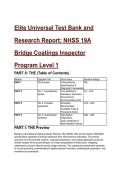
Elite Universal Test Bank and
Research Report: NHSS 19A
Bridge Coatings Inspector
Program Level 1
PART 0: THE (Table of Contents)
Section Cognitive Tier Focus Area Question Range
PART I The Preview Critical Axioms, N/A
Specifications &
Diagnostic Frameworks
PART II Tier 1: Foundational Core Definitions, Q1 – Q15
Syntax Standards, Normative
Documents &
Environmental Limits
PART II Tier 2: Complex Simulation, Q16 – Q35
Application Microclimates,
Feasibility Trials &
Procedural Action
PART II Tier 3: Grandmaster High-Stakes Q36 – Q60
Synthesis Diagnostics,
Dual-Jurisdiction &
Multi-Variable Failures
PART I: THE Preview
Mastery of the National Highway Sector Scheme 19A (NHSS 19A) and the Series 1900/5000
specifications separates functional operators from elite technical authorities. The precise
execution of environmental controls, substrate preparation, and coating application protocols
directly dictates the structural lifespan of critical transportation infrastructure, mitigating
catastrophic corrosion failures across bridge networks. The subsequent assessment demands
an uncompromising understanding of applied polymer chemistry, metallurgical preparation, and
normative documentation.
,The assessment framework relies on several core tenets that dictate inspection parameters.
The table below outlines the critical axioms that govern highway coatings inspection under
current United Kingdom standards.
Critical Axiom Technical Specification Operational Implication
The Thermodynamic Hard Substrate > 3°C above Dew Coatings applied outside these
Deck Point; Ambient > 5°C; RH < parameters will suffer osmotic
80% (Workshop) or < 90% blistering, amine blush, or
(Site). incomplete cross-linking.
The Scope of Authority ICorr Level 1 limits personnel to Level 1 inspectors cannot
executing written instructions select test extents, write
and recording data. procedures, or override failure
criteria without Level 2/3
direction.
The 5.2 MPa Standard New coating systems must Legacy systems below 5.2 MPa
achieve a minimum pull-off may occasionally be retained
adhesion strength of 5.2 MPa. pending expert visual
assessment of overall
condition.
The Friction Grip Limit High Strength Friction Grip Paint applied to the outer
(HSFG) bolted joints have strict surfaces of HSFG joint material
dry film limits. prior to assembly must not
exceed 20 microns Dry Film
Thickness (DFT).
CM 431 Categorization Defect percentages dictate Category III mandates minor
intervention: Category I maintenance; Category IV
(<1.0%), Category II mandates immediate major
(1.0%-3.0%), Category III maintenance and system
(3.0%-10.0%), Category IV replacement.
(>10.0%).
PART II: THE ELITE TEST BANK
Tier 1: Foundational Syntax & Application
Q1: Under the definitions provided by the Specification for Highway Works (Series 1900), which
primary factor dictates whether a newly fabricated steel highway structure is classified as a
"Marine" environment rather than an "Inland" environment? A) The geographic distance of the
structure being less than 50 kilometers from the nearest coastline. B) The requirement to use
high-build zinc-rich epoxy primers in the specification. C) The structure's physical susceptibility
to sea salt spray or road salt spray. D) The structure being situated over a navigable waterway
regardless of salinity.
● The Answer: C (The structure's physical susceptibility to sea salt spray or road salt
spray.)
● Distractor Analysis:
○ A is incorrect: The specification does not utilize arbitrary geographic distance limits;
it relies strictly on direct chemical exposure mechanisms.
○ B is incorrect: Paint specification is a reactive response to the environment, not the
definition of the environmental category itself.
, ○ D is incorrect: A navigable waterway may consist of fresh water entirely devoid of
sea salt spray, thereby classifying the asset as Inland.
The Mentor's Analysis: Environmental classification dictates the necessary rigor of the
specified coating system. A structure is only classified as Marine if it is demonstrably in reach of
chlorides via sea or road salt spray. By assessing exposure mechanics, the inspector bypasses
the novice error of relying on geographic mapping. Professional/Academic Intuition:
Classifications are defined by chemical exposure, not geographic distance.
Q2: According to the CM 431 standard for the maintenance painting of steelwork, a bridge
coating exhibiting numerous areas of denatured paintwork and substrate corrosion exceeding
10.0% of the total surface area is classified under which failure category? A) Category II B)
Category III C) Category IV D) Category V
● The Answer: C (Category IV)
● Distractor Analysis:
○ A is incorrect: Category II involves less than 1.0% substrate corrosion and between
1.0% and 3.0% paint defects. * B is incorrect: Category III involves 3.0% to 10.0%
paintwork defects and represents minor maintenance. * D is incorrect: The CM 431
standard does not recognize a Category V; the scale terminates at Category IV for
general failure.
The Mentor's Analysis: Coating failure assessment requires strict quantitative boundaries to
trigger the correct fiscal and operational maintenance response. By utilizing the Category IV
definition, the inspector identifies a general failure requiring immediate major maintenance.
Professional/Academic Intuition: Defect percentages strictly govern intervention levels:
>10% equals Category IV general failure.
Q3: According to the ICorr certification framework for Protective Coatings Inspectors, which
specific duty falls OUTSIDE the permitted scope of an autonomous Level 1 Inspector? A)
Carrying out operations according to written instructions. B) Recording and classifying the
results of tests against written criteria. C) Selecting the extent of inspection or appropriate test
methods to be used. D) Setting up specific calibration equipment.
● The Answer: C (Selecting the extent of inspection or appropriate test methods to be
used.)
● Distractor Analysis:
○ A, B, and D are incorrect: These represent the explicit, foundational responsibilities
of a Level 1 Inspector. Level 1 personnel act as the primary observers and data
recorders on site.
○ C is incorrect contextually for a Level 1 because selecting methodologies and
determining the scope of inspection remains strictly the jurisdiction of Level 2 or
Level 3 personnel.
The Mentor's Analysis: The hierarchy of inspection protects the engineering integrity of the
project. Level 1 personnel operate strictly within defined parameters. By recognizing the
jurisdictional boundary, the inspector avoids unauthorized procedural deviations.
Professional/Academic Intuition: Level 1 personnel execute protocols; Level 2 personnel
dictate the inspection parameters.
Q4: When assessing a new coating system's adhesion to a steel substrate under CM 431
guidelines, what is the absolute minimum satisfactory pull-off adhesion value required? A) 3.5
MPa B) 4.0 MPa C) 5.2 MPa D) 7.5 MPa
● The Answer: C (5.2 MPa)
● Distractor Analysis:
○ A and B are incorrect: These values fall significantly below the minimum threshold
Research Report: NHSS 19A
Bridge Coatings Inspector
Program Level 1
PART 0: THE (Table of Contents)
Section Cognitive Tier Focus Area Question Range
PART I The Preview Critical Axioms, N/A
Specifications &
Diagnostic Frameworks
PART II Tier 1: Foundational Core Definitions, Q1 – Q15
Syntax Standards, Normative
Documents &
Environmental Limits
PART II Tier 2: Complex Simulation, Q16 – Q35
Application Microclimates,
Feasibility Trials &
Procedural Action
PART II Tier 3: Grandmaster High-Stakes Q36 – Q60
Synthesis Diagnostics,
Dual-Jurisdiction &
Multi-Variable Failures
PART I: THE Preview
Mastery of the National Highway Sector Scheme 19A (NHSS 19A) and the Series 1900/5000
specifications separates functional operators from elite technical authorities. The precise
execution of environmental controls, substrate preparation, and coating application protocols
directly dictates the structural lifespan of critical transportation infrastructure, mitigating
catastrophic corrosion failures across bridge networks. The subsequent assessment demands
an uncompromising understanding of applied polymer chemistry, metallurgical preparation, and
normative documentation.
,The assessment framework relies on several core tenets that dictate inspection parameters.
The table below outlines the critical axioms that govern highway coatings inspection under
current United Kingdom standards.
Critical Axiom Technical Specification Operational Implication
The Thermodynamic Hard Substrate > 3°C above Dew Coatings applied outside these
Deck Point; Ambient > 5°C; RH < parameters will suffer osmotic
80% (Workshop) or < 90% blistering, amine blush, or
(Site). incomplete cross-linking.
The Scope of Authority ICorr Level 1 limits personnel to Level 1 inspectors cannot
executing written instructions select test extents, write
and recording data. procedures, or override failure
criteria without Level 2/3
direction.
The 5.2 MPa Standard New coating systems must Legacy systems below 5.2 MPa
achieve a minimum pull-off may occasionally be retained
adhesion strength of 5.2 MPa. pending expert visual
assessment of overall
condition.
The Friction Grip Limit High Strength Friction Grip Paint applied to the outer
(HSFG) bolted joints have strict surfaces of HSFG joint material
dry film limits. prior to assembly must not
exceed 20 microns Dry Film
Thickness (DFT).
CM 431 Categorization Defect percentages dictate Category III mandates minor
intervention: Category I maintenance; Category IV
(<1.0%), Category II mandates immediate major
(1.0%-3.0%), Category III maintenance and system
(3.0%-10.0%), Category IV replacement.
(>10.0%).
PART II: THE ELITE TEST BANK
Tier 1: Foundational Syntax & Application
Q1: Under the definitions provided by the Specification for Highway Works (Series 1900), which
primary factor dictates whether a newly fabricated steel highway structure is classified as a
"Marine" environment rather than an "Inland" environment? A) The geographic distance of the
structure being less than 50 kilometers from the nearest coastline. B) The requirement to use
high-build zinc-rich epoxy primers in the specification. C) The structure's physical susceptibility
to sea salt spray or road salt spray. D) The structure being situated over a navigable waterway
regardless of salinity.
● The Answer: C (The structure's physical susceptibility to sea salt spray or road salt
spray.)
● Distractor Analysis:
○ A is incorrect: The specification does not utilize arbitrary geographic distance limits;
it relies strictly on direct chemical exposure mechanisms.
○ B is incorrect: Paint specification is a reactive response to the environment, not the
definition of the environmental category itself.
, ○ D is incorrect: A navigable waterway may consist of fresh water entirely devoid of
sea salt spray, thereby classifying the asset as Inland.
The Mentor's Analysis: Environmental classification dictates the necessary rigor of the
specified coating system. A structure is only classified as Marine if it is demonstrably in reach of
chlorides via sea or road salt spray. By assessing exposure mechanics, the inspector bypasses
the novice error of relying on geographic mapping. Professional/Academic Intuition:
Classifications are defined by chemical exposure, not geographic distance.
Q2: According to the CM 431 standard for the maintenance painting of steelwork, a bridge
coating exhibiting numerous areas of denatured paintwork and substrate corrosion exceeding
10.0% of the total surface area is classified under which failure category? A) Category II B)
Category III C) Category IV D) Category V
● The Answer: C (Category IV)
● Distractor Analysis:
○ A is incorrect: Category II involves less than 1.0% substrate corrosion and between
1.0% and 3.0% paint defects. * B is incorrect: Category III involves 3.0% to 10.0%
paintwork defects and represents minor maintenance. * D is incorrect: The CM 431
standard does not recognize a Category V; the scale terminates at Category IV for
general failure.
The Mentor's Analysis: Coating failure assessment requires strict quantitative boundaries to
trigger the correct fiscal and operational maintenance response. By utilizing the Category IV
definition, the inspector identifies a general failure requiring immediate major maintenance.
Professional/Academic Intuition: Defect percentages strictly govern intervention levels:
>10% equals Category IV general failure.
Q3: According to the ICorr certification framework for Protective Coatings Inspectors, which
specific duty falls OUTSIDE the permitted scope of an autonomous Level 1 Inspector? A)
Carrying out operations according to written instructions. B) Recording and classifying the
results of tests against written criteria. C) Selecting the extent of inspection or appropriate test
methods to be used. D) Setting up specific calibration equipment.
● The Answer: C (Selecting the extent of inspection or appropriate test methods to be
used.)
● Distractor Analysis:
○ A, B, and D are incorrect: These represent the explicit, foundational responsibilities
of a Level 1 Inspector. Level 1 personnel act as the primary observers and data
recorders on site.
○ C is incorrect contextually for a Level 1 because selecting methodologies and
determining the scope of inspection remains strictly the jurisdiction of Level 2 or
Level 3 personnel.
The Mentor's Analysis: The hierarchy of inspection protects the engineering integrity of the
project. Level 1 personnel operate strictly within defined parameters. By recognizing the
jurisdictional boundary, the inspector avoids unauthorized procedural deviations.
Professional/Academic Intuition: Level 1 personnel execute protocols; Level 2 personnel
dictate the inspection parameters.
Q4: When assessing a new coating system's adhesion to a steel substrate under CM 431
guidelines, what is the absolute minimum satisfactory pull-off adhesion value required? A) 3.5
MPa B) 4.0 MPa C) 5.2 MPa D) 7.5 MPa
● The Answer: C (5.2 MPa)
● Distractor Analysis:
○ A and B are incorrect: These values fall significantly below the minimum threshold