
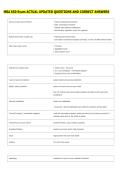
MBA 650 Exam ACTUAL UPDATED QUESTIONS AND CORRECT ANSWERS
Sources of Law Courts Interpret - Federal constitutional provisions
- State constitutional provisions
- Statutes (laws passed by legislatures)
- Administrative regulations (rules from agencies)
Federal Government vs State Law - Federal government has laws
- each state is considered a separate sovereign, so laws can differ between states
State Court system levels 1. Trial Courts
2. Appellate Courts
3. State Supreme Court
Federal Court system levels 1. district courts - trial courts
2. U.S. Court of Appeals - intermediate appeals
3. Supreme Court of the United States
Courts 2 types of jurisdiction subject matter and personal jurisdiction
subject matter jurisdiction power of a court to here a type of case
Key rule: federal courts have limited jurisdiction and state courts have broad
jurisdiction
Personal Jurisdiction Power over a defendant
- Courts ask " does the defendant have sufficient connection with the state"
Criminal Procedure ( automobile exception) Under the automobile exception, police can search as car without a warrant if: 1.
probable cause exists 2. the vehicle is mobile
components of a court opinion procedural history, issue, holding, reasoning
procedural history explains how lower courts ruled previously
issue legal question the court must decide
holding the court's final answer
reasoning explanation of why the court reached the decision
, Tort Law a tort is a civil wrong that causes harm
To win a tort case, the plaintiff must prove elements
negligence requires 4 elements 1. Duty
2. Breach
3. Causation
4. Damages
("but-for" causation alone does not guarantee liability)
premises liability business owe a duty to invitees ( customers)
Duty: business owners must protect customers from dangerous condition whether
known or unknown
Intentional Torts Assault and Battery
Assault Fear of immediate harmful contact
battery harmful or offensive contact
False Imprisonment Intentional confinement without legal authority
privacy torts Intrusion upon seclusion
ex. peeping tom looking into dorm windows
business torts Tortious interference with contract, injurious falsehood, fraud
Tortious interference with contract a third party interferes with an existing contract
injurious falsehood knowingly making false statements about a business or product
fraud occurs when a person knowingly makes a false statement to induce another into a
contract
fraud can also occur by failing to disclose a material fact
Contract Formation (requires) 1. Offer
2. Acceptance
3. Consideration
Mailbox Rule Acceptance occurs when the acceptance is sent, not received
Advertisements Usually invitations to make offers, not offers themselves
Sources of Law Courts Interpret - Federal constitutional provisions
- State constitutional provisions
- Statutes (laws passed by legislatures)
- Administrative regulations (rules from agencies)
Federal Government vs State Law - Federal government has laws
- each state is considered a separate sovereign, so laws can differ between states
State Court system levels 1. Trial Courts
2. Appellate Courts
3. State Supreme Court
Federal Court system levels 1. district courts - trial courts
2. U.S. Court of Appeals - intermediate appeals
3. Supreme Court of the United States
Courts 2 types of jurisdiction subject matter and personal jurisdiction
subject matter jurisdiction power of a court to here a type of case
Key rule: federal courts have limited jurisdiction and state courts have broad
jurisdiction
Personal Jurisdiction Power over a defendant
- Courts ask " does the defendant have sufficient connection with the state"
Criminal Procedure ( automobile exception) Under the automobile exception, police can search as car without a warrant if: 1.
probable cause exists 2. the vehicle is mobile
components of a court opinion procedural history, issue, holding, reasoning
procedural history explains how lower courts ruled previously
issue legal question the court must decide
holding the court's final answer
reasoning explanation of why the court reached the decision
, Tort Law a tort is a civil wrong that causes harm
To win a tort case, the plaintiff must prove elements
negligence requires 4 elements 1. Duty
2. Breach
3. Causation
4. Damages
("but-for" causation alone does not guarantee liability)
premises liability business owe a duty to invitees ( customers)
Duty: business owners must protect customers from dangerous condition whether
known or unknown
Intentional Torts Assault and Battery
Assault Fear of immediate harmful contact
battery harmful or offensive contact
False Imprisonment Intentional confinement without legal authority
privacy torts Intrusion upon seclusion
ex. peeping tom looking into dorm windows
business torts Tortious interference with contract, injurious falsehood, fraud
Tortious interference with contract a third party interferes with an existing contract
injurious falsehood knowingly making false statements about a business or product
fraud occurs when a person knowingly makes a false statement to induce another into a
contract
fraud can also occur by failing to disclose a material fact
Contract Formation (requires) 1. Offer
2. Acceptance
3. Consideration
Mailbox Rule Acceptance occurs when the acceptance is sent, not received
Advertisements Usually invitations to make offers, not offers themselves


