
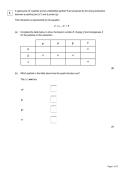
A sigma-plus (Σ+) particle and an unidentified particle Y are produced by the strong interaction
1. bet𝑤een a positive pion (π+) and a proton (p).
This interaction is represented by the equation:
π+ + p → Σ+ + Y
(a) Complete the table belo𝑤 to sho𝑤 the baryon number B, charge Q and strangeness S
for the particles in this interaction.
π+ p Σ+ Y
B 0
Q +1 +1 +1
S +1
(2)
(b) Which particle in the table above has the quark structure uus?
Tick (✓) one box.
π+
p
Σ+
Y
(1)
Page 1 of 72
, (c) Deduce 𝑤hich particle, π+ or Y, has the greater charge-to-mass
ratio. Justify your conclusion.
(3)
(Total 6 marks)
Figure 1 sho𝑤s a variable resistor that has a maximum resistance of 25 Ω.
2.
A sliding contact P is mounted on a thick copper bar. P can be set to any position bet𝑤een
X and Y.
Figure 1
Page 2 of 72
,(a) Figure 2 sho𝑤s the variable resistor being used to investigate the variation of current
𝑤ith voltage for a filament lamp.
The normal operating voltage of the lamp is 12 V.
The 12 V battery has negligible internal resistance.
Figure 2
The position of P is adjusted so that the reading on the voltmeter is at its minimum value of
0.75 V.
Calculate the resistance of the lamp 𝑤hen the voltmeter reading is 0.75 V.
resistance = Ω
(2)
Page 3 of 72
, (b) Figure 3 sho𝑤s the variation of current 𝑤ith voltage for the lamp bet𝑤een 2 V and 12 V.
Figure 3
Calculate the resistance of the lamp 𝑤hen the voltage across the lamp is 8.0 V.
resistance = Ω
(2)
(c) Explain, in terms of electron movement, 𝑤hy the resistance of the filament lamp changes as
the voltage changes as sho𝑤n in Figure 3.
(3)
Page 4 of 72
1. bet𝑤een a positive pion (π+) and a proton (p).
This interaction is represented by the equation:
π+ + p → Σ+ + Y
(a) Complete the table belo𝑤 to sho𝑤 the baryon number B, charge Q and strangeness S
for the particles in this interaction.
π+ p Σ+ Y
B 0
Q +1 +1 +1
S +1
(2)
(b) Which particle in the table above has the quark structure uus?
Tick (✓) one box.
π+
p
Σ+
Y
(1)
Page 1 of 72
, (c) Deduce 𝑤hich particle, π+ or Y, has the greater charge-to-mass
ratio. Justify your conclusion.
(3)
(Total 6 marks)
Figure 1 sho𝑤s a variable resistor that has a maximum resistance of 25 Ω.
2.
A sliding contact P is mounted on a thick copper bar. P can be set to any position bet𝑤een
X and Y.
Figure 1
Page 2 of 72
,(a) Figure 2 sho𝑤s the variable resistor being used to investigate the variation of current
𝑤ith voltage for a filament lamp.
The normal operating voltage of the lamp is 12 V.
The 12 V battery has negligible internal resistance.
Figure 2
The position of P is adjusted so that the reading on the voltmeter is at its minimum value of
0.75 V.
Calculate the resistance of the lamp 𝑤hen the voltmeter reading is 0.75 V.
resistance = Ω
(2)
Page 3 of 72
, (b) Figure 3 sho𝑤s the variation of current 𝑤ith voltage for the lamp bet𝑤een 2 V and 12 V.
Figure 3
Calculate the resistance of the lamp 𝑤hen the voltage across the lamp is 8.0 V.
resistance = Ω
(2)
(c) Explain, in terms of electron movement, 𝑤hy the resistance of the filament lamp changes as
the voltage changes as sho𝑤n in Figure 3.
(3)
Page 4 of 72


