

Introduction:
Evolution:
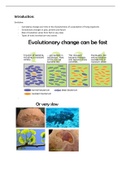
- Cumulative change over time in the characteristics of a population of living organisms
- Evolutionary changes in past, present and future
- Rate of evolution varies from fast to very slow
- Types of traits involved are very varied.
-
,Variation:
- Why does it exist? How is it generated? How can it be used?
- These can be studied with evolution.
Evolution:
- Ultimately these changes will trace back to the DNA sequence and how the genome is
expressed
- Evolution means cumulative change over time in the allele frequencies of a population of
living organisms.
Lack of variation in the future can lead to extinction, because for example it can adapt less to the
changing environment.
Evolutionary biology’s major focus on natural selection:
- Why?
- Historical influence of Darwin and Wallace
- Predictability of natural selection
- Natural selection leads to adaptations and an impression of design (general appeal)
Two means of evolution:
- Evolution: Any net directional or cumulative change in characteristics of organisms or
populations over many generations.
- Some changes lead to better adaptation, other do not:
- Adaptive evolution:
o natural selection causes the increase of genotypes that are better adapted to the
prevailing environment
, - Neutral evolution:
o genetic drift causes random changes in the genetic composition of populations. You
don’t know to which site it will evolve to (positive or negative)
- It’s unlikely that these 2 are not happening in the same population simultaneously. They can
work together for the evolution.
Evolutionary theory – more than selection:
- Necessary and sufficient conditions:
o Property
o Trait variation (condition a)
o Fitness differences (condition b)
o Inheritance (condition c)
o Small effective population size
-
- So basically for evolution to happen you only need 2 things: trait variation and inheritance.
, Genetic variation and nature of traits:
- Discrete classes
o Alleles individually identified
o Population genetics
o Phenotype is usually quite strait forward.
- Continuous variation
o Partitioning of variances
o Usually pinned by more locus and environment plays an role.
o Quantitative genetics.
Heredity’s major focus on DNA sequence, but for understanding evolution and functioning of genes,
be aware that:
- Genes are arranged on chromosomes
- Genes function in pathways
o They influence each other.
- DNA sequence determines more than protein sequence
- Effects of genes are determined by regulation of expression.
- When you know the DNA sequence it doesn’t mean you know how it works, because there
can also be epigenetic effects.
Evolution:
- Cumulative change over time in the characteristics of a population of living organisms
- Evolutionary changes in past, present and future
- Rate of evolution varies from fast to very slow
- Types of traits involved are very varied.
-
,Variation:
- Why does it exist? How is it generated? How can it be used?
- These can be studied with evolution.
Evolution:
- Ultimately these changes will trace back to the DNA sequence and how the genome is
expressed
- Evolution means cumulative change over time in the allele frequencies of a population of
living organisms.
Lack of variation in the future can lead to extinction, because for example it can adapt less to the
changing environment.
Evolutionary biology’s major focus on natural selection:
- Why?
- Historical influence of Darwin and Wallace
- Predictability of natural selection
- Natural selection leads to adaptations and an impression of design (general appeal)
Two means of evolution:
- Evolution: Any net directional or cumulative change in characteristics of organisms or
populations over many generations.
- Some changes lead to better adaptation, other do not:
- Adaptive evolution:
o natural selection causes the increase of genotypes that are better adapted to the
prevailing environment
, - Neutral evolution:
o genetic drift causes random changes in the genetic composition of populations. You
don’t know to which site it will evolve to (positive or negative)
- It’s unlikely that these 2 are not happening in the same population simultaneously. They can
work together for the evolution.
Evolutionary theory – more than selection:
- Necessary and sufficient conditions:
o Property
o Trait variation (condition a)
o Fitness differences (condition b)
o Inheritance (condition c)
o Small effective population size
-
- So basically for evolution to happen you only need 2 things: trait variation and inheritance.
, Genetic variation and nature of traits:
- Discrete classes
o Alleles individually identified
o Population genetics
o Phenotype is usually quite strait forward.
- Continuous variation
o Partitioning of variances
o Usually pinned by more locus and environment plays an role.
o Quantitative genetics.
Heredity’s major focus on DNA sequence, but for understanding evolution and functioning of genes,
be aware that:
- Genes are arranged on chromosomes
- Genes function in pathways
o They influence each other.
- DNA sequence determines more than protein sequence
- Effects of genes are determined by regulation of expression.
- When you know the DNA sequence it doesn’t mean you know how it works, because there
can also be epigenetic effects.


