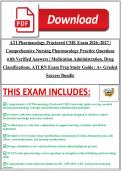
ATI Pharmacology Proctored CME Exam 2026–2027 |
Comprehensive Nursing Pharmacology Practice Questions
with Verified Answers | Medication Administration, Drug
Classifications, ATI RN Exam Prep Study Guide | A+ Graded
Success Bundle
THIS EXAM INCLUDES:
✅ Comprehensive ATI Pharmacology Proctored CME Exam study guide covering essential
nursing pharmacology concepts and medication administration principles
✅ Extensive collection of pharmacology practice questions designed to reinforce critical
medication knowledge and exam readiness
✅ Verified answers with clear explanations to support learning, retention, and clinical
application
✅ Detailed review of major drug classifications, mechanisms of action, therapeutic uses, side
effects, contraindications, and nursing considerations
✅ Dosage calculation review and medication-related clinical judgment practice
✅ NCLEX-style pharmacology review questions to strengthen critical-thinking and test-taking
skills
✅ Comprehensive study material suitable for RN, ADN, BSN, LPN, and practical nursing
students
,Test Bank: Pharmacology & Nursing Practice
1. A provider prescribes phenobarbital for a client who has a seizure
disorder. The medication has a long half-life of 4 days. How many
times per day should the nurse expect to administer this medication?
• A) One
• B) Two
• C) Three
• D) Four
Correct Answer: A
2. A staff educator is reviewing factors that influence medication
metabolism. Which of the following factors indicates a reason to
administer lower medication dosages?
• A) Young adult age
• B) Obesity
• C) Liver failure
• D) Male gender
Correct Answer: C
3. A nurse is preparing to administer eye drops. Which of the following
actions should the nurse take?
• A) Ask the client to look at the floor
• B) Drop medication into the center of the conjunctival sac
• C) Instruct the client to keep their eye open for 30 seconds
• D) Apply the drop directly to the cornea
Correct Answer: B
4. A nurse is teaching a client about transdermal patches. Which
statement indicates understanding?
, • A) "I will apply the patch to an area of skin with no hair."
• B) "I will apply the patch to the same site every day."
• C) "I will cut the patch in half if it is too large."
• D) "I will leave the old patch on when applying a new one."
Correct Answer: A
5. A nurse notes a new prescription to verify the trough level of a
medication. What action should the nurse take?
• A) Obtain a blood specimen 1 hour after the dose
• B) Obtain a blood specimen immediately prior to the next dose
• C) Obtain a blood specimen 4 hours after the dose
• D) Obtain a blood specimen at midnight
Correct Answer: B
6. A nurse is preparing a client's medications. Which action follows
legal practice guidelines?
• A) Adjust the dose based on client request
• B) Split another client's medication for this client
• C) Maintain skill competency
• D) Document after the shift is complete
Correct Answer: C
7. A nurse reviews a prescription for Lisinopril 10mg PO once every
day. This is which type of prescription?
• A) Stat
• B) PRN
• C) Single
• D) Routine
Correct Answer: D
, 8. A nurse reviews a prescription for Ondansetron 4mg PO PRN for
nausea. Which part of the prescription should the nurse clarify with
the provider?
• A) Medication name
• B) Dose
• C) Route
• D) Frequency
Correct Answer: D
9. A nurse is completing a preassessment before administering
medications. Which data should be included?
• A) Use of herbal products
• B) Favorite food
• C) Number of siblings
• D) Type of car driven
Correct Answer: A
10. A nurse is teaching about telephone prescriptions. Which
statement indicates understanding?
• A) "Any staff member can take a telephone prescription."
• B) "A second nurse should listen to the telephone prescription."
• C) "Telephone prescriptions do not need to be read back."
• D) "Telephone prescriptions are not allowed for any medication."
Correct Answer: B
11. A nurse is preparing to administer vancomycin 1g in 100mL over
45 min. Drop factor: 10gtt/mL. How many gtt/min? (Round to nearest
whole number)
• A) 15
Comprehensive Nursing Pharmacology Practice Questions
with Verified Answers | Medication Administration, Drug
Classifications, ATI RN Exam Prep Study Guide | A+ Graded
Success Bundle
THIS EXAM INCLUDES:
✅ Comprehensive ATI Pharmacology Proctored CME Exam study guide covering essential
nursing pharmacology concepts and medication administration principles
✅ Extensive collection of pharmacology practice questions designed to reinforce critical
medication knowledge and exam readiness
✅ Verified answers with clear explanations to support learning, retention, and clinical
application
✅ Detailed review of major drug classifications, mechanisms of action, therapeutic uses, side
effects, contraindications, and nursing considerations
✅ Dosage calculation review and medication-related clinical judgment practice
✅ NCLEX-style pharmacology review questions to strengthen critical-thinking and test-taking
skills
✅ Comprehensive study material suitable for RN, ADN, BSN, LPN, and practical nursing
students
,Test Bank: Pharmacology & Nursing Practice
1. A provider prescribes phenobarbital for a client who has a seizure
disorder. The medication has a long half-life of 4 days. How many
times per day should the nurse expect to administer this medication?
• A) One
• B) Two
• C) Three
• D) Four
Correct Answer: A
2. A staff educator is reviewing factors that influence medication
metabolism. Which of the following factors indicates a reason to
administer lower medication dosages?
• A) Young adult age
• B) Obesity
• C) Liver failure
• D) Male gender
Correct Answer: C
3. A nurse is preparing to administer eye drops. Which of the following
actions should the nurse take?
• A) Ask the client to look at the floor
• B) Drop medication into the center of the conjunctival sac
• C) Instruct the client to keep their eye open for 30 seconds
• D) Apply the drop directly to the cornea
Correct Answer: B
4. A nurse is teaching a client about transdermal patches. Which
statement indicates understanding?
, • A) "I will apply the patch to an area of skin with no hair."
• B) "I will apply the patch to the same site every day."
• C) "I will cut the patch in half if it is too large."
• D) "I will leave the old patch on when applying a new one."
Correct Answer: A
5. A nurse notes a new prescription to verify the trough level of a
medication. What action should the nurse take?
• A) Obtain a blood specimen 1 hour after the dose
• B) Obtain a blood specimen immediately prior to the next dose
• C) Obtain a blood specimen 4 hours after the dose
• D) Obtain a blood specimen at midnight
Correct Answer: B
6. A nurse is preparing a client's medications. Which action follows
legal practice guidelines?
• A) Adjust the dose based on client request
• B) Split another client's medication for this client
• C) Maintain skill competency
• D) Document after the shift is complete
Correct Answer: C
7. A nurse reviews a prescription for Lisinopril 10mg PO once every
day. This is which type of prescription?
• A) Stat
• B) PRN
• C) Single
• D) Routine
Correct Answer: D
, 8. A nurse reviews a prescription for Ondansetron 4mg PO PRN for
nausea. Which part of the prescription should the nurse clarify with
the provider?
• A) Medication name
• B) Dose
• C) Route
• D) Frequency
Correct Answer: D
9. A nurse is completing a preassessment before administering
medications. Which data should be included?
• A) Use of herbal products
• B) Favorite food
• C) Number of siblings
• D) Type of car driven
Correct Answer: A
10. A nurse is teaching about telephone prescriptions. Which
statement indicates understanding?
• A) "Any staff member can take a telephone prescription."
• B) "A second nurse should listen to the telephone prescription."
• C) "Telephone prescriptions do not need to be read back."
• D) "Telephone prescriptions are not allowed for any medication."
Correct Answer: B
11. A nurse is preparing to administer vancomycin 1g in 100mL over
45 min. Drop factor: 10gtt/mL. How many gtt/min? (Round to nearest
whole number)
• A) 15