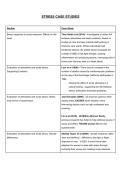
STRESS CASE STUDIES
Section Case Study
Body's response to acute stressors: Effects on the Timo Heidt et al (2014) - Investigated a further link
heart between adrenaline and heart problems, based on
studies of mice and also medical staff working in
intensive care wards. Where individuals had
thickened arteries, the added stress increased the
number of WBC’s that fight disease, causing
inflammation and producing lesions, increasing risk of
blood clots that may lead to a heart attack.
Evaluation of adrenaline and acute stress: Leor et al (1996) - There was an increase in the
Supporting Evidence number of deaths caused by cardiovascular problems
on the day of the Northridge California earthquake in
1994.
- Assess the effect of acute stressors in a
natural setting , supporting the link between
stress, adrenaline and heart problems.
Evaluation of adrenaline and acute stress: Stress Joel Dimsdale (2008) - we must be cautious when
may not be a causal factor saying stress CAUSES heart disease, many
intervening factors such as high cholesterol and
smoking.
Liu et al (2015) - Uk Million Women Study :
previous research has failed to fully address issues of
cause and effect. 700,000 women filled in this
questionnaire.
Evaluation of adrenaline and acute stress: Gender Shelley Taylor et al (2000) - female response called
differences ‘tend and befriend’ - different to the fight or flight
response in men. In EEA, it would have been
adaptive for women to deal with stress through
nurturing their young and creating socal networks
, with other women. Fleeing and fighting would put
their offspring at risk.
Evaluation of adrenaline and acute stress: Challenge Jim Blascovich and Joe Tomaka (1996) - our body
versus threat responds to stressful situations dependent on
whether we assess the event as a challenge or a
threat.
- Challenge = blood vessels are relaxed, heart
beats faster, improving performance.
- Threat = heart beats rapidly causing negative
effects to occur.
Jeremy Jaimson (2012) - random allocation of
participants in 3 groups to perform a task that is
stressful (delivering a speech) where negative
feedback was given. Reappraisal group vs
comparison group vs no instruction.
- Participants who were instructed to think of it
as a challenge (reappraisal) demonstrated a
more adaptive cardiovascular response,
showing the importance of the psychological
aspect of stress.
1. Lacey et al (2000) - HPA axis, carried out a
Body’s response to cortisol and chronic stress prospective investigation of a group of
students preparing for an examination.
Compared to a matched control group the
students showed elevated cortisol levels 1
hour prior to the exam.
1. Kuhlmann et al (2005) - Effects on memory,
administered cortisol to a group of women
who were asked to learn a list of 30 words.
Implications for performance under stress,
reduced ability to recall words, especially
negative.
, 2. Research evidence to effects on health:
Kiecolt-Glaser et al (1984) - investigated
effects of stress on the immune system by
measuring NK cell activity in 75 medical
students 1 month prior and during exams.
Immunosuppression occurs as a result of
stress, NK cell activity decreased
Evaluation of cortisol and chronic stress: Low levels Christine Heim (2000) reported on a low cortisol
of cortisol cause health problems linking to a number of health conditions such as
chronic fatigue syndrome and PTSD. When a
stressor is removed a sudden drop in cortisol may
have inflammatory effects.
Evaluation of cortisol and chronic stress: Issues in Lopez Duran et al (2009) suggested that there may
research studies be age and gender differences in the HPA system
response to stress. Peak cortisol release varied from
10-60 minutes after stress and boys showed greater
cortisol activation response.
Evaluation of cortisol and chronic stress: Stress is In some cases stress may enhance the activity of the
not always bad for the immune system immune system. E.g Phil Evans (1994) looked at an
antibody (slgA) which protects against infection.
When giving talks to other students (immediate
stress) they showed increased slgA but it decreased
over multiple weeks of exam periods. Evans (1997)
proposed stress has 2 effects on the immune system,
1. Increased efficiency, ST acute stress and 2.
Decreased efficiency, LT chronic stress.
Evaluation of cortisol and chronic stress: Stress does Richard Lewis et al (2007) stated that a review of
not always raise cortisol levels studies produced varying results in response to
examination stress, from 58% decline in cortisol to a
95% increase. In his own study there was no
difference in cortisol levels in response to exam
stress. There needs to be more longitudinal studies to
Section Case Study
Body's response to acute stressors: Effects on the Timo Heidt et al (2014) - Investigated a further link
heart between adrenaline and heart problems, based on
studies of mice and also medical staff working in
intensive care wards. Where individuals had
thickened arteries, the added stress increased the
number of WBC’s that fight disease, causing
inflammation and producing lesions, increasing risk of
blood clots that may lead to a heart attack.
Evaluation of adrenaline and acute stress: Leor et al (1996) - There was an increase in the
Supporting Evidence number of deaths caused by cardiovascular problems
on the day of the Northridge California earthquake in
1994.
- Assess the effect of acute stressors in a
natural setting , supporting the link between
stress, adrenaline and heart problems.
Evaluation of adrenaline and acute stress: Stress Joel Dimsdale (2008) - we must be cautious when
may not be a causal factor saying stress CAUSES heart disease, many
intervening factors such as high cholesterol and
smoking.
Liu et al (2015) - Uk Million Women Study :
previous research has failed to fully address issues of
cause and effect. 700,000 women filled in this
questionnaire.
Evaluation of adrenaline and acute stress: Gender Shelley Taylor et al (2000) - female response called
differences ‘tend and befriend’ - different to the fight or flight
response in men. In EEA, it would have been
adaptive for women to deal with stress through
nurturing their young and creating socal networks
, with other women. Fleeing and fighting would put
their offspring at risk.
Evaluation of adrenaline and acute stress: Challenge Jim Blascovich and Joe Tomaka (1996) - our body
versus threat responds to stressful situations dependent on
whether we assess the event as a challenge or a
threat.
- Challenge = blood vessels are relaxed, heart
beats faster, improving performance.
- Threat = heart beats rapidly causing negative
effects to occur.
Jeremy Jaimson (2012) - random allocation of
participants in 3 groups to perform a task that is
stressful (delivering a speech) where negative
feedback was given. Reappraisal group vs
comparison group vs no instruction.
- Participants who were instructed to think of it
as a challenge (reappraisal) demonstrated a
more adaptive cardiovascular response,
showing the importance of the psychological
aspect of stress.
1. Lacey et al (2000) - HPA axis, carried out a
Body’s response to cortisol and chronic stress prospective investigation of a group of
students preparing for an examination.
Compared to a matched control group the
students showed elevated cortisol levels 1
hour prior to the exam.
1. Kuhlmann et al (2005) - Effects on memory,
administered cortisol to a group of women
who were asked to learn a list of 30 words.
Implications for performance under stress,
reduced ability to recall words, especially
negative.
, 2. Research evidence to effects on health:
Kiecolt-Glaser et al (1984) - investigated
effects of stress on the immune system by
measuring NK cell activity in 75 medical
students 1 month prior and during exams.
Immunosuppression occurs as a result of
stress, NK cell activity decreased
Evaluation of cortisol and chronic stress: Low levels Christine Heim (2000) reported on a low cortisol
of cortisol cause health problems linking to a number of health conditions such as
chronic fatigue syndrome and PTSD. When a
stressor is removed a sudden drop in cortisol may
have inflammatory effects.
Evaluation of cortisol and chronic stress: Issues in Lopez Duran et al (2009) suggested that there may
research studies be age and gender differences in the HPA system
response to stress. Peak cortisol release varied from
10-60 minutes after stress and boys showed greater
cortisol activation response.
Evaluation of cortisol and chronic stress: Stress is In some cases stress may enhance the activity of the
not always bad for the immune system immune system. E.g Phil Evans (1994) looked at an
antibody (slgA) which protects against infection.
When giving talks to other students (immediate
stress) they showed increased slgA but it decreased
over multiple weeks of exam periods. Evans (1997)
proposed stress has 2 effects on the immune system,
1. Increased efficiency, ST acute stress and 2.
Decreased efficiency, LT chronic stress.
Evaluation of cortisol and chronic stress: Stress does Richard Lewis et al (2007) stated that a review of
not always raise cortisol levels studies produced varying results in response to
examination stress, from 58% decline in cortisol to a
95% increase. In his own study there was no
difference in cortisol levels in response to exam
stress. There needs to be more longitudinal studies to