

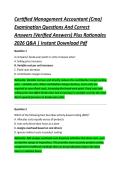
Certified Management Accountant (Cma)
Examination Questions And Correct
Answers (Verified Answers) Plus Rationales
2026 Q&A | Instant Download Pdf
Question 1
A company’s break-even point in units increases when:
A. Selling price increases
B. Variable cost per unit increases
C. Fixed costs decrease
D. Contribution margin increases
Rationale: Variable cost per unit directly reduces the contribution margin (selling
price − variable cost). When contribution margin declines, more units are
required to cover fixed costs, increasing the break-even point. Fixed costs and
selling price also affect break-even, but an increase in variable cost has the most
direct upward pressure on break-even units.
Question 2
Which of the following best describes activity-based costing (ABC)?
A. Allocates costs equally across all products
B. Uses only direct labor hours as a base
C. Assigns overhead based on cost drivers
D. Ignores indirect costs in product costing
Rationale: ABC assigns overhead costs based on activities that drive costs, such
as machine setups or inspections. This provides more accurate product costing
compared to traditional methods that use broad allocation bases like labor
hours or machine hours.
,Question 3
What is the primary purpose of a flexible budget?
A. To eliminate fixed costs
B. To set long-term strategy
C. To adjust for changes in activity levels
D. To replace financial statements
Rationale: A flexible budget recalculates expected revenues and costs based on
actual activity levels, allowing performance evaluation that reflects real
operational conditions rather than static assumptions.
Question 4
In cost-volume-profit analysis, contribution margin equals:
A. Sales − Fixed Costs
B. Fixed Costs − Variable Costs
C. Sales − Variable Costs
D. Net income + Fixed Costs
Rationale: Contribution margin represents the portion of sales revenue
remaining after variable costs are deducted. It is used to cover fixed costs and
generate profit.
Question 5
Which inventory valuation method results in the highest net income during
inflation?
A. FIFO
B. LIFO
C. Weighted average
D. Specific identification
,Rationale: FIFO assigns older, lower costs to cost of goods sold during inflation,
resulting in higher reported profits. LIFO would reduce profit under inflationary
conditions.
Question 6
What is the main objective of variance analysis?
A. To prepare tax returns
B. To eliminate budgeting
C. To compare actual vs planned performance
D. To calculate depreciation
Rationale: Variance analysis identifies differences between budgeted and actual
performance, helping management understand operational efficiency and
control deviations.
Question 7
Which financial statement is most affected by depreciation expense?
A. Statement of cash flows
B. Balance sheet only
C. Income statement and balance sheet
D. Statement of retained earnings only
Rationale: Depreciation reduces net income on the income statement and
reduces asset value on the balance sheet through accumulated depreciation.
Question 8
Operating leverage is highest when:
A. Variable costs are high
B. Fixed costs are low
, C. Fixed costs are high relative to variable costs
D. Sales are declining
Rationale: High fixed costs increase operating leverage, meaning small changes
in sales lead to large changes in profit.
Question 9
Which of the following is a non-financial performance measure?
A. Net profit margin
B. Return on equity
C. Customer satisfaction score
D. Earnings per share
Rationale: Customer satisfaction is a qualitative, non-financial measure often
used in balanced scorecards to evaluate performance beyond financial metrics.
Question 10
Standard costing is primarily used for:
A. External reporting
B. Tax calculation
C. Cost control and performance evaluation
D. Dividend distribution
Rationale: Standard costing sets predetermined costs that are compared with
actual costs to identify inefficiencies and control operations.
Question 11
Which of the following best defines sunk cost?
A. Future avoidable cost
B. Incremental cost
Examination Questions And Correct
Answers (Verified Answers) Plus Rationales
2026 Q&A | Instant Download Pdf
Question 1
A company’s break-even point in units increases when:
A. Selling price increases
B. Variable cost per unit increases
C. Fixed costs decrease
D. Contribution margin increases
Rationale: Variable cost per unit directly reduces the contribution margin (selling
price − variable cost). When contribution margin declines, more units are
required to cover fixed costs, increasing the break-even point. Fixed costs and
selling price also affect break-even, but an increase in variable cost has the most
direct upward pressure on break-even units.
Question 2
Which of the following best describes activity-based costing (ABC)?
A. Allocates costs equally across all products
B. Uses only direct labor hours as a base
C. Assigns overhead based on cost drivers
D. Ignores indirect costs in product costing
Rationale: ABC assigns overhead costs based on activities that drive costs, such
as machine setups or inspections. This provides more accurate product costing
compared to traditional methods that use broad allocation bases like labor
hours or machine hours.
,Question 3
What is the primary purpose of a flexible budget?
A. To eliminate fixed costs
B. To set long-term strategy
C. To adjust for changes in activity levels
D. To replace financial statements
Rationale: A flexible budget recalculates expected revenues and costs based on
actual activity levels, allowing performance evaluation that reflects real
operational conditions rather than static assumptions.
Question 4
In cost-volume-profit analysis, contribution margin equals:
A. Sales − Fixed Costs
B. Fixed Costs − Variable Costs
C. Sales − Variable Costs
D. Net income + Fixed Costs
Rationale: Contribution margin represents the portion of sales revenue
remaining after variable costs are deducted. It is used to cover fixed costs and
generate profit.
Question 5
Which inventory valuation method results in the highest net income during
inflation?
A. FIFO
B. LIFO
C. Weighted average
D. Specific identification
,Rationale: FIFO assigns older, lower costs to cost of goods sold during inflation,
resulting in higher reported profits. LIFO would reduce profit under inflationary
conditions.
Question 6
What is the main objective of variance analysis?
A. To prepare tax returns
B. To eliminate budgeting
C. To compare actual vs planned performance
D. To calculate depreciation
Rationale: Variance analysis identifies differences between budgeted and actual
performance, helping management understand operational efficiency and
control deviations.
Question 7
Which financial statement is most affected by depreciation expense?
A. Statement of cash flows
B. Balance sheet only
C. Income statement and balance sheet
D. Statement of retained earnings only
Rationale: Depreciation reduces net income on the income statement and
reduces asset value on the balance sheet through accumulated depreciation.
Question 8
Operating leverage is highest when:
A. Variable costs are high
B. Fixed costs are low
, C. Fixed costs are high relative to variable costs
D. Sales are declining
Rationale: High fixed costs increase operating leverage, meaning small changes
in sales lead to large changes in profit.
Question 9
Which of the following is a non-financial performance measure?
A. Net profit margin
B. Return on equity
C. Customer satisfaction score
D. Earnings per share
Rationale: Customer satisfaction is a qualitative, non-financial measure often
used in balanced scorecards to evaluate performance beyond financial metrics.
Question 10
Standard costing is primarily used for:
A. External reporting
B. Tax calculation
C. Cost control and performance evaluation
D. Dividend distribution
Rationale: Standard costing sets predetermined costs that are compared with
actual costs to identify inefficiencies and control operations.
Question 11
Which of the following best defines sunk cost?
A. Future avoidable cost
B. Incremental cost


