
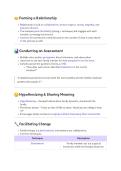
🤝 Forming a Relationship
Relationship is built on collaboration, mutual respect, caring, empathy, and
genuine interest.
The therapist joins the family (joining = technique) and engages with each
member, conveying real concern.
Caution: Do not become overly focused on the content of what is said; attend
to the process as well.
📊 Conducting an Assessment
Multiple entry points: genograms, direct interviews, and observation.
Important to ask each family member for their perspective on the issue.
Sample assessment questions (Corey, p. 412):
“How does each person describe themselves in the current
situation?”
“A detailed assessment uncovers both the overt problem and the hidden relational
patterns that sustain it.”
🤔 Hypothesizing & Sharing Meaning
Hypothesizing = therapist’s ideas about family dynamics, shared with the
family.
Permission phrase: “I have an idea I’d like to share. Would you be willing to hear
it?”
Encourages family members to engage without dismissing their own beliefs.
🔧 Facilitating Change
Family therapy is a joint process; interventions are collaborative.
Common techniques:
Technique Description
Enactments Family members act out a typical
interaction while the therapist observes.
, Assignment of tasks Homework or “behavioral experiments”
given to practice new patterns.
Resource building Identifying internal (skills, strengths) and
external (social support) resources.
Change may be limited by the availability of resources (internal/external).
🌟 Strengths of Family Therapy
Cultural relevance: Many cultures value the extended family; the family
becomes the “identified client.”
Emphasizes culture within the family and larger societal systems.
Considers gender issues and adapts interventions to specific contexts.
⚠️ Challenges of Family Systems Approaches
For Therapist For Client(s)
Managing multiple viewpoints Navigating entrenched family roles and
simultaneously resistance
Balancing attention to process vs. Dealing with possible triangulation and
content loyalty conflicts
📚 Basic Assumptions of Family Systems Therapy
Individuals are best understood by assessing interactions within the whole
family.
Symptoms are viewed as expressions of family dysfunction—often serving a
purpose or reflecting a systemic inability to operate productively.
Patterns can be handed down across generations; a change in one member
affects all.
“We are all interconnected; a shift in one part reverberates throughout the system.”
🔄 Systemic vs. Individual Approach
, Aspect Individual Therapy Systemic (Family)
Therapy
Focus One person’s diagnosis, Whole family relationships,
causes, shared meanings, rules,
cognitive‑emotional‑behavioral cultural & gender
processes perspectives
Goal Help the individual cope Change the individual’s
context to promote
healthier interaction
patterns
Intervention Tailored to the individual Designed to alter family
dynamics and hierarchies
👥 Early Figures in Family Therapy
Theorist Main Contribution
Murray Bowen Multigenerational family therapy
Virginia Satir Human Validation Process Model
Milton Erickson Transformational experiences
Jay Haley Strategic family therapy
Salvador Minuchin Structural family therapy
🗣️ Human Validation Process Model / Communications
Approach
Goal: Enhance and validate self‑esteem through nurturing relationships.
Core values: congruence, openness, and interest in each other.
Therapist listens for reflections of self‑esteem in client communication.
“Transform extreme rules into functional ones, nurture triads, and encourage growth.”
, 🏗️ Structural Family Therapy
Focus: Family interactions → understand structure/organization.
Symptoms are by‑products of structural failings; must first change structure.
Techniques are active, directive, and carefully planned.
Goals:
1. Change the family structure
2. Create an effective hierarchy
3. Establish clear boundaries (rules & roles)
🎯 Strategic Therapy
Brief, process‑focused, solution‑oriented.
Therapist designs strategies to alter behavioral sequences.
Aim: Get people to behave differently, shifting the family organization so the
presenting problem loses its function.
📈 Multigenerational Therapy (Three‑Generation Focus)
Argument: Current problems are fully understood only when relationship
patterns in the family of origin are explored.
Two main goals:
1. Differentiation of self – psychological separation of intellect and emotion,
fostering a rational, non‑reactive stance.
2. Avoid triangulation – prevent pulling a third person into a couple’s conflict.
🛠️ Solution Focused Brief Counseling (SFBC)
📸 Visual Aid – Exceptions & Solutions


