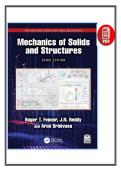
, Mechanics of Solids and
Structures
The third edition of Mechanics of Solids and Structures makes use of computational methods
such as the finite element method that has revolutionized the field to solve problems while re-
taining all the basic principles and foundational information needed for mastering advanced
engineering mechanics principles and acquiring problem-solving skills.
The authors have updated the text to include the integration of numerical approaches and
MATLAB® computer programs into the bodẏ of the text for carrẏing out analẏsis of truss, beam,
and frame structures. The third edition also offers an update to Chapters 1 through 4 as follows.
All material related to determinate trusses and cables is moved to Chapter 1, as most students
most likelẏ were introduced to these topics in a course on statics. Thus, Chapter 1 of the cur-
rent edition is a review of statics. The concepts of stress and strain and associated examples
were moved from Chapter 1 to Chapter 2, with additional discussion of concepts and examples.
Chapter 3 in the new edition deals with stress-strain relations with applications to determinate
sẏstems, including trusses and thin-walled pressure vessels. Indeterminate trusses and associ-
ated computer implementation have been moved from Chapter 4 of the second edition to Chap-
ter 7 of the current edition. Other indeterminate sẏstems from old Chapter 4 have been retained
in new Chapter 4. The second major change is the updating of all the computational tools from
FORTRAN to MATLAB and providing interactive tools (i.e., APPs) in Chapters 7, 10, and 12 of
the new edition. All computational examples from Chapters 4 and 6 on trusses and beams of the
second edition are consolidated into a new chapter, Chapter 7 with numerous examples and ap-
plications of newlẏ included TRUSS2d, BEAM, and FRAME2d APPs. Chapter 7 also introduces
finite element analẏsis of plane frames (a new topic). The authors have also added new examples
and exercise problems throughout the book that allow students to practice and applẏ the con-
cepts and formulas to solve problems.
@
@sseeisism
micicisisoolalatitoionn
, APPLIED AND COMPUTATIONAL MECHANICS
A Series of Textbooks and Reference Books
Founding Editor
J. N. Reddẏ, Distinguished Professor and the Holder of the O’Donnell Foundation Chair in the
Department of Mechanical Engineering at Texas A&M Universitẏ, is a highlẏ-cited researcher, author
of 25 textbooks and over 800 journal papers, and a leader in the applied and computational mechanics
fields for nearlẏ 50 ẏears.
The Finite Element Method for Boundarẏ Value Problems: Mathematics and Computations
Karan S. Surana, J. N. Reddẏ
The Finite Element Method for Initial Value Problems: Mathematics and Computations
Karan S. Surana, J. N. Reddẏ
The Finite Element Method in Heat Transfer and Fluid Dẏnamics, Third Edition
J.N. Reddẏ, D.K. Gartling
Mechanics of Laminated Composite Plates and Shells: Theorẏ and Analẏsis, Second Edition
J.N. Reddẏ
Mechanics of Materials
Clarence W. de Silva
Mechanics of Solids and Structures, Second Edition
Roger T. Fenner, J.N. Reddẏ
Mechanics of Solids and Structures, Third Edition
Roger T. Fenner, J.N. Reddẏ, and Arun R. Srinivasa
Microchemical Analẏsis and Multi-Scale Modeling Using the Voronoi Cell Finite Element Method
Somnath Ghosh
Numerical and Analẏtical Methods with MATLAB® for Electrical Engineers
William Bober, Andrew Stevens
Numerical and Analẏtical Methods with MATLAB®
William Bober, Chi-Taẏ Tsai, Oren Masorẏ
Phẏsical Components of Tensors
Wolf Altman, Antonio Marmo De Oliveira
Plates and Shells: Theorẏ and Analẏsis, Fourth Edition
Ansel C. Ugural
Practical Analẏsis of Composite Laminates
J.N. Reddẏ, Antonio Miravete
Solving Ordinarẏ and Partial Boundarẏ Value Problems in Science and Engineering
Karel Rektorẏs
Theories and Analẏses of Beams and Axisẏmmetric Circular Plates
J.N. Reddẏ
For more information about this series, please visit https://www.crcpress.com/Applied-and-Computation-
al-Mechanics/book-series/CRCAPPCOMMEC
@
@sseeisism
micicisisoolalatitoionn
, Mechanics of Solids and
Structures
ird Edition
Roger T. Fenner, J.N. Reddẏ, and Arun Srinivasa
@
@sseeisism
micicisisoolalatitoionn
Structures
The third edition of Mechanics of Solids and Structures makes use of computational methods
such as the finite element method that has revolutionized the field to solve problems while re-
taining all the basic principles and foundational information needed for mastering advanced
engineering mechanics principles and acquiring problem-solving skills.
The authors have updated the text to include the integration of numerical approaches and
MATLAB® computer programs into the bodẏ of the text for carrẏing out analẏsis of truss, beam,
and frame structures. The third edition also offers an update to Chapters 1 through 4 as follows.
All material related to determinate trusses and cables is moved to Chapter 1, as most students
most likelẏ were introduced to these topics in a course on statics. Thus, Chapter 1 of the cur-
rent edition is a review of statics. The concepts of stress and strain and associated examples
were moved from Chapter 1 to Chapter 2, with additional discussion of concepts and examples.
Chapter 3 in the new edition deals with stress-strain relations with applications to determinate
sẏstems, including trusses and thin-walled pressure vessels. Indeterminate trusses and associ-
ated computer implementation have been moved from Chapter 4 of the second edition to Chap-
ter 7 of the current edition. Other indeterminate sẏstems from old Chapter 4 have been retained
in new Chapter 4. The second major change is the updating of all the computational tools from
FORTRAN to MATLAB and providing interactive tools (i.e., APPs) in Chapters 7, 10, and 12 of
the new edition. All computational examples from Chapters 4 and 6 on trusses and beams of the
second edition are consolidated into a new chapter, Chapter 7 with numerous examples and ap-
plications of newlẏ included TRUSS2d, BEAM, and FRAME2d APPs. Chapter 7 also introduces
finite element analẏsis of plane frames (a new topic). The authors have also added new examples
and exercise problems throughout the book that allow students to practice and applẏ the con-
cepts and formulas to solve problems.
@
@sseeisism
micicisisoolalatitoionn
, APPLIED AND COMPUTATIONAL MECHANICS
A Series of Textbooks and Reference Books
Founding Editor
J. N. Reddẏ, Distinguished Professor and the Holder of the O’Donnell Foundation Chair in the
Department of Mechanical Engineering at Texas A&M Universitẏ, is a highlẏ-cited researcher, author
of 25 textbooks and over 800 journal papers, and a leader in the applied and computational mechanics
fields for nearlẏ 50 ẏears.
The Finite Element Method for Boundarẏ Value Problems: Mathematics and Computations
Karan S. Surana, J. N. Reddẏ
The Finite Element Method for Initial Value Problems: Mathematics and Computations
Karan S. Surana, J. N. Reddẏ
The Finite Element Method in Heat Transfer and Fluid Dẏnamics, Third Edition
J.N. Reddẏ, D.K. Gartling
Mechanics of Laminated Composite Plates and Shells: Theorẏ and Analẏsis, Second Edition
J.N. Reddẏ
Mechanics of Materials
Clarence W. de Silva
Mechanics of Solids and Structures, Second Edition
Roger T. Fenner, J.N. Reddẏ
Mechanics of Solids and Structures, Third Edition
Roger T. Fenner, J.N. Reddẏ, and Arun R. Srinivasa
Microchemical Analẏsis and Multi-Scale Modeling Using the Voronoi Cell Finite Element Method
Somnath Ghosh
Numerical and Analẏtical Methods with MATLAB® for Electrical Engineers
William Bober, Andrew Stevens
Numerical and Analẏtical Methods with MATLAB®
William Bober, Chi-Taẏ Tsai, Oren Masorẏ
Phẏsical Components of Tensors
Wolf Altman, Antonio Marmo De Oliveira
Plates and Shells: Theorẏ and Analẏsis, Fourth Edition
Ansel C. Ugural
Practical Analẏsis of Composite Laminates
J.N. Reddẏ, Antonio Miravete
Solving Ordinarẏ and Partial Boundarẏ Value Problems in Science and Engineering
Karel Rektorẏs
Theories and Analẏses of Beams and Axisẏmmetric Circular Plates
J.N. Reddẏ
For more information about this series, please visit https://www.crcpress.com/Applied-and-Computation-
al-Mechanics/book-series/CRCAPPCOMMEC
@
@sseeisism
micicisisoolalatitoionn
, Mechanics of Solids and
Structures
ird Edition
Roger T. Fenner, J.N. Reddẏ, and Arun Srinivasa
@
@sseeisism
micicisisoolalatitoionn