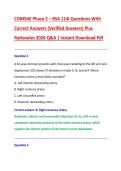
COMSAE Phase 2 – BSA 114i Questions With
Correct Answers (Verified Answers) Plus
Rationales 2026 Q&A | Instant Download Pdf
Question 1
A 62-year-old man presents with chest pain radiating to the left arm and
diaphoresis. ECG shows ST elevation in leads II, III, and aVF. Which
coronary artery is most likely occluded?
A. Left anterior descending artery
B. Right coronary artery
C. Left circumflex artery
D. Posterior descending artery
Correct answer: B. Right coronary artery
Rationale: Inferior wall myocardial infarction (II, III, aVF) is most
commonly caused by occlusion of the right coronary artery, which
supplies the inferior portion of the heart in most individuals.
Question 2
,A 24-year-old woman presents with fever, dysuria, and flank pain.
Urinalysis shows nitrites and leukocyte esterase. Most likely organism?
A. Staphylococcus saprophyticus
B. Escherichia coli
C. Proteus mirabilis
D. Klebsiella pneumoniae
Correct answer: B. Escherichia coli
Rationale: E. coli is the most common cause of uncomplicated urinary
tract infections due to its ability to ascend the urethra and adhere to
uroepithelial cells.
Question 3
A patient has chronic cough, hemoptysis, and cavitary lesions in the
upper lobes. Most likely diagnosis?
A. Sarcoidosis
B. Tuberculosis
C. Lung adenocarcinoma
D. Pulmonary embolism
Correct answer: B. Tuberculosis
Rationale: Reactivation tuberculosis typically affects the upper lobes
due to high oxygen tension, causing cavitary lesions and hemoptysis.
,Question 4
Which vitamin deficiency causes Wernicke encephalopathy?
A. Vitamin B1
B. Vitamin B6
C. Vitamin B12
D. Vitamin C
Correct answer: A. Vitamin B1
Rationale: Thiamine (B1) deficiency leads to Wernicke encephalopathy
characterized by confusion, ophthalmoplegia, and ataxia.
Question 5
A newborn has jaundice within 24 hours of birth. Most likely cause?
A. Physiologic jaundice
B. Breast milk jaundice
C. Hemolytic disease of the newborn
D. Biliary atresia
Correct answer: C. Hemolytic disease of the newborn
Rationale: Pathologic jaundice within the first 24 hours suggests
hemolysis, often due to ABO or Rh incompatibility.
, Question 6
Which hormone increases calcium reabsorption in the distal tubule?
A. Calcitonin
B. Parathyroid hormone
C. Aldosterone
D. Vitamin D
Correct answer: B. Parathyroid hormone
Rationale: PTH increases calcium reabsorption in the distal tubules
and increases serum calcium levels.
Question 7
A patient presents with tremor at rest, rigidity, and bradykinesia. Which
structure is most affected?
A. Caudate nucleus
B. Substantia nigra
C. Putamen
D. Globus pallidus
Correct Answers (Verified Answers) Plus
Rationales 2026 Q&A | Instant Download Pdf
Question 1
A 62-year-old man presents with chest pain radiating to the left arm and
diaphoresis. ECG shows ST elevation in leads II, III, and aVF. Which
coronary artery is most likely occluded?
A. Left anterior descending artery
B. Right coronary artery
C. Left circumflex artery
D. Posterior descending artery
Correct answer: B. Right coronary artery
Rationale: Inferior wall myocardial infarction (II, III, aVF) is most
commonly caused by occlusion of the right coronary artery, which
supplies the inferior portion of the heart in most individuals.
Question 2
,A 24-year-old woman presents with fever, dysuria, and flank pain.
Urinalysis shows nitrites and leukocyte esterase. Most likely organism?
A. Staphylococcus saprophyticus
B. Escherichia coli
C. Proteus mirabilis
D. Klebsiella pneumoniae
Correct answer: B. Escherichia coli
Rationale: E. coli is the most common cause of uncomplicated urinary
tract infections due to its ability to ascend the urethra and adhere to
uroepithelial cells.
Question 3
A patient has chronic cough, hemoptysis, and cavitary lesions in the
upper lobes. Most likely diagnosis?
A. Sarcoidosis
B. Tuberculosis
C. Lung adenocarcinoma
D. Pulmonary embolism
Correct answer: B. Tuberculosis
Rationale: Reactivation tuberculosis typically affects the upper lobes
due to high oxygen tension, causing cavitary lesions and hemoptysis.
,Question 4
Which vitamin deficiency causes Wernicke encephalopathy?
A. Vitamin B1
B. Vitamin B6
C. Vitamin B12
D. Vitamin C
Correct answer: A. Vitamin B1
Rationale: Thiamine (B1) deficiency leads to Wernicke encephalopathy
characterized by confusion, ophthalmoplegia, and ataxia.
Question 5
A newborn has jaundice within 24 hours of birth. Most likely cause?
A. Physiologic jaundice
B. Breast milk jaundice
C. Hemolytic disease of the newborn
D. Biliary atresia
Correct answer: C. Hemolytic disease of the newborn
Rationale: Pathologic jaundice within the first 24 hours suggests
hemolysis, often due to ABO or Rh incompatibility.
, Question 6
Which hormone increases calcium reabsorption in the distal tubule?
A. Calcitonin
B. Parathyroid hormone
C. Aldosterone
D. Vitamin D
Correct answer: B. Parathyroid hormone
Rationale: PTH increases calcium reabsorption in the distal tubules
and increases serum calcium levels.
Question 7
A patient presents with tremor at rest, rigidity, and bradykinesia. Which
structure is most affected?
A. Caudate nucleus
B. Substantia nigra
C. Putamen
D. Globus pallidus