lOMoAR cPSD| 67756003
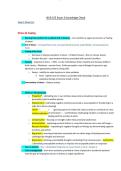
NUR 155 Exam 3 Knowledge Check
Exam 3 Check List:
Stress & Coping
- Nursing Interventions for a patient that is Anxious o Can manifest as vague nervousness or feeling
of dread
- S/S of Stress – increased heart rate, increased blood pressure, pupil dilation, increased glucose
levels
- Coping with stress:
o Decrease in physical symptoms of stress o Problem focued – alter or remove stessor
o Emotion focused – ease emotional distress associated with stressful condition
- Anxiety – response to stress o Mild - can be motivational, foster creativity and increase ability to
think clearly o Moderate - narrows focus, Dulles perception, may challenge the person to pay
attention or use appropriate problem solving skills
o Severe - inability to make decisions or solve problems
▪ Panic - highest level of anxiety is associated with physiologic changes as well as
subjective feelings of extreme dread or terror
- Intervention of stress o Reduce anxiety.
- Defense Mechanisms
o Projection* – attributing one 's own motives values desires situational responses and
personality traits to another person
o Displacement - redirecting negative emotions perceived as unacceptable or threatening to a
safer focus (stress cleaning)
Denial* – o ignoring aspects of reality that induce anxiety or contribute to a loss
Intellectualization of self esteem o - overthinking A challenging situation or impulse to avoid
dealing with the emotion it elicits
o Compensation – focusing on strengths rather than perceived weaknesses
o Rationalization – explaining personal actions in a way that enhances one's own self-image o
Reaction formation – responding to negative thoughts or feelings by demonstrating opposite
emotions and actions
o Regression – reverting to behavior associated with an earlier stage of development when
challenged by thoughts and stressors
o Repression – blocking unacceptable thoughts and feelings from consciousness o Sublimation
- channeling unacceptable emotions or impulses into acceptable actions or responses
- Fear vs Anxiety – fear = idenifyable thing that can cause threat or harm. Anxiety is
- Crisis management - short term assistance provided at a time of physical or emotional upheaval
with the goal of helping the person in distress to regain equilibrium
, lOMoAR cPSD| 67756003
- Burnout - mental or physical exhaustion due to constant stressor activity o Prevention: exercise,
balanced nutrition, mindfulness therapy
Leadership (Delegation of Care) / ethics and legal
o Appropriate Tasks for RN, UAP, LPN – anything that is not major, does not require assessing.
Can monitor VS and REPORT abnormalities, bed baths, feeding assist, etc.
- Advanced Directive – patients medical wishes should they be unconscious or lose ability to express
wants. BROAD term for future care.
- Living will – (type of advanced directive) treatment a person wants to receive when he or she is
unconscious or unable to make decisions independently
- Durable power of attorney – a legal document allowing designated person to make legal actions on
behalf of an individual unable or not permitted to make legal decisions independently - Health care
proxy – specifies who can make health care decisions for that ind.
Factors Effecting Immobility
- Physical effects of prolonged mobility – contracture, fixation of joints. Dizziness when standing,
ambulation issues, weak muscles, etc.
- Preventing Contractors – Range of motion
- Types of exercise-
▪ Isometric: constant contraction such as self feeding or walking
▪ Isotonic: contraction w relaxation such as a wall sit or yoga
▪ Aerobic: anything that requires air or can make you winded such as walking,
climbing stairs, running, etc
Anaerobic: ▪ builds muscle, weightlifting ▪ Needs assistance.
Passive-ROM: ▪ Active-ROM: Self/ no assistance
Cardio and Respiratory
- Assessing impaired tissue perfusion o Clubbing o Cyanosis
o Vs
o Heart fail = low hemoglobin, edema o COPD = high hematocrit
- Diagnostic Exams
- Promoting a healthy heart –
▪ exercising
NUR 155 Exam 3 Knowledge Check
Exam 3 Check List:
Stress & Coping
- Nursing Interventions for a patient that is Anxious o Can manifest as vague nervousness or feeling
of dread
- S/S of Stress – increased heart rate, increased blood pressure, pupil dilation, increased glucose
levels
- Coping with stress:
o Decrease in physical symptoms of stress o Problem focued – alter or remove stessor
o Emotion focused – ease emotional distress associated with stressful condition
- Anxiety – response to stress o Mild - can be motivational, foster creativity and increase ability to
think clearly o Moderate - narrows focus, Dulles perception, may challenge the person to pay
attention or use appropriate problem solving skills
o Severe - inability to make decisions or solve problems
▪ Panic - highest level of anxiety is associated with physiologic changes as well as
subjective feelings of extreme dread or terror
- Intervention of stress o Reduce anxiety.
- Defense Mechanisms
o Projection* – attributing one 's own motives values desires situational responses and
personality traits to another person
o Displacement - redirecting negative emotions perceived as unacceptable or threatening to a
safer focus (stress cleaning)
Denial* – o ignoring aspects of reality that induce anxiety or contribute to a loss
Intellectualization of self esteem o - overthinking A challenging situation or impulse to avoid
dealing with the emotion it elicits
o Compensation – focusing on strengths rather than perceived weaknesses
o Rationalization – explaining personal actions in a way that enhances one's own self-image o
Reaction formation – responding to negative thoughts or feelings by demonstrating opposite
emotions and actions
o Regression – reverting to behavior associated with an earlier stage of development when
challenged by thoughts and stressors
o Repression – blocking unacceptable thoughts and feelings from consciousness o Sublimation
- channeling unacceptable emotions or impulses into acceptable actions or responses
- Fear vs Anxiety – fear = idenifyable thing that can cause threat or harm. Anxiety is
- Crisis management - short term assistance provided at a time of physical or emotional upheaval
with the goal of helping the person in distress to regain equilibrium
, lOMoAR cPSD| 67756003
- Burnout - mental or physical exhaustion due to constant stressor activity o Prevention: exercise,
balanced nutrition, mindfulness therapy
Leadership (Delegation of Care) / ethics and legal
o Appropriate Tasks for RN, UAP, LPN – anything that is not major, does not require assessing.
Can monitor VS and REPORT abnormalities, bed baths, feeding assist, etc.
- Advanced Directive – patients medical wishes should they be unconscious or lose ability to express
wants. BROAD term for future care.
- Living will – (type of advanced directive) treatment a person wants to receive when he or she is
unconscious or unable to make decisions independently
- Durable power of attorney – a legal document allowing designated person to make legal actions on
behalf of an individual unable or not permitted to make legal decisions independently - Health care
proxy – specifies who can make health care decisions for that ind.
Factors Effecting Immobility
- Physical effects of prolonged mobility – contracture, fixation of joints. Dizziness when standing,
ambulation issues, weak muscles, etc.
- Preventing Contractors – Range of motion
- Types of exercise-
▪ Isometric: constant contraction such as self feeding or walking
▪ Isotonic: contraction w relaxation such as a wall sit or yoga
▪ Aerobic: anything that requires air or can make you winded such as walking,
climbing stairs, running, etc
Anaerobic: ▪ builds muscle, weightlifting ▪ Needs assistance.
Passive-ROM: ▪ Active-ROM: Self/ no assistance
Cardio and Respiratory
- Assessing impaired tissue perfusion o Clubbing o Cyanosis
o Vs
o Heart fail = low hemoglobin, edema o COPD = high hematocrit
- Diagnostic Exams
- Promoting a healthy heart –
▪ exercising