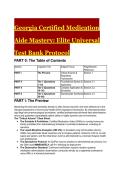
Georgia Certified Medication
Aide Mastery: Elite Universal
Test Bank Protocol
PART 0: The Table of Contents
Section Cognitive Tier Subject Focus Page/Section
Reference
PART I The Preview Critical Axioms & Section 1
Regulatory
Frameworks
PART II Tier 1 (Questions Foundational Syntax & Section 2.1
1–15) Application
PART II Tier 2 (Questions Complex Application & Section 2.2
16–35) Simulation
PART II Tier 3 (Questions Grandmaster Synthesis Section 2.3
36–60)
PART I: The Preview
Mastering this test bank translates directly to elite clinical execution and strict adherence to the
Georgia Department of Community Health (DCH) regulatory frameworks. By internalizing these
rigid legal and pharmacological boundaries, certified professionals eliminate fatal administrative
errors and guarantee unparalleled patient safety in highly dynamic care environments.
The "Critical Axioms" Cheat Sheet:
● The Schedule II Prohibition: Certified Medication Aides (CMAs) in nursing homes are
strictly prohibited from administering Schedule II controlled substances, including all
narcotics.
● The Liquid Morphine Exception (HB 374): In Assisted Living Communities (ALCs),
CMAs may administer liquid morphine only to hospice patients, limited to a 50 mL on-site
supply per patient, and the initial dose must be administered by a licensed hospice health
care professional.
● The Epinephrine Protocol: An EpiPen may be assisted or administered per protocol, but
the CMA must IMMEDIATELY call 911 following its deployment.
● The Observation Standard: Continued certification requires random quarterly
medication administration observations conducted strictly by a registered professional
nurse (RN) or a licensed pharmacist.
, ● The Packaging Law: All medications administered by a CMA must be housed in unit or
multi-dose packaging; CMAs cannot manipulate, compound, or alter raw medications
outside these parameters.
Regulatory Jurisdiction Liquid Morphine Authority Required Oversight for
(Hospice Only) Quarterly Med Pass
Nursing Home Strictly Prohibited (No Schedule RN or Licensed Pharmacist
II)
Assisted Living Community Authorized (Max 50 mL, RN or Licensed Pharmacist
(ALC) post-initial dose)
Personal Care Home (PCH) Strictly Prohibited Proxy Caregiver / Hospice Staff
PART II: The Elite Test Bank
Tier 1 - Foundational Syntax & Application
Q1: A newly certified medication aide in a Georgia nursing home is reviewing a patient's
Medication Administration Record (MAR). The physician has ordered a Schedule II narcotic for
severe back pain. Based on the principles of O.C.G.A. § 31-7-12.7, which action is the MOST
ACCURATE? A) Administer the medication if the charge nurse provides a secondary verification
signature. B) Administer the medication only if it is packaged in a tamper-evident unit-dose
container. C) Refuse to administer the medication as this violates the state scope of practice for
CMAs in nursing homes. D) Delegate the administration to a Certified Nursing Assistant (CNA)
with more than 5 years of senior experience.
● The Answer: C (Refuse to administer the medication as this violates the state scope of
practice for CMAs in nursing homes.)
● Distractor Analysis:
○ A is incorrect: A charge nurse cannot override state legislation; Schedule II
controlled substances are legally prohibited for CMAs in nursing homes regardless
of supervision.
○ B is incorrect: While unit packaging is a standard requirement for all CMA
medications , it does not bypass the strict legal ban on narcotics.
○ D is incorrect: A CNA possesses a lower licensure tier and holds zero legal
authority to administer medications under any circumstances.
The Mentor's Analysis: The legislative boundary in a nursing home is absolute: CMAs do not
administer Schedule II narcotics. When facing pain management crises, the immediate priority is
escalating the order to a licensed nurse. By utilizing strict adherence to legal scope boundaries,
the clinician bypasses the common trap of operating under assumed delegated authority.
Professional/Academic Intuition: No internal facility protocol can ever supersede a state
legislative ban on controlled substances.
Q2: Under the Georgia Department of Community Health (DCH) regulations, an Assisted Living
Community (ALC) employs CMAs to administer liquid morphine to eligible residents. What is the
MAXIMUM allowable on-site supply of liquid morphine per hospice patient? A) 100 mL B) A
30-day supply based on calculated PRN usage C) 50 mL D) 10 mL
● The Answer: C (50 mL)
● Distractor Analysis:
○ A is incorrect: 100 mL exceeds the strict limit established by Georgia House Bill
374. * B is incorrect: Supply limits are strictly volumetric, not time-based, due to the
high diversion risk associated with Class II medications.
, ○ D is incorrect: 10 mL is a common single-dose formulation limit but does not
represent the maximum on-site storage capacity permitted by law.
The Mentor's Analysis: Georgia House Bill 374 represents a legislative compromise allowing
palliative efficiency while mitigating narcotic diversion. When facing hospice supply
management, the immediate priority is verifying the physical volume in the lockbox. By utilizing
the 50 mL maximum cap, the clinician bypasses the common trap of illegally hoarding controlled
substances at the facility level. Professional/Academic Intuition: In ALCs, the 50 mL
morphine limit is an absolute, non-negotiable metric for regulatory compliance.
Q3: A CMA is preparing to administer an oral medication to a resident. The medication must be
crushed due to the resident's severe dysphagia. According to Georgia CMA standards, which
conclusion is MOST ACCURATE? A) The CMA may independently crush the medication if the
resident verbally requests it to prevent choking. B) The CMA may crush the medication only if
there is a specific physician's order directing the medication to be crushed. C) The CMA is
strictly prohibited from altering or crushing any medication under any circumstance. D) The CMA
may crush the medication if they dissolve it in exactly 10 mL of sterile water prior to
administration.
● The Answer: B (The CMA may crush the medication only if there is a specific physician's
order directing the medication to be crushed.)
● Distractor Analysis:
○ A is incorrect: Patient preference cannot override pharmacological delivery
mechanisms without a formalized physician's order.
○ C is incorrect: CMAs are permitted to crush medications, but only when operating
under explicit, documented physician direction.
○ D is incorrect: Arbitrary dissolution volumes represent unsafe practice without
specific pharmaceutical guidance regarding drug solubility.
The Mentor's Analysis: Pharmacokinetics are fundamentally altered when a pill is crushed,
risking fatal dose dumping. When facing a patient with dysphagia, the immediate priority is
verifying the physician's explicitly written mechanical order. By utilizing prescriber verification,
the clinician bypasses the common trap of assuming all oral tablets are mechanically identical.
Professional/Academic Intuition: Altering a drug's physical state requires the exact same
level of authorization as altering its dose.
Q4: A resident with known severe allergies exhibits acute anaphylaxis. The CMA assists the
resident in administering their prescribed epinephrine auto-injector (EpiPen). What is the CMA's
IMMEDIATE required action following administration? A) Monitor the resident's vital signs for 15
minutes before taking further action. B) Call 911 and activate Emergency Services. C)
Document the intervention in the Medication Administration Record (MAR). D) Administer a
second dose if symptoms do not visibly improve in 60 seconds.
● The Answer: B (Call 911 and activate Emergency Services.)
● Distractor Analysis:
○ A is incorrect: Monitoring is necessary, but delaying emergency escalation during
anaphylaxis guarantees a catastrophic airway failure.
○ C is incorrect: While MAR documentation is legally required, it is a secondary
administrative task, not the immediate clinical priority.
○ D is incorrect: Subsequent doses are the purview of advanced life support or
specific physician protocol, not standard CMA discretion.
The Mentor's Analysis: Epinephrine provides a temporary physiological bridge, not a definitive
cure for anaphylactic shock. When facing severe allergic reactions, the immediate priority is
securing advanced life support. By utilizing immediate 911 escalation , the clinician bypasses
Aide Mastery: Elite Universal
Test Bank Protocol
PART 0: The Table of Contents
Section Cognitive Tier Subject Focus Page/Section
Reference
PART I The Preview Critical Axioms & Section 1
Regulatory
Frameworks
PART II Tier 1 (Questions Foundational Syntax & Section 2.1
1–15) Application
PART II Tier 2 (Questions Complex Application & Section 2.2
16–35) Simulation
PART II Tier 3 (Questions Grandmaster Synthesis Section 2.3
36–60)
PART I: The Preview
Mastering this test bank translates directly to elite clinical execution and strict adherence to the
Georgia Department of Community Health (DCH) regulatory frameworks. By internalizing these
rigid legal and pharmacological boundaries, certified professionals eliminate fatal administrative
errors and guarantee unparalleled patient safety in highly dynamic care environments.
The "Critical Axioms" Cheat Sheet:
● The Schedule II Prohibition: Certified Medication Aides (CMAs) in nursing homes are
strictly prohibited from administering Schedule II controlled substances, including all
narcotics.
● The Liquid Morphine Exception (HB 374): In Assisted Living Communities (ALCs),
CMAs may administer liquid morphine only to hospice patients, limited to a 50 mL on-site
supply per patient, and the initial dose must be administered by a licensed hospice health
care professional.
● The Epinephrine Protocol: An EpiPen may be assisted or administered per protocol, but
the CMA must IMMEDIATELY call 911 following its deployment.
● The Observation Standard: Continued certification requires random quarterly
medication administration observations conducted strictly by a registered professional
nurse (RN) or a licensed pharmacist.
, ● The Packaging Law: All medications administered by a CMA must be housed in unit or
multi-dose packaging; CMAs cannot manipulate, compound, or alter raw medications
outside these parameters.
Regulatory Jurisdiction Liquid Morphine Authority Required Oversight for
(Hospice Only) Quarterly Med Pass
Nursing Home Strictly Prohibited (No Schedule RN or Licensed Pharmacist
II)
Assisted Living Community Authorized (Max 50 mL, RN or Licensed Pharmacist
(ALC) post-initial dose)
Personal Care Home (PCH) Strictly Prohibited Proxy Caregiver / Hospice Staff
PART II: The Elite Test Bank
Tier 1 - Foundational Syntax & Application
Q1: A newly certified medication aide in a Georgia nursing home is reviewing a patient's
Medication Administration Record (MAR). The physician has ordered a Schedule II narcotic for
severe back pain. Based on the principles of O.C.G.A. § 31-7-12.7, which action is the MOST
ACCURATE? A) Administer the medication if the charge nurse provides a secondary verification
signature. B) Administer the medication only if it is packaged in a tamper-evident unit-dose
container. C) Refuse to administer the medication as this violates the state scope of practice for
CMAs in nursing homes. D) Delegate the administration to a Certified Nursing Assistant (CNA)
with more than 5 years of senior experience.
● The Answer: C (Refuse to administer the medication as this violates the state scope of
practice for CMAs in nursing homes.)
● Distractor Analysis:
○ A is incorrect: A charge nurse cannot override state legislation; Schedule II
controlled substances are legally prohibited for CMAs in nursing homes regardless
of supervision.
○ B is incorrect: While unit packaging is a standard requirement for all CMA
medications , it does not bypass the strict legal ban on narcotics.
○ D is incorrect: A CNA possesses a lower licensure tier and holds zero legal
authority to administer medications under any circumstances.
The Mentor's Analysis: The legislative boundary in a nursing home is absolute: CMAs do not
administer Schedule II narcotics. When facing pain management crises, the immediate priority is
escalating the order to a licensed nurse. By utilizing strict adherence to legal scope boundaries,
the clinician bypasses the common trap of operating under assumed delegated authority.
Professional/Academic Intuition: No internal facility protocol can ever supersede a state
legislative ban on controlled substances.
Q2: Under the Georgia Department of Community Health (DCH) regulations, an Assisted Living
Community (ALC) employs CMAs to administer liquid morphine to eligible residents. What is the
MAXIMUM allowable on-site supply of liquid morphine per hospice patient? A) 100 mL B) A
30-day supply based on calculated PRN usage C) 50 mL D) 10 mL
● The Answer: C (50 mL)
● Distractor Analysis:
○ A is incorrect: 100 mL exceeds the strict limit established by Georgia House Bill
374. * B is incorrect: Supply limits are strictly volumetric, not time-based, due to the
high diversion risk associated with Class II medications.
, ○ D is incorrect: 10 mL is a common single-dose formulation limit but does not
represent the maximum on-site storage capacity permitted by law.
The Mentor's Analysis: Georgia House Bill 374 represents a legislative compromise allowing
palliative efficiency while mitigating narcotic diversion. When facing hospice supply
management, the immediate priority is verifying the physical volume in the lockbox. By utilizing
the 50 mL maximum cap, the clinician bypasses the common trap of illegally hoarding controlled
substances at the facility level. Professional/Academic Intuition: In ALCs, the 50 mL
morphine limit is an absolute, non-negotiable metric for regulatory compliance.
Q3: A CMA is preparing to administer an oral medication to a resident. The medication must be
crushed due to the resident's severe dysphagia. According to Georgia CMA standards, which
conclusion is MOST ACCURATE? A) The CMA may independently crush the medication if the
resident verbally requests it to prevent choking. B) The CMA may crush the medication only if
there is a specific physician's order directing the medication to be crushed. C) The CMA is
strictly prohibited from altering or crushing any medication under any circumstance. D) The CMA
may crush the medication if they dissolve it in exactly 10 mL of sterile water prior to
administration.
● The Answer: B (The CMA may crush the medication only if there is a specific physician's
order directing the medication to be crushed.)
● Distractor Analysis:
○ A is incorrect: Patient preference cannot override pharmacological delivery
mechanisms without a formalized physician's order.
○ C is incorrect: CMAs are permitted to crush medications, but only when operating
under explicit, documented physician direction.
○ D is incorrect: Arbitrary dissolution volumes represent unsafe practice without
specific pharmaceutical guidance regarding drug solubility.
The Mentor's Analysis: Pharmacokinetics are fundamentally altered when a pill is crushed,
risking fatal dose dumping. When facing a patient with dysphagia, the immediate priority is
verifying the physician's explicitly written mechanical order. By utilizing prescriber verification,
the clinician bypasses the common trap of assuming all oral tablets are mechanically identical.
Professional/Academic Intuition: Altering a drug's physical state requires the exact same
level of authorization as altering its dose.
Q4: A resident with known severe allergies exhibits acute anaphylaxis. The CMA assists the
resident in administering their prescribed epinephrine auto-injector (EpiPen). What is the CMA's
IMMEDIATE required action following administration? A) Monitor the resident's vital signs for 15
minutes before taking further action. B) Call 911 and activate Emergency Services. C)
Document the intervention in the Medication Administration Record (MAR). D) Administer a
second dose if symptoms do not visibly improve in 60 seconds.
● The Answer: B (Call 911 and activate Emergency Services.)
● Distractor Analysis:
○ A is incorrect: Monitoring is necessary, but delaying emergency escalation during
anaphylaxis guarantees a catastrophic airway failure.
○ C is incorrect: While MAR documentation is legally required, it is a secondary
administrative task, not the immediate clinical priority.
○ D is incorrect: Subsequent doses are the purview of advanced life support or
specific physician protocol, not standard CMA discretion.
The Mentor's Analysis: Epinephrine provides a temporary physiological bridge, not a definitive
cure for anaphylactic shock. When facing severe allergic reactions, the immediate priority is
securing advanced life support. By utilizing immediate 911 escalation , the clinician bypasses