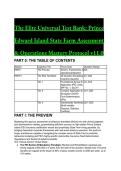
The Elite Universal Test Bank: Prince
Edward Island State Farm Assessment
& Operations Mastery Protocol v11.0
PART 0: THE TABLE OF CONTENTS
Section Cognitive Tier Focus Area Question Range
PART I The Preview Axioms, Frameworks, & N/A
Operational Baseline
PART II The Elite Test Bank 30-Question Escalating Q1–Q30
Cognitive Gauntlet
Tier 1 Foundational Syntax & Q1–Q10
Application (PEI Limits,
SPF No. 1, SLCP)
Tier 2 Complex Application & Q11–Q20
Simulation (DCPD,
Fault Determination,
KPIs)
Tier 3 Grandmaster Synthesis Q21–Q30
(Multi-variable
Disputes, Statutory
Conflicts)
PART I: THE PREVIEW
Mastering this rigorous assessment architecture translates directly into elite clinical judgment
and administrative mastery, guaranteeing definitive success on high-stakes Prince Edward
Island (PEI) insurance certification exams and proprietary State Farm hiring gauntlets. By
bridging theoretical corporate frameworks with real-world statutory execution, this protocol
forges practitioners capable of navigating the complex nexus of State Farm’s predictive
behavioral modeling and PEI's highly specific Automobile Insurance Fault Determination
Regulations and Section B statutory benefits.
The "Critical Axioms" Cheat Sheet:
● The PEI Section B Mandatory Paradigm: Medical and Rehabilitation expenses are
strictly capped at $50,000 or 4 years from the date of the accident. Weekly loss of income
benefits are capped at the lesser of 80% of gross weekly income or $250 per week, up to
104 weeks.
, ● The PEI Minor Injury Cap Index: For the 2026 calendar year, the statutory limit for
non-pecuniary general damages (pain and suffering) for injuries classified as "minor"
(such as WAD 2 soft tissue injuries) is strictly capped at $9,659.
● Direct Compensation - Property Damage (DCPD): Implemented on October 1, 2015,
DCPD mandates that policyholders settle property damage strictly with their own insurer
to the degree they are not at fault. Collision coverage responds to the at-fault portion.
● The PEI Fault Determination Doctrine: Fault is determined strictly by vehicular position
and movement using statutory diagrams. Environmental conditions, weather, visibility, and
pedestrian actions are strictly excluded from fault assignment.
● The KSAO & SLCP Behavioral Framework: State Farm evaluates agency and
operational candidates utilizing the Sales & Leadership Career Profile (SLCP), isolating
exactly 13 distinct predictive behavioral traits , alongside Situational Judgment Tests
(SJT) requiring hyper-calibrated 1-7 rating scale responses.
PART II: THE ELITE TEST BANK
Q1: A policyholder in Prince Edward Island causes a catastrophic multi-vehicle collision
resulting in severe bodily injury and massive property damage. Based on the Prince Edward
Island Insurance Act, which limit represents the absolute MINIMUM third-party liability coverage
the policyholder's standard auto insurance policy must provide? A) $50,000 B) $500,000 C)
$200,000 D) $1,000,000
● The Answer: C ($200,000)
● Distractor Analysis:
○ A is incorrect: This represents a common novice error conflating the Section B
medical and rehabilitation maximum limit ($50,000) with the third-party liability
minimum.
○ B is incorrect: This is the mandatory minimum third-party liability limit in the
neighboring jurisdiction of Nova Scotia, representing a geographic conflation error.
○ D is incorrect: While heavily recommended by brokers for adequate protection
against catastrophic loss and tort exposure, $1,000,000 is an optional
endorsement, not the statutory minimum.
The Mentor's Analysis: The foundation of Atlantic Canadian auto insurance requires precise
jurisdictional mapping. In Prince Edward Island, the absolute statutory minimum for Third Party
Liability is $200,000. When facing cross-border claims, the adjuster must anchor immediately to
the primary jurisdiction of the policy. The underlying trend across Canada is a gradual push
toward higher mandatory limits due to inflation in medical and vehicular repair costs, yet PEI's
statutory floor remains at $200,000. Professional/Academic Intuition: Statutory minimums
are geographic absolutes; PEI mandates $200,000 for Third-Party Liability, acting as the
hard deck for all underwriting and claims initiation.
Q2: A State Farm agency candidate is undergoing the corporate hiring assessment. The
evaluation incorporates the Sales & Leadership Career Profile (SLCP) to predict field success.
How many distinct behavioral traits are isolated and measured by this specific proprietary
instrument? A) 5 B) 10 C) 13 D) 15
● The Answer: C (13)
● Distractor Analysis:
○ A is incorrect: Five represents a common personality framework (The Big Five) but
is not the specific proprietary structure of the State Farm SLCP.
, ○ B is incorrect: Ten is a frequent distractor representing the typical number of
situational judgment scenarios presented, not the underlying traits measured.
○ D is incorrect: Fifteen is an arbitrary legacy number from outdated pre-employment
screening methodologies.
The Mentor's Analysis: Elite performance in proprietary corporate evaluations requires an
exact understanding of the testing architecture. The SLCP is algorithmically designed to
measure exactly 13 predictive behavioral traits to assess agency viability. These traits heavily
isolate attributes like Initiative, Interpersonal Orientation, and Persuasiveness. Mastery of this
framework allows recruiters and agency principals to predict retention and sales velocity before
extending an offer. Professional/Academic Intuition: The SLCP is a 13-trait predictive
behavioral matrix; deviations from this structure indicate alternative or outdated
assessments.
Q3: A Prince Edward Island policyholder is injured in a collision and sustains a severe
whiplash-associated disorder (WAD 2) that does not permanently interfere with their daily living
activities. The accident occurred on May 15, 2026. What is the absolute MAXIMUM
non-pecuniary general damage award the policyholder can recover for pain and suffering? A)
$2,500 B) $7,500 C) $9,659 D) $10,862
● The Answer: C ($9,659)
● Distractor Analysis:
○ A is incorrect: $2,500 is the legacy cap implemented upon the original enactment of
the legislation in April 2004, representing a severe temporal error.
○ B is incorrect: $7,500 is the revised base cap implemented in October 2014 before
subsequent annual consumer price index (CPI) adjustments took effect.
○ D is incorrect: $10,862 represents the 2026 minor injury cap for Nova Scotia,
demonstrating a failure to isolate provincial statutory indices.
The Mentor's Analysis: PEI statutory tort limits require precise chronological indexing.
Because the injury is classified as "minor" and does not constitute a permanent, serious
impairment, it is subject to the minor injury cap. By utilizing the 2026 indexed figure of $9,659,
you bypass the common trap of utilizing outdated historical base rates.
Calendar Year Applicable Minor Injury Cap
2024 $9,358
2025 $9,526
2026 $9,659
Professional/Academic Intuition: Minor
Injury Caps are dynamically indexed
annually via the CPI; for PEI in 2026, the
absolute ceiling for non-pecuniary minor
injury damages is $9,659.
Q4: Under the Prince Edward Island Standard Automobile Policy (S.P.F. No. 1), a policyholder is
totally disabled following a collision and applies for Section B Loss of Income benefits. The
policyholder’s pre-accident gross income was $400 per week. What is the precise weekly
indemnity the insurer MUST provide? A) $250 B) $320 C) $400 D) $200
● The Answer: A ($250)
● Distractor Analysis:
○ B is incorrect: $320 represents exactly 80% of the policyholder's gross weekly
income. While the formula dictates 80% of gross income, this answer fails to apply
the absolute statutory cap.
Edward Island State Farm Assessment
& Operations Mastery Protocol v11.0
PART 0: THE TABLE OF CONTENTS
Section Cognitive Tier Focus Area Question Range
PART I The Preview Axioms, Frameworks, & N/A
Operational Baseline
PART II The Elite Test Bank 30-Question Escalating Q1–Q30
Cognitive Gauntlet
Tier 1 Foundational Syntax & Q1–Q10
Application (PEI Limits,
SPF No. 1, SLCP)
Tier 2 Complex Application & Q11–Q20
Simulation (DCPD,
Fault Determination,
KPIs)
Tier 3 Grandmaster Synthesis Q21–Q30
(Multi-variable
Disputes, Statutory
Conflicts)
PART I: THE PREVIEW
Mastering this rigorous assessment architecture translates directly into elite clinical judgment
and administrative mastery, guaranteeing definitive success on high-stakes Prince Edward
Island (PEI) insurance certification exams and proprietary State Farm hiring gauntlets. By
bridging theoretical corporate frameworks with real-world statutory execution, this protocol
forges practitioners capable of navigating the complex nexus of State Farm’s predictive
behavioral modeling and PEI's highly specific Automobile Insurance Fault Determination
Regulations and Section B statutory benefits.
The "Critical Axioms" Cheat Sheet:
● The PEI Section B Mandatory Paradigm: Medical and Rehabilitation expenses are
strictly capped at $50,000 or 4 years from the date of the accident. Weekly loss of income
benefits are capped at the lesser of 80% of gross weekly income or $250 per week, up to
104 weeks.
, ● The PEI Minor Injury Cap Index: For the 2026 calendar year, the statutory limit for
non-pecuniary general damages (pain and suffering) for injuries classified as "minor"
(such as WAD 2 soft tissue injuries) is strictly capped at $9,659.
● Direct Compensation - Property Damage (DCPD): Implemented on October 1, 2015,
DCPD mandates that policyholders settle property damage strictly with their own insurer
to the degree they are not at fault. Collision coverage responds to the at-fault portion.
● The PEI Fault Determination Doctrine: Fault is determined strictly by vehicular position
and movement using statutory diagrams. Environmental conditions, weather, visibility, and
pedestrian actions are strictly excluded from fault assignment.
● The KSAO & SLCP Behavioral Framework: State Farm evaluates agency and
operational candidates utilizing the Sales & Leadership Career Profile (SLCP), isolating
exactly 13 distinct predictive behavioral traits , alongside Situational Judgment Tests
(SJT) requiring hyper-calibrated 1-7 rating scale responses.
PART II: THE ELITE TEST BANK
Q1: A policyholder in Prince Edward Island causes a catastrophic multi-vehicle collision
resulting in severe bodily injury and massive property damage. Based on the Prince Edward
Island Insurance Act, which limit represents the absolute MINIMUM third-party liability coverage
the policyholder's standard auto insurance policy must provide? A) $50,000 B) $500,000 C)
$200,000 D) $1,000,000
● The Answer: C ($200,000)
● Distractor Analysis:
○ A is incorrect: This represents a common novice error conflating the Section B
medical and rehabilitation maximum limit ($50,000) with the third-party liability
minimum.
○ B is incorrect: This is the mandatory minimum third-party liability limit in the
neighboring jurisdiction of Nova Scotia, representing a geographic conflation error.
○ D is incorrect: While heavily recommended by brokers for adequate protection
against catastrophic loss and tort exposure, $1,000,000 is an optional
endorsement, not the statutory minimum.
The Mentor's Analysis: The foundation of Atlantic Canadian auto insurance requires precise
jurisdictional mapping. In Prince Edward Island, the absolute statutory minimum for Third Party
Liability is $200,000. When facing cross-border claims, the adjuster must anchor immediately to
the primary jurisdiction of the policy. The underlying trend across Canada is a gradual push
toward higher mandatory limits due to inflation in medical and vehicular repair costs, yet PEI's
statutory floor remains at $200,000. Professional/Academic Intuition: Statutory minimums
are geographic absolutes; PEI mandates $200,000 for Third-Party Liability, acting as the
hard deck for all underwriting and claims initiation.
Q2: A State Farm agency candidate is undergoing the corporate hiring assessment. The
evaluation incorporates the Sales & Leadership Career Profile (SLCP) to predict field success.
How many distinct behavioral traits are isolated and measured by this specific proprietary
instrument? A) 5 B) 10 C) 13 D) 15
● The Answer: C (13)
● Distractor Analysis:
○ A is incorrect: Five represents a common personality framework (The Big Five) but
is not the specific proprietary structure of the State Farm SLCP.
, ○ B is incorrect: Ten is a frequent distractor representing the typical number of
situational judgment scenarios presented, not the underlying traits measured.
○ D is incorrect: Fifteen is an arbitrary legacy number from outdated pre-employment
screening methodologies.
The Mentor's Analysis: Elite performance in proprietary corporate evaluations requires an
exact understanding of the testing architecture. The SLCP is algorithmically designed to
measure exactly 13 predictive behavioral traits to assess agency viability. These traits heavily
isolate attributes like Initiative, Interpersonal Orientation, and Persuasiveness. Mastery of this
framework allows recruiters and agency principals to predict retention and sales velocity before
extending an offer. Professional/Academic Intuition: The SLCP is a 13-trait predictive
behavioral matrix; deviations from this structure indicate alternative or outdated
assessments.
Q3: A Prince Edward Island policyholder is injured in a collision and sustains a severe
whiplash-associated disorder (WAD 2) that does not permanently interfere with their daily living
activities. The accident occurred on May 15, 2026. What is the absolute MAXIMUM
non-pecuniary general damage award the policyholder can recover for pain and suffering? A)
$2,500 B) $7,500 C) $9,659 D) $10,862
● The Answer: C ($9,659)
● Distractor Analysis:
○ A is incorrect: $2,500 is the legacy cap implemented upon the original enactment of
the legislation in April 2004, representing a severe temporal error.
○ B is incorrect: $7,500 is the revised base cap implemented in October 2014 before
subsequent annual consumer price index (CPI) adjustments took effect.
○ D is incorrect: $10,862 represents the 2026 minor injury cap for Nova Scotia,
demonstrating a failure to isolate provincial statutory indices.
The Mentor's Analysis: PEI statutory tort limits require precise chronological indexing.
Because the injury is classified as "minor" and does not constitute a permanent, serious
impairment, it is subject to the minor injury cap. By utilizing the 2026 indexed figure of $9,659,
you bypass the common trap of utilizing outdated historical base rates.
Calendar Year Applicable Minor Injury Cap
2024 $9,358
2025 $9,526
2026 $9,659
Professional/Academic Intuition: Minor
Injury Caps are dynamically indexed
annually via the CPI; for PEI in 2026, the
absolute ceiling for non-pecuniary minor
injury damages is $9,659.
Q4: Under the Prince Edward Island Standard Automobile Policy (S.P.F. No. 1), a policyholder is
totally disabled following a collision and applies for Section B Loss of Income benefits. The
policyholder’s pre-accident gross income was $400 per week. What is the precise weekly
indemnity the insurer MUST provide? A) $250 B) $320 C) $400 D) $200
● The Answer: A ($250)
● Distractor Analysis:
○ B is incorrect: $320 represents exactly 80% of the policyholder's gross weekly
income. While the formula dictates 80% of gross income, this answer fails to apply
the absolute statutory cap.