

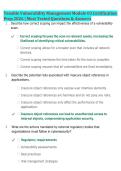
Tenable Vulnerability Management Module 03 Certification
Prep 2026 | Most Tested Questions & Answers
1. Describe how correct scoping can impact the effectiveness of a vulnerability
scan.
Correct scoping focuses the scan on relevant assets, increasing the
likelihood of identifying critical vulnerabilities.
Correct scoping allows for a broader scan that includes all network
devices.
Correct scoping minimizes the time taken for the scan to complete.
Correct scoping ensures that all vulnerabilities are fixed immediately.
2. Describe the potential risks associated with insecure object references in
applications.
Insecure object references only expose user interface elements.
Insecure object references are harmless and do not pose any risks.
Insecure object references only affect the performance of the
application.
Insecure object references can lead to unauthorized access to
internal objects, compromising application security.
3. What are the actions mandated by external regulatory bodies that
organizations must follow in cybersecurity?
Regulatory requirements
Vulnerability assessments
Best practices
Risk management strategies
,4. If an organization has a vulnerability scanning schedule that conflicts with its
peak business hours, what might be a potential consequence?
More efficient scanning processes.
Improved employee productivity.
Reduced operational costs.
Increased risk of undetected vulnerabilities.
5. What are the 2 major types of vulnerability scans?
credentialed and non-credentialed
non-invasive and credentialed
credentialed and non-invasive
non-invasive and invasive
6. Which of the following is true of improper error handling?
Attackers can use error messages to extract specific information from
a system
Attackers can use unexpected errors to knock an application off line,
creating a denial-of-service attack
Unexpected errors can provide an attacker with a buffer or stack
overflow condition that sets the stage for an arbitrary code execution
All of the above
7. What is the primary purpose of data classification in the context of
vulnerability management?
To create a backup of data
To determine the sensitivity of data
, To eliminate all vulnerabilities
To identify all types of vulnerabilities
8. Describe the significance of addressing improper error handling in
vulnerability management.
Improper error handling has no impact on system security.
Improper error handling can lead to information leakage and make
systems more vulnerable to attacks.
Improper error handling ensures that users receive clear feedback on
their actions.
Improper error handling is only a concern for web applications.
9. What is the primary consequence of insufficient monitoring and logging in
cybersecurity?
Improved system performance
Enhanced user privacy
Hindered threat detection
Increased data storage
10. According to the material, which category of vulnerabilities would
companies experience the most?
Poor credential management
Improper input validation
Improper configuration and maintenance of the system
Poor code quality
, 11. If an organization implements a server-based vulnerability scanner, what
immediate benefit can they expect?
Reduced need for manual security audits.
Increased network speed and performance.
Improved identification of system vulnerabilities.
Elimination of all security risks.
12. Describe the significance of conducting different types of vulnerability scans
in an organization.
Vulnerability scans are only necessary for applications and not for
networks.
Only one type of scan is sufficient for comprehensive security.
Different types of vulnerability scans help identify specific security
weaknesses across various components of the IT infrastructure.
All types of scans are the same and provide identical results.
13. Describe the process of active scanning in vulnerability management.
Active scanning monitors user activity to detect unauthorized access.
Active scanning is a passive method of observing network traffic.
Active scanning involves sending test requests to systems to
identify vulnerabilities.
Active scanning is a method of encrypting data to prevent exposure.
14. If a vulnerability scan reveals that a system is exposed to sensitive data due
to improper configurations, what immediate action should be taken?
Ignore the findings if the system is functioning properly.
Prep 2026 | Most Tested Questions & Answers
1. Describe how correct scoping can impact the effectiveness of a vulnerability
scan.
Correct scoping focuses the scan on relevant assets, increasing the
likelihood of identifying critical vulnerabilities.
Correct scoping allows for a broader scan that includes all network
devices.
Correct scoping minimizes the time taken for the scan to complete.
Correct scoping ensures that all vulnerabilities are fixed immediately.
2. Describe the potential risks associated with insecure object references in
applications.
Insecure object references only expose user interface elements.
Insecure object references are harmless and do not pose any risks.
Insecure object references only affect the performance of the
application.
Insecure object references can lead to unauthorized access to
internal objects, compromising application security.
3. What are the actions mandated by external regulatory bodies that
organizations must follow in cybersecurity?
Regulatory requirements
Vulnerability assessments
Best practices
Risk management strategies
,4. If an organization has a vulnerability scanning schedule that conflicts with its
peak business hours, what might be a potential consequence?
More efficient scanning processes.
Improved employee productivity.
Reduced operational costs.
Increased risk of undetected vulnerabilities.
5. What are the 2 major types of vulnerability scans?
credentialed and non-credentialed
non-invasive and credentialed
credentialed and non-invasive
non-invasive and invasive
6. Which of the following is true of improper error handling?
Attackers can use error messages to extract specific information from
a system
Attackers can use unexpected errors to knock an application off line,
creating a denial-of-service attack
Unexpected errors can provide an attacker with a buffer or stack
overflow condition that sets the stage for an arbitrary code execution
All of the above
7. What is the primary purpose of data classification in the context of
vulnerability management?
To create a backup of data
To determine the sensitivity of data
, To eliminate all vulnerabilities
To identify all types of vulnerabilities
8. Describe the significance of addressing improper error handling in
vulnerability management.
Improper error handling has no impact on system security.
Improper error handling can lead to information leakage and make
systems more vulnerable to attacks.
Improper error handling ensures that users receive clear feedback on
their actions.
Improper error handling is only a concern for web applications.
9. What is the primary consequence of insufficient monitoring and logging in
cybersecurity?
Improved system performance
Enhanced user privacy
Hindered threat detection
Increased data storage
10. According to the material, which category of vulnerabilities would
companies experience the most?
Poor credential management
Improper input validation
Improper configuration and maintenance of the system
Poor code quality
, 11. If an organization implements a server-based vulnerability scanner, what
immediate benefit can they expect?
Reduced need for manual security audits.
Increased network speed and performance.
Improved identification of system vulnerabilities.
Elimination of all security risks.
12. Describe the significance of conducting different types of vulnerability scans
in an organization.
Vulnerability scans are only necessary for applications and not for
networks.
Only one type of scan is sufficient for comprehensive security.
Different types of vulnerability scans help identify specific security
weaknesses across various components of the IT infrastructure.
All types of scans are the same and provide identical results.
13. Describe the process of active scanning in vulnerability management.
Active scanning monitors user activity to detect unauthorized access.
Active scanning is a passive method of observing network traffic.
Active scanning involves sending test requests to systems to
identify vulnerabilities.
Active scanning is a method of encrypting data to prevent exposure.
14. If a vulnerability scan reveals that a system is exposed to sensitive data due
to improper configurations, what immediate action should be taken?
Ignore the findings if the system is functioning properly.


